Showing posts with label S-curve. Show all posts

Friday, June 5, 2026

Electrifying: EV sales in Australia

From The Driven

Australia’s latest VFACTS and EVC data confirms what we’ve been charting all year: EV sales are multiplying, ICE is slowly losing control of the market, and the power EV dealers are supplying is genuinely electrifying.

China now dominates as the source of those vehicles, while grease and petrol and diesel look so “last century” with every monthly update.

As Tim Minchin might put it, the sun is finally coming out on Australia’s electric age – and this time it’s science, not faith, doing the work.

The May 2026 figures show another big jump for battery electrics.

Tesla’s Model Y has topped the national sales charts, while BYD remains the leading EV brand on year-to-date volumes, and Zeekr has emerged as the fastest-growing new player.

EV sales overall are up more than 110 per cent year-on-year, a doubling that reflects both rising demand and a rapidly widening model mix. Every month, more Australians discover that the supposed compromises of EVs were mostly theatre; the weekend, it turns out, was never really at risk.

Country-of-origin data reinforces the point.

China is now firmly the number-one source of new vehicles in Australia, well ahead of Japan and pulling further away.

A growing share of EVs on Australian roads – and a fair number of hybrids and even some ICE models – are built in Chinese factories, whether they carry BYD, Zeekr, MG, GWM, Volvo or Tesla badges.

For a country that doesn’t build cars, we are being swept along an S-curve largely designed in Shanghai and Shenzhen.

Since the post‑COVID bounce in 2021, petrol and diesel volumes have been sliding on a clear downward trend, punctuated by the familiar EOFY “dead cat” jumps seeking moonlight.

Even those June bounces in 2023 and 2025 only delivered lower plateaus afterwards, as buyers shifted into hybrids, plug‑ins and BEVs. BEV sales are now close to overtaking the combined hybrid sales including PHEVs, as they first tried to do in 2022.

The old oil era is fading into the twilight, even as the solar‑powered sun finally rises over the showroom, tomorrow.

The long-run picture is no summer fling; combustion is in a decidedly not slow fade-out to the horizon.


By contrast, the electrified side of the ledger is all upward motion. Hybrids first inched into the mainstream, then PHEVs began to appear in meaningful numbers, and BEVs have recently shot to one in five sales in market share.

In the last few months, the BEV line on our charts has started to look like those classic S-curve graphs from EV-heavy Europe and China – and Singapore and Indonesia. This is what the steep part of the transition feels like: one record month after another, as more households and fleets decide they’ve had enough of fuel-price roulette.

Policy and geopolitics are both amplifying the trend.

The New Vehicle Efficiency Standard is only in its early stages, but it is already nudging manufacturers to push low- and zero-emission models harder and to clear older, higher-emission stock.

At the same time, the world’s fourth oil crisis has reminded Australians how fragile the “cheap fuel forever” story really is. Each time global tensions flare and servo price boards jump, a few more drivers decide they’re ready to unplug from oil altogether.

That’s why this moment matters.

For decades, petrol and diesel were the unquestioned kings of Australia’s car market. Now, almost quietly, they are becoming the legacy option. ICE-only is still more than half of new sales, but that share is shrinking, and the trend has momentum.

The old soundtrack of the market is fading under the hum and whirr of motors powered from the grid and, increasingly, from rooftop solar.

So yes, Grease is so last century – at least for Australia’s car fleet.

EVs are no longer a sideshow; they’re the main act, stepping into the spotlight as the headliners from the age of oil shuffle offstage.

For all the noise and scare campaigns, the data say, the future turns up slowly, then all at once, like the sun coming out after a long, cloudy morning.

And from what the latest VFACTS data shows, this is one number that’s only going to keep building, key change after key change, as electrified vehicles take over the chorus line.

The chart below shows monthly EV sales, unadjusted for seasonality (blue line), adjusted for seasonality (red line) and smoothed (my seasonal adjustment and smoothing).  Note logarithmic scale. 

 Sales have doubled over the last year; given that EVs now have the same sticker price as petrol/diesel cars, and are much cheaper to run, rapid growth is likely to continue.  As The Driven's article points out--we are in the steeply rising part of the S-curve.  See the lower chart, which is plotted on a linear scale.


Tuesday, March 24, 2026

The S-curve rules

 From Professor Ray Wills


When these countries decided to swap to electric vehicles, they just did And it doesn't seem to take long They won't be having much of a crisis of oil (still some, just not as much as the rest of us) Graphs by @leraffl.bsky.social leraffl.github.io/LeRaffl-Gall...


As ever, S-curves initially turn up (or down!) very slowly.  Progress looks so s-l-o-w.  Then, wham!  ICEV sales fall from to from 80% to 20% in an average of five years.  Notice in the charts how PHEVs initially rise, because consumers have range anxiety, but that quickly disappears as rising EV sales lead to rising numbers of charger sites, while the cost of two engines becomes unacceptable.

Anecdotal reports suggest huge jumps in EV sales as a result of the current oil crisis.

(The two Bluesky accounts are:

https://bsky.app/profile/profraywills.futuresmart.com.au

and

https://bsky.app/profile/leraffl.bsky.social)


Saturday, November 15, 2025

Solar doubling every 3 years

 From EV Curve Futurist


We’re about to hit the phase of the S-curve where the world goes from “fast” to “holy shit.” Solar’s doubling on a 24-month cycle — but the real elephant in the room is . As storage scales, the grid stops being a bottleneck and starts becoming a battery-backed solar engine.


Solar is by far the cheapest source of electricity. And the plunge in battery costs means that it can now provide what used to be called baseload power, cheap and carbon-free. It's doubling every 3 years (the chart says 2 years but the text says 3, and Our World in Data also says 3, so I'll go with 3). In 2024 solar provided 7% of the world's electricity, Total electricity demand rose by 2582 TWh over the last 3 years, while solar alone rose by 1077 TWh. With solar doubling every 3 years, solar should rise by ~2100 TWh over the next 3. Wind rose by 640 TWh over 3 years. If demand grows by 10% over the next 3 years, the rise in supply from wind and solar will meet 96% of the rise in total electricity demand. And when solar doubles again, over the subsequent 3 years, demand for electricity from coal power stations will plunge. Emissions from electricity generation will have peaked.


Sunday, October 12, 2025

The great EV shift: 90% by 2030

 From EVCurveFuturist


What if I told you that even with political setbacks, EVs will dominate car sales by 2030? That’s right—despite recent challenges, the road to mass BEV adoption is still clear. Back in 2019, I projected that global BEV (Battery Electric Vehicle) sales would reach between 90-95% of total vehicle sales by 2030. This forecast was based on several critical factors: technological improvements, cost reductions, increasing consumer acceptance, and strong policy support from major economies.

However, as we move into 2025, new developments have prompted a reassessment of these projections. While my 2024 forecast was accurate—missing the actual NEV (New Energy Vehicle) final sales figure by just 100,000 units—I have now factored in the ‘Trump effect’ when updating my 2025-2030 outlook.

The ‘Trump effect’—including a 25% tariff on imported EV batteries, reduced federal tax credits, and emissions regulation rollbacks—could raise U.S. EV prices by 10% and slow sales growth by 5%. As the U.S. remains a major automotive market, this impacts global adoption, lowering my projection from 95% to 90% by 2030. However, state initiatives like California’s zero-emission mandates and New York’s infrastructure investments may mitigate these setbacks. Local policies can counteract federal headwinds, keeping the BEV transition on track.

Despite the potential challenges posed by the ‘Trump effect’, strong consumer demand, rapid battery innovation, and international momentum for EV adoption persist. Europe and Asia are doubling down on their commitments to electric mobility, driven by emissions regulations and aggressive electrification targets.

Technological advancements continue to lower the cost of ownership, with new battery technologies like LFP and sodium-ion promising even greater affordability and efficiency. Recent insights from ARK Invest suggest that EV adoption is surpassing traditional S-curve dynamics, indicating a more rapid and expansive growth trajectory. As battery costs decline, EVs become accessible to new consumer segments, sparking fresh waves of adoption. ARK’s analysis highlights that, rather than plateauing, EV adoption is accelerating, driven by overlapping adoption cycles as cost reductions make BEVs increasingly attractive to budget-conscious buyers. According to BloombergNEF, battery costs have fallen from $132/kWh in 2022 to $89/kWh today, with LFP batteries already at $50/kWh in China. Coupled with 500KW global fast chargers expected by 2025 (IEA), the cost and convenience of BEVs are set to dominate new car sales.

Emerging markets like Latin America, India, and Africa face challenges with charging infrastructure, but affordable EVs from brands like BYD and sodium-ion battery tech offer potential solutions. A major driving force here is the desire of everyday people to break free from oil dependency and escape the cycle of petrol price gouging. The economic motivation for energy independence is especially strong in developing regions, where fuel costs can take a significant portion of household income. By transitioning to cheap renewables and EVs, these communities can reduce reliance on volatile oil, coal and gas markets, making electric mobility not just a technological shift but a social and economic liberation. These regions, with their growing demand and focus on cost-effective solutions, could have an edge in reaching 90% adoption by 2030 if infrastructure gaps are addressed.

While the consensus often lands around 50% BEV sales by 2030, I project 90% based on the S-curve formula used to model adoption in Norway, Denmark, and Sweden. Key factors include battery cost reductions, technological advancements, and the collapse of ICE supply chains. I also foresee that from 2027 onwards, global PHEV sales will begin collapsing. PHEVs have long been viewed as a transitional technology—providing a safety net for those wary of limited range or charging availability. However, advancements in battery density, particularly with LFP and sodium-ion technologies, are rapidly making PHEVs obsolete. As costs drop and range extends, the onboard petrol generator loses its appeal, especially when BEVs offer lower maintenance, running costs, and a simpler powertrain.

From 2027 to 2030, the growth of BEVs will be exceptionally strong for several reasons. First, the maturity of next-gen battery technologies will push prices well below parity with ICE vehicles, making BEVs the obvious financial choice. Second, legacy automakers, facing increasing pressure to electrify, will accelerate their BEV lineups while phasing out hybrids. Lastly, consumer preferences will continue to shift toward pure electric as charging networks expand and EV infrastructure becomes more ubiquitous, reinforcing the idea that hybrids were merely a temporary stepping stone. I wrote more in depth on this subject in Why PHEVs Are Losing Their Shine.


[Read more here]

Thursday, September 18, 2025

In China, more than 1 in 2 cars sold is an EV

EV and PHEV sales in China continue to motor ahead.

The first chart shows EV and PHEV sales in absolute terms, seasonally adjusted (by me), and plotted on a log scale.   A log scale shows a time series with a constant growth rate as a straight line.  The line on the chart below has been gradually levelling off, implying that the growth rate trend is gradually slowing.


This is confirmed by the chart below.  There are wild swings over the covid period, but the trend growth rate has slipped to 30% per annum over the last 3 years.  That's still a high growth rate, which would lead to a doubling of EV sales every 3 years.


The growth rate of EVs remains much higher than the growth rate of petrol cars.  In fact, petrol car sales in China peaked in 2018/19, recovered partially after the Covid lockdowns, but have since resumed their decline.  The chart below shows EVs/PHEVs as a percentage of total car registrations.  It is not plotted on a log scale.  Note the occasional spikes, which occur when EV sales go up and total sales go down.  This happens when government incentive schemes change, or when Chinese New Year moves, or simply because of random swings in the time series--one zigging up and the other down in the same month.  (Seasonal adjustment of monthly time series in China is tricky because of the peripatetic new year.)  There is no fundamental reason for the spike in April, or for the decline in May and June, and I expect to see it reversed over the next few months.  EVs will continue to gain market share, because battery prices continue to decline fast, and even despite government attempts to reduce very competitive conditions, EV prices are likely to remain under pressure.


China produces ~1/3rd of the world's cars, and EVs/PHEVs make up more than half of them.  By the end of this year, that ratio will prolly be 60%.   It's worth remembering that in January 2014, only 0.2% of cars sold in China were EVs or PHEVs.  And notice the surge in the percentage of EV sales over the last five years, from 5% to 55%.  (Just a personal note:  most analysts got this acceleration completely wrong.  Prof Ray Wills and Tony Seba got it right.  And luckily, I believed them, so I did too.)  This is a classic S-curve, but it shows no signs of flexing over, yet, though as EV sales head towards 80 or 90% of total sales, that has to be imminent.

[Data sources:  José Pontes at CleanTechnica; Prof Ray Wills, China's NBS (National Bureau of Statistics); my seasonal adjustment (tweaked X-11 variant); my smoothing, using a 13-term Henderson curve.]


Tuesday, September 16, 2025

Solar surging by 64% per annum

 From EMBER


Global solar installations are on track for another record year. In the first six months of 2025, the world added 380 GW of new solar capacity — 64% higher than during the same period in 2024, when 232 GW were installed. In 2024, it took until September for global solar capacity additions to surpass 350 GW, while in 2025, the milestone was reached in June.


Visit the original of this chart, here, to see the interactive version

The rapid expansion of solar capacity in recent years has made it the fastest growing source of new electricity generation. In 2024, global solar output rose by 28% (+469 TWh) compared to 2023, more than any other source.

China remains the global leader of this surge. In the first half of 2025, its installations more than doubled compared with the same period last year. As a result, China added more than twice as much solar capacity as the rest of the world combined, making up 67% of the global total. In the first half of 2024, China made up 54% of global solar installations.


This growth was spurred in part by developers racing to complete projects before new rules on wind and solar compensation came into effect in June this year. While this may lead to a slowdown in the second half of the year, new clean power procurement requirements for industry and higher full-year deployment expectations from China’s solar PV association (CPIA) suggest that 2025 will surpass 2024’s record high installations.

Outside China, all other countries together installed an estimated 124 GW in the first half of 2025 — 15% higher than the first half of 2024. India recorded the second highest installations with 24 GW, a 49% increase over the already strong 16 GW added in deployment in H1-2024. The United States ranked third with 21 GW, up 4% year-on-year, despite recent moves by the US government to restrict clean power deployment. Deployment dipped slightly in Germany and Brazil. The remaining countries added 65 GW in H1-2025, 22% more than in H1-2024.

Growth in Africa is also beginning to take off, as the amount of solar panels it imported from China rose 60% in the last 12 months, as Ember reported. However, lack of access to official installation data still obscures the actual pace of solar deployment on the continent.

With deployment surging across key markets and China’s rapid scale-up pushing global installations to new highs, 2025 is on track to become another historic year for solar power. The numbers highlight not only solar’s momentum, but also its pivotal role in reshaping the global energy system.


In 2024, solar provided 6.9% of the world's electricity.  In 2014, it was 0.8%.  The growth rate in the absolute output of solar over the last 10 years has averaged 32% per annum.

Over the last year, solar output grew 28%.  Electricity demand, since 2019, has increased by 2.8% per annum.  If solar output continues to grow this fast --- and we are in the midst of an S-curve inflexion point --- and electricity demand growth remains at 2.8%  per annum, by 2027, the rise in the supply of electricity from solar alone will exceed the total growth of electricity demand.  Just from solar.  Ignore increases from wind and nuclear.  

Of course, one can construct different scenarios.  Solar growth could slow.  And demand growth could accelerate, because of the rollout of EVs and AI data centres.  I'm comfortable with the growth in solar supply:  solar panels are cheap, battery storage in cheap, and both are getting cheaper.  The world is switching to solar plus storage because it makes economic sense to do so, and will make more sense every year that passes.   Only the USA (unfortunately) is immune to this logic.  Because battery costs are falling so fast, it's entirely possible output from solar will accelerate, because previous limitations on the percentage of solar in the grid, imposed by the lack of storage, fall away.

Demand, however, will probably accelerate, because of EVs, and maybe AI data centres.  If demand growth accelerates by 50%, to 4.2% per annum, the crossover point will come in 2029.   And every year after that, solar supply will continue to rise by larger and larger amounts in absolute terms, reducing coal faster and faster.

This doesn't mean we're out of the woods yet.  For global temperatures to stop rising, total emissions have to fall to close to zero.  The growth in solar will only reduce emissions from electricity generation, which is ~30% of total electricity supply.   And, even with the very rapid growth in EVs, it will take a decade at least for the car fleet to transition after EVs reach 100% of sales.  But it's a giant beginning.  Rich countries have reduced emissions because we felt it right to do so, despite the cost.  But the rest of the world couldn't afford to do that.  Now it can, and the magic of the S-curve means that this shift  can only accelerate.  


Friday, May 30, 2025

China's solar panel manufacturing

This chart shows the level of Chinese solar panel manufacturing in 10,000 kW.  I have interpolated some gaps, particularly with respect to the usual Chinese practice of not publishing data for January and February separately, or at all.  I have seasonally and extreme-adjusted the time series.  These would be solar panels for both local use and exports.

It is plotted on a log scale because of its rapid growth.  It is up 17-fold since 2014, an annual average growth rate of 33% per annum since 2014.  Recently, the growth in output has been accelerating again, which is consistent with the very rapid growth in domestic installations.

Despite all the talk, developed countries didn't really believe in solar, and didn't support it enough.  (Ironically, Australia once led the world in solar, but the government decided to withdraw developmental subsidies, and the Chinese graduate student who'd helped develop solar in this country, returned to China to start theirs.)  

China decided to support the new technologies needed to fight climate change for three reasons.  

First, its coal-led growth had produced terrible, lethal pollution.   You could even see it from space.

Second, they knew climate change was real.  They had no rancid Right, to try and stop the revolution.  And no oil and coal companies to seduce politicians with bribes and poison the public debate with lies.

Third, it saw that these new technologies (wind, solar, lithium-ion batteries, and EVs) were going to be vastly important, and even though they were starting off small, they would grow fast, and would enable China to get rich.  They saw the future and they grabbed it.  

The West kept on believing that growth would be linear, not exponential.  (Many forecasts and projections continue to make this mistake.)   China supported these industries in early years with subsidies and directives.   This forced them down a rapid learning curve.  Cut-throat domestic competition forces the companies in these sectors to past the cost declines on to their customers, which in turn expands the markets.   That's called industrial policy.   It uses the learning curve to carve out new markets.  

End result:  China dominates, and these industries outside China are +-5 years behind, except perhaps for wind.   Chinese EVs, batteries, and solar panels are cheaper than the rest of the world, and only protectionism keeps other domestic markets safe.  

Have developed countries learned their lesson?  You have to wonder.  The US certainly hasn't.  I suspect that this is what Trump is dimly grasping at with his Trump tariffs.  But the Chinese have also made a point of training and educating their work force, and companies spend more than their profits on research to improve the technologies.  BYD is an excellent example.  And they also don't chop and change policies every five minutes.  

Will this kind of industrial policy work in other sectors in China?  Chinese technology firm, DeepSeek, seems to following the same government-driven development path, but for AI.   There was a time when I would have said, but would you trust a Chinese AI?  But would you trust an AI from the USA these days?  And yet, if you're Pakistan or Thailand or Indonesia, do you even care?

If you're a small or a poor economy--in other words, anyone outside the Big 8--it makes sense to buy these products from China.   They're cheap, and will raise your GDP and living standards, while cutting your emissions and your air pollution.  If you're one of the Big 8 economies, you need to spend heavily on promoting production of these technologies to catch up.  Or you might as well give up.  

Meanwhile, the US (the world's largest economy!), has stupidly decided to deal death blows to its own EV, battery and solar industries.  

There are lots of lessons here, but I doubt the West, still in thrall to neo-liberalism, still wedded to the belief that the market always knows best, will learn them.


Monday, May 5, 2025

China's oil demand to fall

In this piece, I talked about how it had taken 15 years for plug-ins to reach 10 million total sales in China, and about how this year, another 10 million would be sold.   The S-Curve in action. The chart below, from Our World in Data, shows the percentage of plug-in (EV and PHEV) cars on the road in China, but it only goes to the end of 2023.  Let's assume, conservatively, that the percentage rose again by 3% during 2024.  This means that plug-in share of the car fleet reached 11% at the end of 2024, and will rise to 22% at the end of 2025.  That means that the demand for oil in China to fuel cars will fall by 11% this year.  That is not the only end-use of China's local and imported oil, because oil is used in petro-chemical manufacture, for heavy-duty vehicles, and for shipping, domestic and foreign.   I don't know how much these are, but at the very least, Chinese oil demand has probably stopped growing.  China contributed much of the growth in global oil demand in the previous 20 years.

This is the impact just in China.  But plug-ins outside the USA have reached price parity with ICEVs.  As they fall in price, their sales will grow faster and faster.   For the world as a whole, plug-ins reached 3% of the car fleet at the end of 2023, so perhaps it reached 4 or 4.5% by end 2024.  It's an S-curve, and will continue to rise exponentially.   

Global oil demand has peaked.  Initially, the decline will be small--1% a year for vehicle fuel, which is about 40% of total oil demand -- but it is likely to accelerate every year thereafter.


Wednesday, April 30, 2025

China's consumers to buy 10 million plug-ins this year

 From CleanTechnica, with my charts below.


March signals the end of the low season in the Chinese EV market — due to the timing of the New Year celebrations. This year, plugins scored almost a million units in the last month of the quarter (in a 1.9-million-unit overall market). They had a 39% growth rate, a positive outcome in a total market that expanded 12% YoY, especially considering that ICE sales dropped some 76,000 units YoY in March.

ICE deliveries down, EV deliveries up — looking good….

Digging deeper into the numbers, BEVs were the fastest growing technology, going up by 51% to 646,000 units, while PHEVs grew 25% and EREVs grew 4%.

This pulls the year-to-date (YTD) tally to over 2.4 million units. So, we should see plugins end the year well above 10 million units. In China alone….

Share-wise, March saw plugin vehicles cross the 50% market share threshold, reaching 52%! Full electrics (BEVs) alone accounted for 34% of the country’s auto sales, while PHEVs had 27% share and EREVs 8%, making BEVs the best selling powertrain in China, above petrol vehicles and HEVs

This good result in March pulled the 2025 share up by three percentage points, to 48%. BEVs alone also jumped by 3% share, to 30%. Expect to see plugins above 50% and BEVs at around 33% in the first half of the year.

(Could China finish the year above 60%?)[At the current growth rate, yes!]

10 million plug-ins sold to December 2024.  And another 10 million this year.  It took 15 years to get to total cumulative sales of 10 million, and will take just one more year to get to 20!   The energy transition is really speeding up.  Note that these data do not include exports, which are growing even faster.


Tuesday, March 25, 2025

BYD leads unstoppable charge

BYD's plug-in hybrid, The Shark


From The Driven 


In 2024, China registered 31.436 million new automobiles, a rise of 4.5 per cent over the previous year, with the growth of NEVs (new energy vehicles) jumping an astonishing 35.5 per cent.

In the passenger vehicle market, China achieved an annual penetration rate of NEVs of 47.6% throughout 2024, with the percentage of new sales exceeding 50% for five consecutive months in the second half of the year.

That trend has continued into 2025, with China’s February NEV sales reaching 892,000, up 87 per cent from February 2024. BEV and PHEV sales were up 85% and 90% year on year respectively, far outpacing the overall demand growth (including ICE vehicles) of 34 per cent.

As the country’s biggest car maker BYD says, the facts demonstrate the unstoppable trend of electrification and accelerated replacement of ICE vehicles with NEVs.

As the world’s largest NEV producer, BYD is leading the charge both domestically and internationally on transforming the possibilities of electrified mobility and household electrification. Its rival, Tesla, has effectively left the race when it comes to sales growth.

The BYD profit report released overnight reveals that BYD generated RMB 777.1 billion ($US107 billion) in revenues in 2024, up 29.02% yoy, driven by a 40% yoy growth in NEV sales.

This translated to a 34% yoy growth of net profit to RMB 40.3bn ($US5.55bn) over the year for BYD, even as it invested RMB 54.2bn ($US7.48 billion) into R&D in 2024, taking its total investment into R&D to RMB 180bn ($US24.83 billion), most of it into its world-leading technology in batteries, electronics and EVs.

The company has 20,000 R&D engineers, and submits an average of 45 patent applications and 20 patent licenses every day. One of the latest is the ‘Super e-Platform’, enabling 1,000 kW charging power. Stepping into the era of “charging as fast as refuelling” with the ability to charge 400km in just 5 minutes.

The impact of that R&D is there to see. Battery prices have fallen 82% in the last 10 years alone. In the same time, battery densities have risen 5-fold.

In 2024, lithium-ion battery prices fell a further 20% to a record low of US$115/kWh as manufacturing overcapacity continues to surge.

In 2024, 3,100 GWh of fully commissioned battery-cell manufacturing capacity was online, more than 2.5x that of annual demand. This has driven massive demand growth for EVs and stationary energy storage (BESS) systems globally, with China continuing to dominate.

BYD is already showing incredible growth in 2025, with sales up 93% in the first two months of the year to 623,300 vehicles.

While Tesla’s profitability contracted over 2024, and its share price continues to dive as the US regresses on climate, clean energy and trade, BYD’s share price is up more than 51% in 2025 on the Hong Kong Exchange.

China was already the winner. Now it is clear, the runner-up has left the race. Incredible to see the EV revolution and China’s leadership in real time.

I've been saying for nearly a decade that the growth of EVs to market dominance was inevitable.  You just had to extend the lines plotted on log scale to see what was likely.

What I got wrong was that I assumed that Tesla would remain the market leader.  But Musk became obsessed with right-wing culture wars, and took his eye off the ball.  Anybody who has ever managed a business will know that that is fatal.   Market leadership has now switched to BYD, and more broadly, China.  The US had the lead; and together Musk and the Republicans have thrown it away.  Even assuming a changed administration in 2028, the US auto industry's lag behind China will have expanded to 5 years.   With the speed with which the market is shifting, that might as well be a lifetime.  Things are moving so fast in China that competitors will be unable to respond.

BYD is also driving down battery prices for grid storage.  And this will accelerate the replacement of coal and gas by solar with storage.   Learning curves with a vengeance, fuelled by billions of dollars of Chinese research.  Under these circumstances, no rational investor will put money into coal, oil or gas.  They're done.  Over.  Antediluvian.  As outdated as the Lockheed Constellation, or the Vickers Viscount, technological marvels of their time.   

So, whatever Trump or the Republicans or Big Oil think or do, electricity generation and road transport will go fully electric.  And as battery energy density rises, so will rail transport, shipping, and (eventually) air transport.  50% of global emissions will be eliminated.

[BYD's sales include plug-in hybrids.  These will surely be replaced with fully electric vehicles as cost falls and energy density increases.  At some point the cost of a second engine will outweigh the cost of bigger batteries, while at the same time, the rapid deployment of fast chargers will remove range anxiety.]


Monday, March 24, 2025

EV sales could reach 25% mkt share this year

 In December 2018, I wrote a piece called  Red letter day: EVs pass 3% of car sales.  In that piece, I pointed out that EV/PHEV sales made up just 0.4% of global car sales in 2014, but by early 2018, they had reached 3.1%.  I argued that if this growth rate continued, EV/PHEV sales would reach a 50% market share by 2025.    Well, they haven't.   

In January 2025, they had reached 19%, globally.    This is still 6 times as large as in 2018, but one can't deny, it's not 50%.   Was this a bad forecast?  From their behaviour, most of the legacy car-makers clearly assumed that the growth rate in EVs/PHEVs would be linear, not exponential.  In other words, that the market share would rise by, say, 1% a year (or less!), meaning that their forecasts for the EV/PHEV market share by end 2024 would be 9% or below, not the actual 19%.  So it was a better forecast than legacy auto. 

What went wrong with my forecast?   First, Covid.  Second, I didn't understand that in the EU, they set 5-year targets for EV penetration, rather than a year-by-year increase, and the car-makers wait as long as possible before they comply, so you get a step-up every five years, rather than a smooth upward trajectory.   In the US, high tariffs on EV imports, especially from China, shielding legacy car manufacturers from competition, also meant the EV prices were higher than they could have been.  So EV sales in the USA are growing more slowly than before. And then there's been the impact of the leading EV brand, Tesla.  Its sales have plunged, globally, and competitors are still filling that gap.  

The result has been that the annual growth rate in EV/PHEV sales has slowed from 50% a year to 30% (see the second chart below)  At this growth rate the global EV market share won't reach 50% until 2028.  China is already there, with its plug-in share rising from 35% a year ago to 50% now, because EVs have reached price parity with ICEVs in China.  And in Brazil and SE Asia, EV sales are skyrocketing, though the EV market share is still low.

So what's my new forecast? Outside the USA, the plunge in battery costs will I think cause EV sales growth to pick up.  Market share in Latin America and SE Asia will rise fast, and they will become much more important markets for EV/PHEVs than they have been so far.  Chinese car-makers will sell to them as well as setting up assembly plants in them.  And at some point, the US will see how stupid it's been about EVs, and will reverse course, so EV sales there will start to grow fast again.   I'm confident EVs/PHEVs will reach 50% market share by 2028, and 90% by 2030.  We'll see, if I'm still around.


Monday, March 10, 2025

EV sales in China skyrocket

 From The Electric Viking


  • China's EV+PHEV sales up 82% year-on-year in February; up 50% YoY so far this year.
  • Volkswagen group's EV sales fell >50%.
  • BYD dominates in China, and its exports were up nearly 180% YoY.  It's opening another factory in Europe.
  • None of the 15 top-selling EV manufacturers is a legacy car maker.
  • 31 million cars sold in China; global car market 80 million.  So China is 38% of the world total.
  • EVs/PHEVs will reach 100% of car sales next year.   At a 50% growth rate, EVs/PHEVs will reach 70% of total car sales in China this year, and (as near as dammit)  100% next year.
The S-curve in action.  This is it.

My take on this is that any auto manufacturing country in the world which does not race to make its own EVs will lose this industry.  Biden saw this in the US; Trump does not.  And his tariffs on Mexico and Canada will only make things worse.  

I read somewhere that Europe is going to subsidies EVs produced in Europe, which might -- might -- save its car industry.  The US can protect its own car industry, but the rest of the world will transition to dirt-cheap EVs, saving themselves money, and crashing oil sales.  
 

Thursday, February 27, 2025

Half of homes will need heat pumps by 2040

This analysis is about the UK, but the logic applies everywhere.  Globally, heating and cooling buildings produces 17.5% of global emissions.   Every government everywhere should be aggressively promoting heat pumps, because even if the electricity grid has a high percentage of fossil fuels, heat pumps are far more efficient than other kinds of heating, and so, will produce fewer emissions.

From The BBC


Four in five cars should be electric and half of homes should have heat pumps within 15 years, say the government's independent climate advisers.

By law the UK must reach "net zero" - no longer adding to the total amount of greenhouse gases in the atmosphere - by 2050.

UK greenhouse gas emissions have more than halved since 1990, largely thanks to less electricity coming from fossil fuels and more from renewables. But the Climate Change Committee (CCC) says that to reach the 2050 target we will also need to change how we drive and heat our homes.

Energy Secretary Ed Miliband said the government would consider the advice and respond in due course.

"We owe it to current generations to seize the opportunities for energy security and lower bills, and we owe it to future generations to tackle the existential climate crisis," he said.

Under UK law, the CCC provides independent advice on how much the UK should emit over five-year periods, known as "carbon budgets", and how it might get there.

Each carbon budget is a stepping stone to net zero by 2050. The latest advice is that by 2040, emissions should be 13% of their 1990 levels, for the UK to stay on track.

The CCC advice is not policy, but the government has historically accepted it. If it does, the target will become legally binding, but government will still decide how to achieve it.


Meeting these long-term goals will mean significant changes in the years ahead. One-third of emissions cuts between now and 2040 need to come from households making low-carbon choices, the CCC says.

This will mainly be through switching from petrol and diesel cars to electric vehicles and from fossil fuel boilers to heat pumps, making use of growing supplies of clean electricity. Smaller contributions will come from other choices, such as eating less meat and dairy.

As the graph below shows, these changes are ambitious. But they are deliverable, argues the CCC, without people having to scrap their existing boiler or car early.

Other emerging technologies, like mobile phones and internet connections, have achieved similar rates of increases previously.


"For electric vehicles, the market is already pretty much at parity with internal combustion engine vehicles, so we think just naturally that will start to be a choice people make," Emma Pinchbeck, chief executive of the CCC, told the BBC's Today programme.

"For heat pumps, we're saying it's different, the costs are still higher than a fossil fuel boiler and the government will need to act to help people get those technologies.

"But the rollout rate that we've looked at is similar to what happened to our neighbours in Ireland but also to much colder countries in Europe."

Emissions cuts will be needed in other areas too, such as farming and flying, two of the hardest sectors to decarbonise.

The CCC no longer directly advises against net airport expansion, which it has previously. But it warns the costs of decarbonising aviation will need to be picked up by airlines, which will probably drive up ticket prices.

It says we will need to eat less meat and dairy too. In the CCC's pathway, sheep and cattle numbers fall by 27% by 2040, and the area covered by woodland rises from 13% to 16%.

Cost of net zero


The costs of tackling climate change have become highly politicised in recent years.

The CCC estimates most of the expense will be borne by the private sector and calculates the savings from moving to more efficient technologies should outweigh costs by the early 2040s.

"We are crystal clear in this analysis, in this carbon budget, for the first time we start to see the economy making savings from this investment, and they make savings over and above what we would do if we stay dependent on fossil fuels," Ms Pinchbeck told BBC News.

This should improve energy security and filter down to lower bills in the long term, the CCC argues, provided the government acts to make electricity cheaper.

It advises removing policy costs – funding for social and environmental schemes – from electricity bills. That would cut them by about 19% based on expected 2025 prices, the CCC says, making it more cost-effective for people to switch to electric vehicles or heat pumps.

These costs could instead sit on gas bills or general taxation.

"Regardless of what you think about climate change, what we are laying out today is a massive industrial revolution," said Ms Pinchbeck.

"It will save the economy money by 2040, it saves people money on their energy bills, it saves people money on their driving costs, but all of that is underpinned by a cheaper electricity price."

Saturday, January 25, 2025

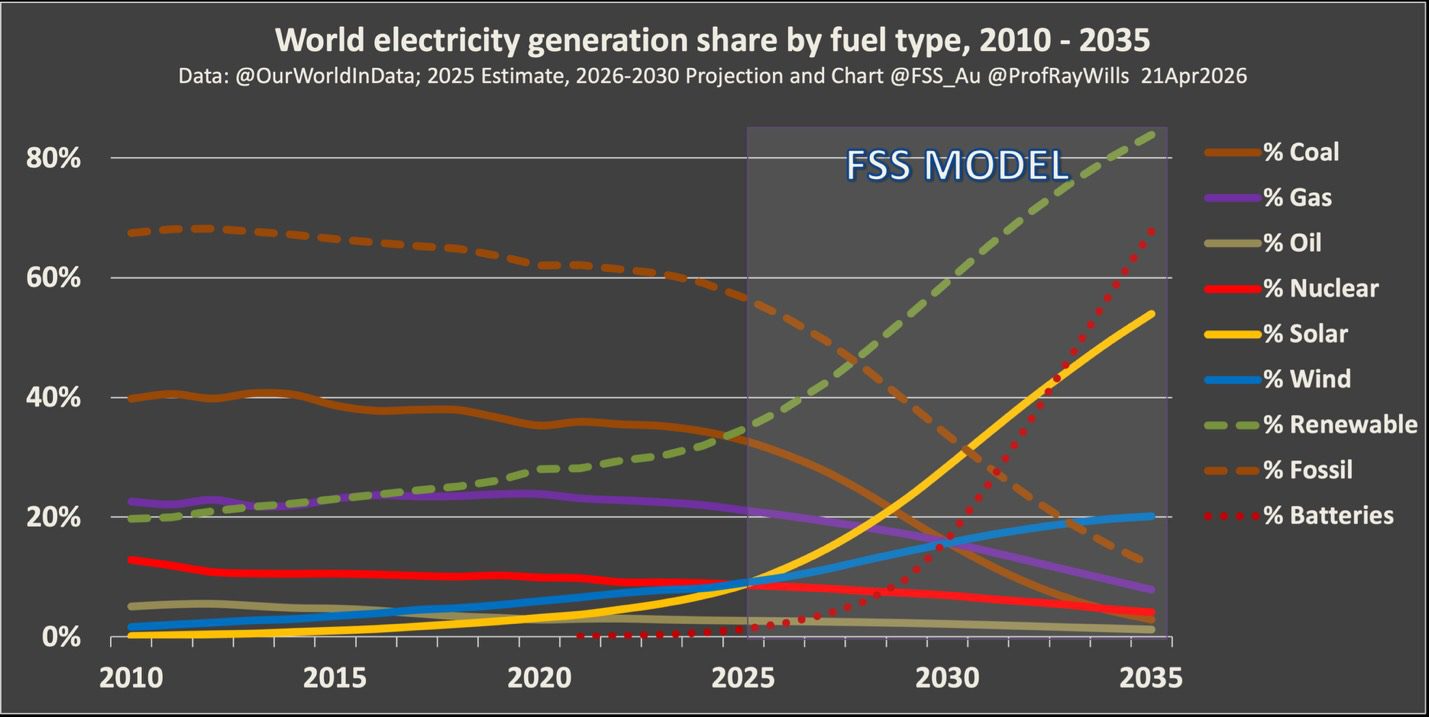
Half the world's electricity to come from solar by 2035

 I've talked about the S-curve before.  At first, the new technology has a tiny market share.  But let's say it grows by 15% a year.  The market share will rise four-fold in 10 years, and 66-fold in 30.   At a 20% growth rate, market share will rise 6-fold in 10 years, 237-fold in 30 years.   Naturally, as market share gets closer to 100%, growth rates slow.  Hence the S-curve.

From The Electric Viking:


Tuesday, June 11, 2024

EVs and PHEVs now 18% of world car sales

From CleanTechnica


Global plugin vehicle registrations were up 25% in April 2024 compared to April 2023. There were 1.2 million registrations. BEVs were up by 14% YoY, while plugin hybrids jumped 51% YoY.

In the end, plugins represented 18% share of the overall auto market (12% BEV share alone). This means that the global automotive market remains in the Electric Disruption Zone.

Year to date, plugin electric vehicle market share was up by 1%, to 17% (11% BEV).

Full electric vehicles (BEVs) represented 65% of plugin registrations in April, pulling the year-to-date tally to 64% share.


Globally, BYD is now way ahead of Tesla with a 20.7% market share, compared with Tesla's 7.6% (though Tesla makes no plug-in hybrids).  Part of the reason for the slowing growth shown in the chart below is because Tesla's sales are going backwards.  Partly it's because EV sales in Europe have temporarily stopped growing, which in turn is partly due to Germany cancelling all EV buying incentives.    Over the last 12 months, Germany made up 27% of Europe's car registrations.  Over 2021 & 2022, Europe's EV/PHEV sales grew by 180%, so this slow-down is perhaps to be expected.  

The collapse in battery costs will drive EV costs lower, and sales will pick up.  Growth rates fell in 2019 and 2020, when China removed EV incentives and Covid lockdowns crushed sales, but they recovered strongly in 2021 and 2022.  EV/PHEV sales in China have already started to accelerate again, so I feel reasonably confident forecasting a 30% per annum growth rate for the next couple of years.   

 In 2017, when EV/PHEV sales were just 2% of global car sales, I forecast that EV/PHEV car sales would reach 40% of global car sales this year.  But Covid delayed that schedule by a couple of years.   And US and European tariffs on EVs and batteries will also slow the transition down some more.  We prolly won't reach 40% for another two and a half years (extrapolating a 30% per annum growth rate).  On the other hand, most analysts were forecasting much lower numbers, because they were extrapolating the trend linearly, instead of exponentially. 

For legacy car makers, this point is key: EV growth was exponential, and their puny forecasts meant they kept on scrambling to catch up.  BYD is the world's biggest EV/PHEV manufacturer.  It's just produced an EV costing less than US$10,000.  An EV this cheap will accelerate EV take up.  S-curves rule.   For me, I didn't allow for Covid.  I'll try harder next time.


Wednesday, September 13, 2023

EVs/PHEVs/HEVs now 25% of global car sales

 From CleanTechnica


Global plugin vehicle registrations were up 41% in July 2023 compared to July 2022, rising to 1,104,00 units. In the end, plugins represented 16% share of the overall auto market (11% BEV share alone). This means that the global automotive market is firmly in the Electric Disruption Zone. Add close to 900,000 units coming from plugless hybrids and we have one quarter of global registrations having some form of electrification!

Year to date, plugin electric vehicle market share was stable at 15% (10% BEV).

Full electric vehicles (BEVs) represented 69% of plugin registrations in July, keeping the year-to-date tally at 70% share.

Only two legacy manufacturers made it into the list of top 20 models sold globally for the month, and the dominant manufacturers were BYD and Tesla.   The legacy car-makers are being left in the dust.

The chart below shows global EV + PHEV (plug-in hybrid) sales using the original (i.e., not seasonally adjusted) data from InsideEVs and CleanTechnica.  I've seasonally adjusted and smoothed the underlying data. Note that the chart has been plotted using a log scale.   In January 2014, global EV/PHEV car sales were 14,512.  In July this year, monthly sales were 1,152,657 on a trend basis.   Ponder that for a moment.

In Q1, EVs and PHEVs made up +-16.9% of global car sales (my calculations; I'm busy improving my global car sales data); in 2018 (just 5 years ago!) they made up 2.9%.   The S-curve continues to flex up.  

In 2017, I forecast that EV/PHEV sales would make up 22.5% of total car sales; we'll reach that by the end of this year.  (My forecast then was that we'd reach 100% by 2031, which still seems likely.)  I estimated that by this point, the annual decline in petrol (gasoline) sales would be 3.7% as the ICEV car fleet was replaced by EVs/PHEVs.  The same can't be said about diesel, as we're only just at the beginning of the switch-over to electric in the heavy-duty lorry sector.  In 2020, 48.6% of oil produced was used for road transport in the OECD, but that excludes China, one third of the world's car sales, where the EV revolution is much further advanced.  Peak oil, anyone?


Saturday, July 8, 2023

Let's start with the cow

From a tweet thread by Tony Seba


Let me start with #insulin. In the 1970s, insulin was extracted from the pancreas of animals. In the 1980s, @Genentech, working with Eli Lilly (@LillyPad), developed insulin using a new technology that I call #PrecisionFermentation. It wasn’t animal insulin. It was human insulin.

The mainstream would say: “health care is slow, it can’t be disrupted.” Well, here’s the S-curve of #PrecisionFermentation human insulin. Human insulin disrupted animal insulin in about 13 years.


#PrecisionFermentation is a concept that I coined in my  @rethink_x report ‘Rethinking Food and Agriculture’ with @CatherineTubb in September 2019.

Think about beer #fermentation. You take a microorganism (a yeast) and feed it sugar, wheat, nitrogen.. and out comes beer.

The difference with #PrecisionFermentation: you genetically modify the yeast, so it can produce the ingredient you want. In this case, a #protein.

The #protein itself cannot be #GeneticallyModified. The yeast is, but there’s no genetic material in proteins. None. Anyone who tells you “#GMOprotein” is lying to you. Proteins have exactly no generic material.

How is #PrecisionFermentation going to disrupt #milk? — Milk is almost 90% water. 3.3% of milk is #proteins, and that is the commercially valuable part of #dairy. So, essentially, you disrupt 3% of that milk bottle and the entire dairy industry is gone.

The #PrecisionFermentation disruption of #dairy is a #B2B ingredient #disruption. No consumer behavior change is needed. All the industry needs to do is disrupt protein shakes, protein bars etc. and ⅓ of #dairy industry revenues go away.

This technology has existed for 40 years and they’ve gone through an incredible capability cost curve. #PrecisionFermentation dairy proteins are already in the market (cheese, chocolate, ice cream etc). This is not in the future. This is now.

To give you an idea of the cost curve of #PrecisionFermentation, between 2000 and 2020, the cost per kilo/pound went down by about 10,000x in 20 years from ~$1m to ~$100. That cost curve makes #MooresLaw (computing) look like a straight line into the future.


Over the next ten years, we’re going to experience the #disruption of #food and #agriculture. And I am going to focus on the cow.

Because the cow is — by far — the most inefficient food production technology on the planet.

Every #animal that we use for #livestock is going to be #disrupted. If the cost curve keeps improving the way it has over the last few decades, the cost-per-kilo of #PrecisionFermentation proteins will reach price parity with the cow by ~2025. That’s only three years away.

We know that in #food and #ingredients, #disruptions happen quickly and they happen as S-curves. Think about Pepsi and Coca Cola. In the 1980s, in the United States, they went from all cane sugar to all corn-based sugar in only four years.

This is not a “veggie revolution”.  What is happening today is the ‘Second Domestication of Plants and Animals’. We’re going from domesticating large organisms — cow sheep horse chicken — to microorganisms as a source of food.

#PrecisionFermentation proteins are 5-100x more resource-efficient than the cow. #PFproteins, casein and whey, can be made today using 100x less land than the cow. Think about it. 100x less land.

An Israeli company called @Remilk_Foods announced that they’re going to open the world’s largest facility to create cow-free milk in Denmark. They’re going to make the dairy equivalent of 50,000 cows on 750,000 sq-ft = a standard industrial-size facility. A fermentation farm.

Canada’s dairy industry has about 1 million cows (whole country). Take 20 @Remilk_Foods facilities, i.e. #PrecisionFermentation farms, and they could produce the equivalent of 1m cows. This would take 344 acres and disrupt the whole dairy industry in Canada. That’s it. Gone!

How quickly is this going to happen? — The CEO of @Remilk_Foods says they can produce dairy as cheap as animal protein by 2024, which is within the cost curve that I published 3 years ago. That’s only 3 years away, not 20 or 30 as the mainstream would suggest. We need to prepare.

#FermentationFarms are the new #FoodFarms where we are going to create our proteins. New business model innovations and possibilities will open up, in this case, for example: #FoodAsSoftware.

The #proteins we eat today come from just a few #plants and #animals that we domesticated thousands of years ago. 12 plants and 5 animals account for 75% of food. There are millions of plants & animals on Earth. There’s a huge possibility space out there. #PrecisionFermentation

With #FoodAsSoftware and #PrecisionFermentation, we can make proteins from any animal, from any plant, at speed and scale. The number of possible #proteins mathematically is infinite. I did the numbers. It is larger than the number of atoms in the universe.

And it’s not just about the cow. It’s not even about food. #PrecisionFermentation is disruptive across many sectors. It’s being used for #cosmetics. #Collagen, for instance. #HumanCollagen is being made with precision fermentation. Today!

#SweetProteins are going to be so disruptive! One of those proteins — #brazzein — is ~1000x sweeter than cane sugar. 1 pound of brazzein can sweeten the equivalent of 1000 pounds of sugar. Think about that! Without the #insulin reaction.

The magic #ingredient that makes  @ImpossibleFoods’ meat smell and taste like meat is #heme. Heme is only 2% of their burgers. Think about how  @generalelectric got disrupted with only 2% market penetration of solar, wind & batteries (#SWB). Same thing is happening with #meat.

And you may think: “will this fly in x” or “will they eat it in #Texas?” — Yes, they will. I was at the airport in #Houston, and sure enough, they’re selling #ImpossibleNachos & #ImpossibleQuesadillas. And the menu doesn’t even say it’s vegetarian.


This is not just the #disruption of the cow. This is the disruption of all food that comes from animals: pork, fish eggs etc. All of them can be, and will be, disrupted by #PrecisionFermentation and #FoodAsSoftware.

I expect three phases in the “#Disruption of #Food & #Agriculture”. What we’re undergoing now is the first phase, which is #ingredients, #B2B etc.

The second phase, which starts around 2024, is more complex proteins & meats that will be made with #PrecisionFermentation, and later, #CellularAgriculture.

I expect that the animal extraction industry, the livestock-as-food industry, will be gone by 2035. It’s pretty much over. I expect the dairy industry to be bankrupt by 2030 — that’s less than 10 years away — and the whole livestock industry by 2035.

That doesn’t mean you can’t eat a cow after 2035. You can, but it’s going to be a little bit like the horse and the car. You can still ride horses, but it’s not a mainstream form of transportation, and it’s very expensive. Eating cows will be just like owning a horse today


For those of you who think Tony Seba's views are way out there .... you're wrong. He has consistently called it right for at least a decade. He understands that new technologies grow *exponentially*, not linearly.  And given how high emissions from beef, mutton and other meats are, this could save the world.  Because if we're all eating vat meat and vat eggs and drinking vat milk, then all that land freed up by ending animal husbandry will be able to revert to forest.  And that will be the most powerful carbon capture and storage process we could have.