Showing posts with label energy efficiency. Show all posts

Tuesday, November 7, 2023

Yes, heat pumps do work in winter


From EuroNews Green


Oyvind Solsta’s “light bulb” moment with heat pumps came upon reading that the heat they produce far exceeds the amount of electricity that goes in.

Installing a heat pump in his house in the hills of Oslo has greatly benefited the 56-year-old communications adviser for a railways company: improving his comfort, finances and climate footprint.

Norway is among the countries with the most heat pumps per capita, along with neighbouring Finland and Sweden.

"When I researched this, I read that a heat pump can generate the heat equivalent of three to four times the amount of electricity you put into it," said Solsta.

"So just that fact made a light bulb go off above my head, thinking 'This has to be clever'."

Hundreds of thousands of Norwegians have had the same bright idea, including Crown Prince Haakon who has had heat pumps installed at his official residence.

The International Energy Agency (IEA) considers the technology as instrumental in combatting climate change as electric vehicles, since heating solutions generate some four billion tonnes of carbon dioxide per year, representing eight per cent of global emissions.

The fact that Nordic countries, known for their harsh winters, are among the biggest users disproves the often-held assumption that the technology does not work when the temperature plummets.

The myth has fuelled resistance across continental Europe.

"There are a lot of false myths out there about heat pumps. Some oil and gas producing countries such as Russia, some people, some sectors, some businesses don't want to see this transition," explained Caroline Haglund Stignor, a researcher at RISE Research Institutes of Sweden.

"Yes, heat pumps work in cold climates. Yes, heat pumps work in old buildings."

To heat a home, heat pumps extract outdoor heat - which exists even in cold weather - and inject it indoors.

Early models did not include defrosting systems or variable speed compressors, which nowadays enable them to run more efficiently in a wider range of temperatures.

While their efficiency declines somewhat in cold weather, they are still more efficient and greener than other options, experts say.

"This is a mature technology that works, proven to keep millions of homes warm every winter. But it's a continuous development to make it even better," Stignor said.

According to a study by the independent group Regulatory Assistance Project (RAP), air source cold-climate heat pumps can be up to twice as efficient as electric heating when outdoor temperatures fall to -30 Celsius.

In France, heat pump detractors also argue they lead to higher electricity consumption, don't work well in all conditions, such as poorly insulated homes, and require costly installation.

Oil and gas furnaces remain popular in many countries.

In Germany, coalition partners this year finally reached an agreement to ban fossil-based heating as of 2045.

The state now subsidises heat pumps, which in 2022 were used in just three per cent of homes, and sales are beginning to take off.

Contrary to many European countries, Norway has almost no district heating, and banned oil furnaces in January 2020.

To keep warm during its cold winters, the country relies primarily on its abundant and clean electricity, thanks to its vast hydropower resources.

By producing about three to five kWh of thermal energy for every kWh of electricity consumed, heat pumps are instruments for energy efficiency - a key aspect of the fight against climate change - and also allow consumers to make major savings.

After replacing his electric radiator with an air-to-air heat pump two years ago, Solstad saw his electricity bills shrink.

"In the first four months, our consumption decreased by 20 per cent compared to the previous year even though we bought an electric car in the meantime," he said.

While his initial investment may seem costly, at around €2,500 including installation, he thinks it will pay for itself "in just a few years".

As an added bonus, his heat pump works as an air conditioner in summer.

When electricity prices went through the roof last year during the energy crisis brought on by the war in Ukraine, sales of heat pumps hit a record high in Norway, jumping by 25 per cent.

The trend continued in the first half of this year.

"Norwegians have understood that they can expect higher electricity prices in the coming years compared to the past," explained Rolf Iver Mytting Hagemoen, head of the Norwegian Heat Pump Association (NOVAP).

"And energy efficiency is an increasingly hot issue," he said.


Tuesday, August 22, 2023

The IPCC's path to radically lower emissions


From The Guardian


It feels impossible. The world has to slash carbon emissions by almost half in the next seven years to remain on track for just 1.5C of global heating and avoid the worst of climate impacts. Yet emissions are rising.

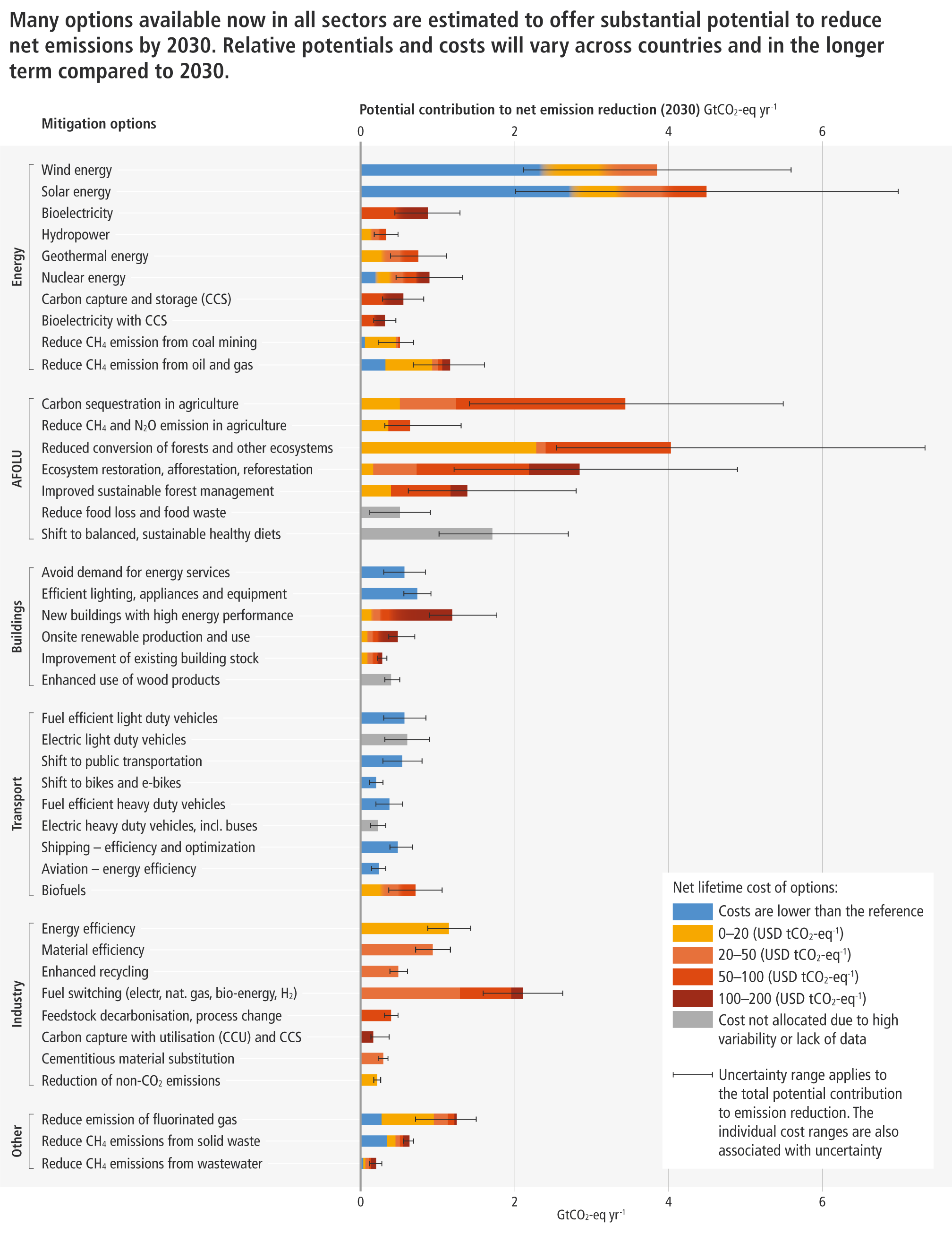
However, tucked away in the recent (and devastating) landmark report from the Intergovernmental Panel on Climate Change (IPCC) is a chart that provides the road map for an escape from catastrophe. It assesses with extraordinary clarity the potential for emissions cuts of more than 40 options. You can view it here.

The simplicity of the chart is deceptive. It was compiled by a team of the world’s best scientists, based on 175 studies. Its power is amplified by the fact that it was signed off by all of the world’s governments, from the cleanest and greenest to the darkest petrostates.

So what does it show? First, solar and wind power are by far the best option, with the potential to cut a staggering 8bn tonnes from annual CO2 emissions by 2030. That is equivalent to the combined emissions of the US and European Union today. Even more startling is that most of that potential can be achieved at lower cost than just continuing with today’s electricity systems.

“What struck me especially was that wind and solar was so big,” Prof Kornelis Blok, at Delft University of Technology in the Netherlands, told me this week. Blok, who led the work on the chart, identified the winners: “The big five are wind, solar, energy efficiency, stopping deforestation and reducing methane emissions.”

Just as important as the winners in this analysis are the losers. Nuclear power and carbon capture and storage (CCS) each have just 10% of the potential of wind and solar, and at far higher cost. The same applies to bioenergy – burning wood or crops for electricity. It’s no wonder that the UK’s energy strategy, published last week, received significant criticism: it goes heavy on nuclear and CCS, while ignoring onshore wind.

After wind and solar, the biggest prize is stopping the destruction of forests and other wild places, the IPCC scientists found. That has the potential to cut 4bn tonnes of emissions a year by 2030, not far off double the fossil fuel emissions from the whole of Africa and South America today. Including the restoration of degraded forests adds almost 3bn tonnes. Much of this could be achieved for less than $50 per tonne – half the price polluters pay for carbon permits in Europe today.

Energy efficiency in buildings, industry, lighting and appliances remains a no-brainer – 4.5bn tonnes a year by 2030 – as does slashing methane emissions, particularly from leaky fossil fuel installations. The latter could save the equivalent of about 3bn tonnes.

There are some interesting details too. A shift to “sustainable diets” – ie eating much less red meat in rich nations – could cut 1.7bn tonnes of emissions, equivalent to all the annual pollution from fossil fuel giant Russia. A push towards public transport, bikes and e-bikes has the potential to cut emissions more than the rollout of electric cars, showing both are needed. An often overlooked option – burying charcoal in fields (biochar) – is relatively costly to implement but potentially huge. Along with avoiding the ploughing of fields, which releases carbon, biochar could save 3.4bn tonnes of CO2 a year.

The IPCC chart is a map of climate optimism. It shows we can cut emissions by half by 2030 with options costing at most $100 per tonne, which is a bargain when set against the further damages that climate inaction will inevitably bring.

The solutions – wind, solar, trees, energy saving and methane cuts – require no new technology. But what they do require is a resource heavily lacking so far: the political will to push aside vested interests and rapidly pursue the policies that will work.

“The chart is a very useful hitlist,” says Blok. “I think every country can take it and see in which areas they could do more. If we don’t achieve [a 50% cut in emissions by 2030], it will not be because of a lack of options.”


To sum up:

  • Solar and wind are the biggies; nuclear and CCS are more or less irrelevant
  • Stop clearing forests
  • Restore degraded forests
  • Energy efficiency 
  • Slashing methane emissions
  • Eating less meat
  • A shift towards public transport, bikes and e-bikes
  • EVs
  • Biochar

Click on chart to see clearer image