Showing posts with label hydrogen-boron fusion. Show all posts

Thursday, March 31, 2022

Hydrogen-boron fusion demonstration hugely successful

 I've talked about this before, when it was still in the planning stage.  Now it's actually being tested.  This is by far the most promising fusion process I've seen.

(From New Atlas)

[The Australian company,] HB11 is approaching nuclear fusion from an entirely new angle, using high power, high precision lasers instead of hundred-million-degree temperatures to start the reaction. Its first demo has produced 10 times more fusion reactions than expected, and the company says it's now "the only commercial entity to achieve fusion so far," making it "the global frontrunner in the race to commercialize the holy grail of clean energy."

We've covered Australian company HB11's hydrogen-boron laser fusion innovations before in detail, but it's worth briefly summarizing what makes this company so different from the rest of the field. In order to smash atoms together hard enough to make them fuse together and form a new element, you need to overcome the incredibly strong repulsive forces that push two positively-charged nuclei apart. It's like throwing powerful magnets at each other in space, hoping to smash two north poles together instead of having them just dance out of each other's way.

The Sun accomplishes this by having a huge amount of hydrogen atoms packed into a plasma that's superheated to tens of millions of degrees at its core. Heat is a measure of kinetic energy – how fast a group of atoms or molecules are moving or vibrating. At these temperatures, the hydrogen atoms are moving so fast that they smack into each other and fuse, releasing the energy that warms our planet.

Most fusion reactor designs aim to replicate these conditions, by magnetically confining hydrogen atoms in a plasma, and then using gyrotrons and other specialized equipment to create small pockets of insane temperatures – over 100 million °C (180 million °F) – in which they hope they'll get enough random collisions between nuclei to create a chain reaction. This is the basic idea underpinning the multi-billion dollar stellarator and tokamak projects that have dominated fusion research for decades.

HB11 is using a different approach that's closer to a snooker shot. It doesn't require huge amounts of heat, or tricky, radioactive fuels like tritium. Instead, it takes advantage of recent advances in ultra-high powered "chirped pulse amplification" lasers that can produce monstrous, unprecedented power levels over 10 petawatts.

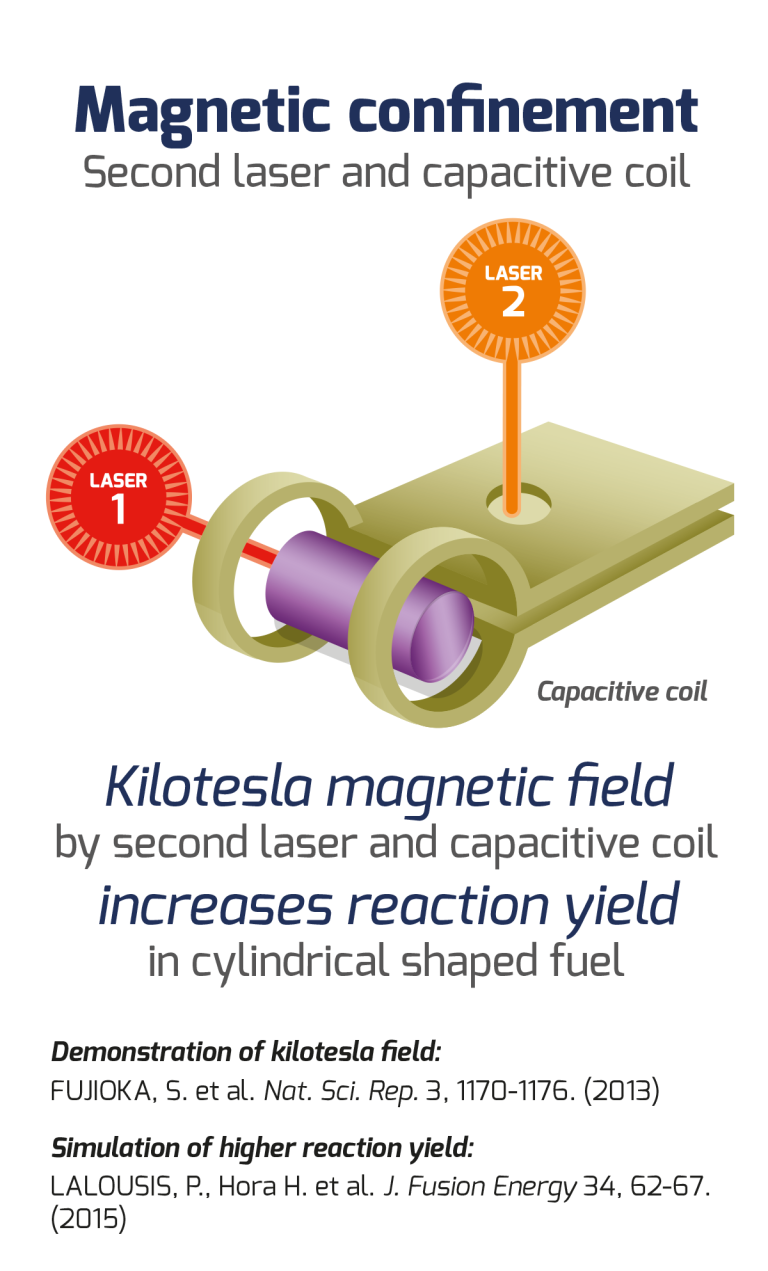
An HB11 reactor would be a mostly empty metal sphere, with a "modestly sized" boron fuel pellet held in the middle, and apertures in two spots on the sphere for a pair of lasers. One laser, in combination with a capacitive coil, is used to establish a powerful kilotesla magnetic containment field for the plasma, and the second is used to massively accelerate hydrogen atoms through the boron sample. So you're not heating things up in the hope that they'll smack together at speed, you're literally aiming the hydrogen right at the boron and using these bleeding-edge lasers to make it go so fast that it'll fuse if it hits a nucleus.

Hydrogen-boron fusion doesn't create heat, it merely creates "naked" helium atoms, or alpha particles, which are missing electrons and thus positively charged. HB11 plans to simply collect that charge to create energy, rather than needing to superheat steam and drive lossy turbines. No nuclear waste is created.

Initial experiments on laser-triggered chain reactions returned reaction rates a billion times higher than anticipated, leading HB11 to claim in 2020 that it "stands a high chance of reaching the goal of net energy gain well ahead of other groups."

"As we aren’t trying to heat fuels to impossibly high temperatures, we are sidestepping all of the scientific challenges that have held fusion energy back for more than half a century,” HB11 Managing Director Dr. Warren McKenzie told us at the time. “This means our development roadmap will be much faster and cheaper than any other fusion approach."

You can see why this is a very exciting company to keep an eye on, and today's news lends further academic credibility to the idea. In a new research study, led by HB11 Energy Lead Scientist Dimitri Batani and collaborator Daniele Margarone and funded by the Czech Republic's Ministry of Education, Youth and Sports and the EU's EUROfision consortium, HB11's technology has been demonstrated at Osaka University's Institute of Laser Engineering.

The study, published in the peer-reviewed journal Applied Sciences, showed what HB11 claims is a "world-first 'material' number of fusion reactions by a private company, producing ten times more fusion reactions than expected based on earlier experiments at the same facility."
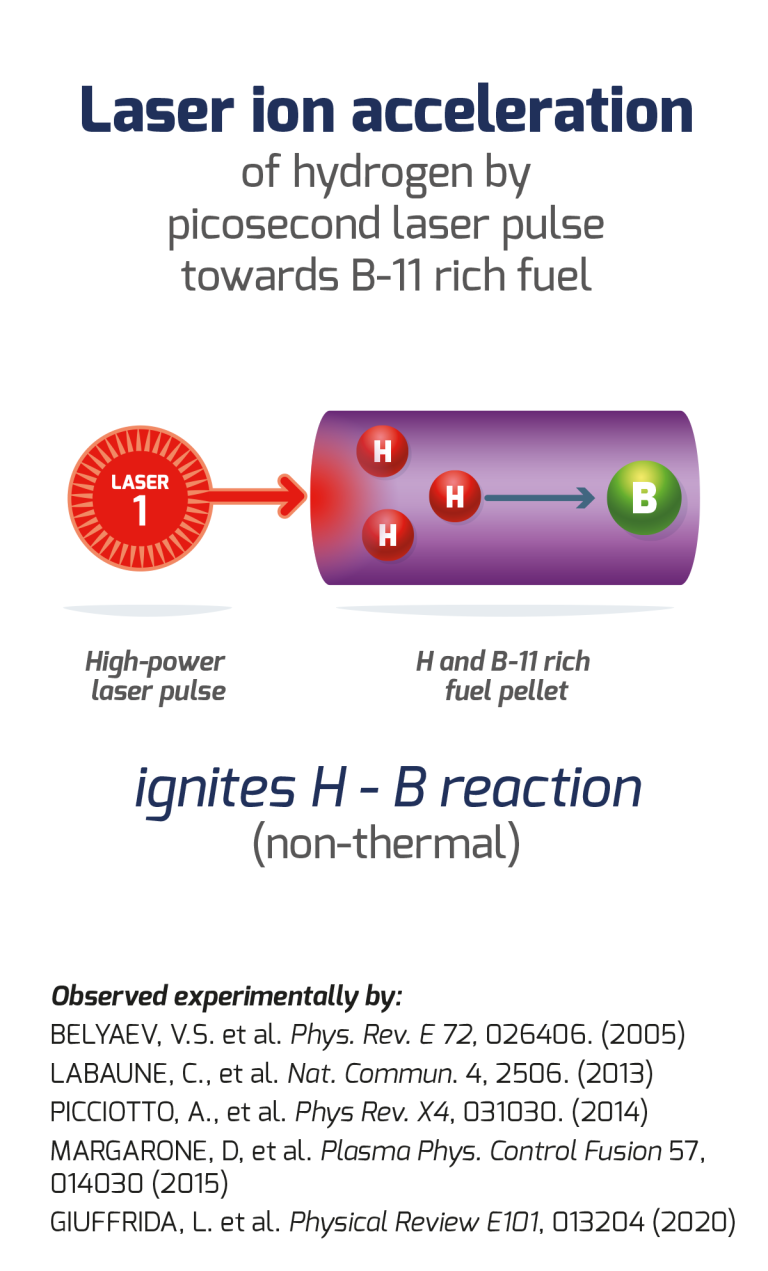


STEP 1: shoot hydrogen into boron fuel


STEP 2: keep result confined by powerful magnet


STEP 3: increase reaction


STEP 4:utilise charged He ions to generate electricity


Saturday, January 6, 2018

Hydrogen-boron nuclear fusion


Source: ZME Science


For the last 70 years, nuclear fusion has always been 20 years away.  But maybe for the first time we might get it.

Most nuclear power comes from nuclear fission--heavy molecules like uranium or plutonium are split into lighter molecules and the process releases energy.  Alas, it also releases some very toxic by-products.  For decades, the holy grail has been nuclear fusion, which involves smashing together light atoms like hydrogen and helium and their isotopes to produces heavier atoms.  This is the process by which stars--including our own sun--produce energy.  But it requires the incredibly high temperatures and pressures inside a star to work.  The problem for nuclear fusion attempts so far has been that duplicating that high pressure and temperature here on earth has been hard.  It's been done--that's what a hydrogen bomb does.  But to do it safely and produce more energy out than we put in has so far eluded us.

Previous attempts to recreate the temperature and pressure inside a star's heart involved a tokamak--a ring which contains the superhot plasma inside a magnetic field in the shape of a torus.  The new technique, invented by an Australian scientist at the University of New South Wales, involves used very short ultra-powerful laser bursts to set off a cascading reaction.

From Space.com

The new hydrogen-boron reactor is potentially a game changer for a simple reason: efficiency.

A deuterium-tritium reactor faces two challenges on the way to producing electricity: A lot of the energy gets wasted as atoms shed neutrons during the reaction, and the remaining energy can't be converted directly to electricity. Instead, it's used to heat up water, which turns a turbine, which produces electricity. So, most of the energy put into the reaction can't be efficiently translated into usable electricity.

But in the new study, which was published Dec. 12 in the journal Laser and Particle Beams, Heinrich Hora, a physicist at the University of New South Wales in Australia, and colleagues argued that they can sidestep these challenges by using a completely different fusion reaction.

If you fuse hydrogen-0 (just a single proton with no neutrons or electrons) and boron-11 (a version of boron with six neutrons) to make three helium-4 nuclei (each containing two protons and two neutrons), the researchers wrote, no neutrons get wasted. The atoms combine cleanly without losing any of their core particles. And in the reactor Hora proposes, the energy of the plasma could be converted directly into electricity without wastefully heating up water along the way, because the fusion's energy is released as a stream of electrically charged particles, which can relatively easily be turned into current in a wire.

Unlike deuterium-tritium reactors, which hold superheated plasma in place using magnets inside donut-shaped chambers, Hora's spherical hydrogen-boron reactor uses lasers to trigger and sustain the reaction. Those lasers are critical, Hora said: They waste much less energy heating up the atoms in the plasma and use less energy keeping the atoms in place. 


The lasers allow the hydrogen-boron plasma to reach temperatures of 5 billion degrees Fahrenheit (3 billion degrees Celsius) and densities 100,000 times greater than those of the plasmas inside a deuterium-tritium reactor. Those are much more intense reaction conditions than other projects aim for, but Hora and his team wrote that it should be easier to achieve these conditions given current technology, at least according to the researchers' early experiments and simulations.

The spherical shape, meanwhile, would allow the superhot plasma to retain a more efficient cylindrical shape at its core, which makes it an ideal target for the cylindrical laser. A spherical shape also efficiently retains the energy produced by the fusion reaction, the researchers said.
[Read more here]

One of the brightest burning dreams of sci-fi enthusiasts the world over is closer to reality than we’ve ever dared hope: sustainable fusion on Earth. Drawing on advances in high-power, high-intensity lasers, an international research team led by Heinrich Hora, Emeritus Professor of Theoretical Physics at UNSW Sydney, is close to bringing hydrogen-boron reactions to a reactor near you.
Energy from scratch


In a recent paper, Hora argues that the path to hydrogen-boron fusion is now viable and closer to implementation that other types of fusion we’re toying with — such as the deuterium-tritium fusion system being developed by the US National Ignition Facility (NIF) and the International Thermonuclear Experimental Reactor under construction in France.

Hydrogen-boron fusion has several very appealing properties which Hora believes puts it at a distinct advantage compared to other systems. For one, it relies on precise, rapid bursts from immensely powerful lasers to squish atoms together. This dramatically simplifies reactor construction and reaction maintenance. For comparison, its ‘competitors’ have to heat fuel to the temperatures of the Sun and then power massive magnets to contain this superhot plasma inside torus-shaped (doughnut-like) chambers.

Furthermore, hydrogen-boron fusion doesn’t release any neutrinos in its primary reaction — in other words, it’s not radioactive. It requires no radioactive fuel and produces no radioactive waste. And, unlike most other energy-generation methods which heat water as an intermediary media to spin turbines — such as fossil-fuel or nuclear — hydrogen-boron fusion releases energy directly into electricity.

All of this goody goodness comes at a price, however, which always kept them beyond our grasp. Hydrogen-boron fusion reactions require immense pressures and temperatures — they’re only comfortable upwards of 3 billion degrees Celsius or so, some 200 times hotter than the Sun’s core.

Back in the 1970s, Hora predicted that this fusion reaction should be feasible without the need for thermal equilibrium, i.e. in temperature conditions we can actually reach and maintain. We had nowhere near the technological basis needed to prove his theory back then, however.
 [Read more here]

I have no doubt we will one day get fusion.  It will be essential to our exploration of the solar system.  In the mean time, back on earth, we'll continue to rely of the giant fusion reactor in the sky, via solar panels.  Solar now costs under $20/MWh.  But the time we get fusion, solar power will be down to below $10/MWh (1 cent/kWh).  But fusion will be extremely useful on Mars, where the insolation is less than half what it is here.  And if it works this time, it'll come on stream just when it's needed.