Showing posts with label Ray Wills. Show all posts

Tuesday, July 7, 2026

Solar sounds the knell for fossil fuels

 From This is not Cool


RenewEconomy (Australia)[Article by Ray Wills]:

Solar is not just getting cheaper; it is sprinting down a learning curve that has held for half a century, with module prices falling about ten-thousand-fold as cumulative capacity has exploded. 

That is my first message: a technology whose cost keeps dropping predictably as deployment grows, and where every new gigawatt makes the next gigawatt cheaper again. 

And beating the trend line. [Prof Wills' comment refers to the way the slope of the capacity price trend line has steepened since 2020; i.e., the learning curve has accelerated]


The second message is about speed. 

When we line up all major power sources from the year each first exceeded a bigly amount of energy – 100 TWh – solar and wind are now racing ahead faster than coal, gas, hydro or nuclear ever did – nuclear did move fast for a while there, but then it stopped. Wind hasn’t.

And batteries are climbing even more steeply from their own 100 TWh “year zero”.

This is already the fastest shift in electricity generation in history, and it is still accelerating.


The third story is where it takes us. 

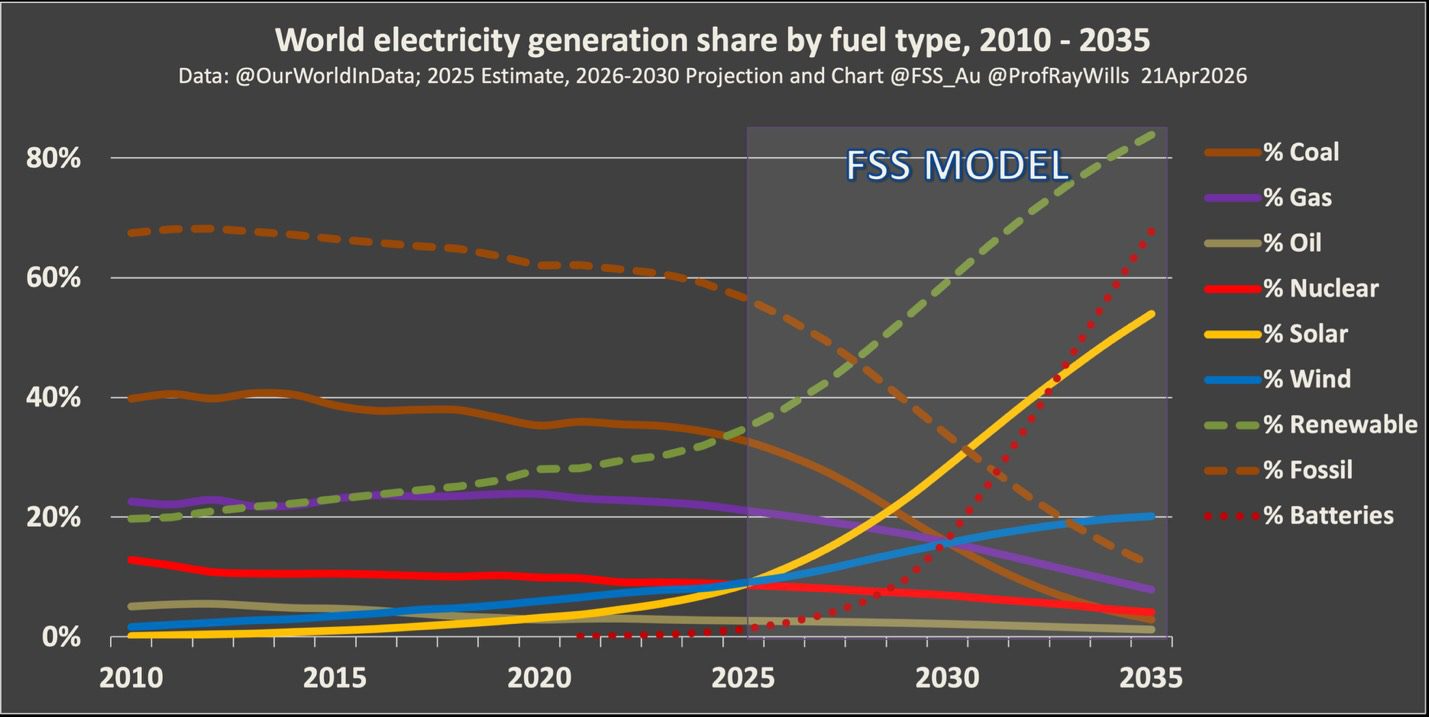
On current trajectories, the Future Smart Strategies  [Prof Ray Wills' consulting company] model has solar, wind and batteries driving renewables towards around 80 per cent of global electricity by 2035, with coal, oil and gas pushed to the margins of the system.


Yet mainstream outlooks such as BNEF’s 2026 New Energy Outlook still assume a convenient slowing of this trend beyond the visible horizon, even though every call for a slowdown since 2015 has been wrong, and every retrospective look has had to revise growth up, not down.

Solar is moving fast. Really fast. Batteries are moving faster.

There is no evidence in either prices or deployment that the system is about to tap the brakes.

For our Future Smart global growth model, the logical response is not to ask why the transition is so quick, but to ask: why on earth it would be slow?

Ray Willis and Peter Newman in The Conversation:

Solar produces cheap, abundant power. Batteries allow it to be used later. These technologies are useful first to clean up electricity generation and boost energy security. 

But these two technologies can unlock much more. They can make it possible to electrify polluting sectors long considered “hard to abate”. 

Electric options for heavy industry are multiplying. Electric arc furnaces are now replacing coal‑fired blast furnaces in steelmaking. High‑temperature electric heat pumps and electric boilers are replacing gas in some chemical and food‑processing plants, while heavy duty battery‑electric haul trucks are being trialled in mining and construction.

These technologies are still at an early stage. They’re often more expensive up-front. But the selling point is the fact they are cheaper to run – as long as electricity is fairly cheap. 

This is exactly the outcome solar and battery combinations deliver.


I have found in the past several years that Prof Ray Wills has been a much better forecaster than 95% of the rest of the renewables futurists, with the only exception being Tony Seba.  What characterises both these blokes is their reliance on exponential growth curves.    I have learnt from both of them.

What my own analysis suggests (still working on the data—I'll try and get my article out later this week) is that wind and solar will reach roughly two-thirds of global generation (output) by 2035, which is slower that Wills's forecasts.  There are many caveats to my forecasts, which I'll get into in the article.  But what this means is that fossil fuels in electricity generation will be mostly phased out by 2035.

If you add the S-curve transition taking place in EVs, emissions are likely to fall very fast from 2030 onwards.  Unless the world becomes an AI hellhole.

Friday, June 5, 2026

Electrifying: EV sales in Australia

From The Driven

Australia’s latest VFACTS and EVC data confirms what we’ve been charting all year: EV sales are multiplying, ICE is slowly losing control of the market, and the power EV dealers are supplying is genuinely electrifying.

China now dominates as the source of those vehicles, while grease and petrol and diesel look so “last century” with every monthly update.

As Tim Minchin might put it, the sun is finally coming out on Australia’s electric age – and this time it’s science, not faith, doing the work.

The May 2026 figures show another big jump for battery electrics.

Tesla’s Model Y has topped the national sales charts, while BYD remains the leading EV brand on year-to-date volumes, and Zeekr has emerged as the fastest-growing new player.

EV sales overall are up more than 110 per cent year-on-year, a doubling that reflects both rising demand and a rapidly widening model mix. Every month, more Australians discover that the supposed compromises of EVs were mostly theatre; the weekend, it turns out, was never really at risk.

Country-of-origin data reinforces the point.

China is now firmly the number-one source of new vehicles in Australia, well ahead of Japan and pulling further away.

A growing share of EVs on Australian roads – and a fair number of hybrids and even some ICE models – are built in Chinese factories, whether they carry BYD, Zeekr, MG, GWM, Volvo or Tesla badges.

For a country that doesn’t build cars, we are being swept along an S-curve largely designed in Shanghai and Shenzhen.

Since the post‑COVID bounce in 2021, petrol and diesel volumes have been sliding on a clear downward trend, punctuated by the familiar EOFY “dead cat” jumps seeking moonlight.

Even those June bounces in 2023 and 2025 only delivered lower plateaus afterwards, as buyers shifted into hybrids, plug‑ins and BEVs. BEV sales are now close to overtaking the combined hybrid sales including PHEVs, as they first tried to do in 2022.

The old oil era is fading into the twilight, even as the solar‑powered sun finally rises over the showroom, tomorrow.

The long-run picture is no summer fling; combustion is in a decidedly not slow fade-out to the horizon.


By contrast, the electrified side of the ledger is all upward motion. Hybrids first inched into the mainstream, then PHEVs began to appear in meaningful numbers, and BEVs have recently shot to one in five sales in market share.

In the last few months, the BEV line on our charts has started to look like those classic S-curve graphs from EV-heavy Europe and China – and Singapore and Indonesia. This is what the steep part of the transition feels like: one record month after another, as more households and fleets decide they’ve had enough of fuel-price roulette.

Policy and geopolitics are both amplifying the trend.

The New Vehicle Efficiency Standard is only in its early stages, but it is already nudging manufacturers to push low- and zero-emission models harder and to clear older, higher-emission stock.

At the same time, the world’s fourth oil crisis has reminded Australians how fragile the “cheap fuel forever” story really is. Each time global tensions flare and servo price boards jump, a few more drivers decide they’re ready to unplug from oil altogether.

That’s why this moment matters.

For decades, petrol and diesel were the unquestioned kings of Australia’s car market. Now, almost quietly, they are becoming the legacy option. ICE-only is still more than half of new sales, but that share is shrinking, and the trend has momentum.

The old soundtrack of the market is fading under the hum and whirr of motors powered from the grid and, increasingly, from rooftop solar.

So yes, Grease is so last century – at least for Australia’s car fleet.

EVs are no longer a sideshow; they’re the main act, stepping into the spotlight as the headliners from the age of oil shuffle offstage.

For all the noise and scare campaigns, the data say, the future turns up slowly, then all at once, like the sun coming out after a long, cloudy morning.

And from what the latest VFACTS data shows, this is one number that’s only going to keep building, key change after key change, as electrified vehicles take over the chorus line.

The chart below shows monthly EV sales, unadjusted for seasonality (blue line), adjusted for seasonality (red line) and smoothed (my seasonal adjustment and smoothing).  Note logarithmic scale. 

 Sales have doubled over the last year; given that EVs now have the same sticker price as petrol/diesel cars, and are much cheaper to run, rapid growth is likely to continue.  As The Driven's article points out--we are in the steeply rising part of the S-curve.  See the lower chart, which is plotted on a linear scale.


Tuesday, March 24, 2026

The S-curve rules

 From Professor Ray Wills


When these countries decided to swap to electric vehicles, they just did And it doesn't seem to take long They won't be having much of a crisis of oil (still some, just not as much as the rest of us) Graphs by @leraffl.bsky.social leraffl.github.io/LeRaffl-Gall...


As ever, S-curves initially turn up (or down!) very slowly.  Progress looks so s-l-o-w.  Then, wham!  ICEV sales fall from to from 80% to 20% in an average of five years.  Notice in the charts how PHEVs initially rise, because consumers have range anxiety, but that quickly disappears as rising EV sales lead to rising numbers of charger sites, while the cost of two engines becomes unacceptable.

Anecdotal reports suggest huge jumps in EV sales as a result of the current oil crisis.

(The two Bluesky accounts are:

https://bsky.app/profile/profraywills.futuresmart.com.au

and

https://bsky.app/profile/leraffl.bsky.social)


Monday, October 6, 2025

Politicians favouring fossil fuels are idiots

 From Professor Ray Wills:

Only excuse for politicians who

  • continue subsidies on costly fossil fuels
  • think nuclear power is cheap
  • claim clean energy is expensive
  • want to end decarbonisation?

Idiots

Only idiots ignore the data

My model projections from 2018, and updated 2025:

Prof Wills wasn't 100% correct in his forecasts back in 2018 (nearly 8 years ago).  On the other hand, he was among the least wrong.  The IEA (International Energy Agency), for example, consistently, year after year, underestimated the growth in renewables, and overestimated the growth in demand for fossil fuels.  I myself thought that emissions from coal peaked in 2018, and instead there was a surge in electricity generation from coal in China.  You can read about my latest forecast that emissions have peaked, here.

2018 forecasts

Wills sees oil peaking in 2027, and coal and gas peaking now.

2025 forecasts

Note that the two charts below show primary energy consumption, which is much more than, say, electricity production, because three-quarters of the fuel burnt to generate electricity or to power an ICEV is wasted as heat.

2018 forecasts

2025 forecasts


You'll notice that Wills doesn't think nuclear will grow:

Most important reason nuclear isn't viable in one graph

Apart from long build, it's expensive electricity, [and] if it's really hot, you need to turn them off


Not to mention that all the lethal by-products. 


Global solar output overtook nuclear output 2025

Global wind output will pass nuclear output early 2028

Now here's where some peeps lose it and call me a loony:

[In] my model projection, renewable[s] will pass fossil fuel primary energy consumption in 2035 

Does that mean that we will have halved emissions by then?  No, because there is still growth in demand.  But each year that the share of renewables rises means that demand growth will be increasingly supplied by renewables.  


Thursday, September 18, 2025

In China, more than 1 in 2 cars sold is an EV

EV and PHEV sales in China continue to motor ahead.

The first chart shows EV and PHEV sales in absolute terms, seasonally adjusted (by me), and plotted on a log scale.   A log scale shows a time series with a constant growth rate as a straight line.  The line on the chart below has been gradually levelling off, implying that the growth rate trend is gradually slowing.


This is confirmed by the chart below.  There are wild swings over the covid period, but the trend growth rate has slipped to 30% per annum over the last 3 years.  That's still a high growth rate, which would lead to a doubling of EV sales every 3 years.


The growth rate of EVs remains much higher than the growth rate of petrol cars.  In fact, petrol car sales in China peaked in 2018/19, recovered partially after the Covid lockdowns, but have since resumed their decline.  The chart below shows EVs/PHEVs as a percentage of total car registrations.  It is not plotted on a log scale.  Note the occasional spikes, which occur when EV sales go up and total sales go down.  This happens when government incentive schemes change, or when Chinese New Year moves, or simply because of random swings in the time series--one zigging up and the other down in the same month.  (Seasonal adjustment of monthly time series in China is tricky because of the peripatetic new year.)  There is no fundamental reason for the spike in April, or for the decline in May and June, and I expect to see it reversed over the next few months.  EVs will continue to gain market share, because battery prices continue to decline fast, and even despite government attempts to reduce very competitive conditions, EV prices are likely to remain under pressure.


China produces ~1/3rd of the world's cars, and EVs/PHEVs make up more than half of them.  By the end of this year, that ratio will prolly be 60%.   It's worth remembering that in January 2014, only 0.2% of cars sold in China were EVs or PHEVs.  And notice the surge in the percentage of EV sales over the last five years, from 5% to 55%.  (Just a personal note:  most analysts got this acceleration completely wrong.  Prof Ray Wills and Tony Seba got it right.  And luckily, I believed them, so I did too.)  This is a classic S-curve, but it shows no signs of flexing over, yet, though as EV sales head towards 80 or 90% of total sales, that has to be imminent.

[Data sources:  José Pontes at CleanTechnica; Prof Ray Wills, China's NBS (National Bureau of Statistics); my seasonal adjustment (tweaked X-11 variant); my smoothing, using a 13-term Henderson curve.]


Tuesday, March 15, 2022

100% EVs by 2025?

From a Twitter thread by Professor Ray Wills, who along with Tony Seba, has been consistently right with his forecasts for the growth in EV sales.  He has been even more optimistic than me, and I was very optimistic.  In mid-2016, when EV/PHEV sales were just 1% of global car sales, I forecast that they would reach 16% in 2022.  They reached 10% in 2021, and at current growth rates should hit ±16% in 2022.  The problem with most forecasters is that they extend lines linearly instead of exponentially.  If something is growing by 50% per annum,  it goes up 10-fold every 5 and a half years.  EV sales are growing by 70% per annum, while total car and commercial vehicle sales are falling.  Wills's forecast of an end to ICEV sales by 2025 seems perfectly plausible.  


Sales of electric cars hit 6.6m in 2021

> 3X EVs market share from 2019

> 2X 2020

16m #EVs on the road worldwide

More #EVs now sold every week than in the whole of 2012

But overall car sales are still falling

We hit peak car in 2017 

WEForum article.


Note that these are sales of EVs only, and do not include PHEVs


Note how hybrids are falling and how (B)EVs are now dominant


China is 1/3rd of the global car/light truck market


Full self driving (level 5) by 2027!  Transport as a service (TaaS) takes off.


Monday, January 17, 2022

Teslas are very safe

 From a twitter thread by Prof Ray Wills.  

I'm just using two charts, but the whole thread is interesting.


Note the inverted scale. 
This is not deaths per million miles, but million miles per death.
In other words, Teslas on autopilot are 10 times safer than the general car fleet.
 

The other chart I chose, which is very interesting, but entirely logical (Ozzie data):

The reason deaths at speed limits of 110 kph are less than those at 100 kph,
 is because there are only a few places where 110 kph is permitted, 


As Prof Wills points out lower in the thread, we choose to live with these fatalities:

EU road safety stats:

  • 22800 deaths in EU
  • 50% road deaths are pedestrians, cyclists or motorcyclists
  • 20% road deaths (4628) pedestrians killed by cars
  • 70% pedestrians killed by cars


0.88% deaths from bicycle striking a pedestrian  


Monday, July 5, 2021

EVs price competitive with petrol by 2023

 Ray Wills, an Ozzie futurist, has long had as optimistic forecasts as Tony Seba for battery and EV cost declines and EV take-up rates.  Both their forecasts have turned out to be on the mark, while other more conservative forecasters, including BNEF, have underestimated just how rapidly EVs are going to gain market share.


From The Age

Electric cars will hit price parity with petrol by 2023 and be the only cars produced by 2026, while many city petrol stations will be obsolete within a decade, says a Perth 'futurist'.  Ray Wills is managing director of advisory firm Future Smart Strategies, which examines the growth of commodities in the marketplace.

Professor Wills, who is also a board member of remote energy services provider Horizon Power and former chief executive of the Sustainable Energy Association of Australia, said anyone thinking of buying a car would be well advised to wait a few years if possible.

“The future is coming faster than we think,” he said.  “And when it arrives, we always say it was faster than we thought.”

Future Smart had been modelling since 2012 and its models had been “robust” since 2014, he said.  It also “post-casted”, evaluating previous performance.  In 2015, Future Smart Strategies projected 1.85 million EVs would be sold globally in 2018; it turned out to be 2.02 million.

Professor Wills said his models, while more aggressive than those of traditional forecasters such as Bloomberg and Deloitte, were less so than his nearest neighbour in approach, Stanford University’s Tony Seba, who had estimated EVs would be the only vehicles produced by 2025.

He said the disruptive power of electrics was visible in their eclipse of hybrids: for the past decade, 1.5 million hybrids had been sold. More EVs than that were sold in 2018 alone.

“When you see a disrupted market, it’s the thing that has the momentum that rules the day,” he said.  “Nobody will ever be exactly right. But I have been labelled as a futurist and the art of a futurist is to be the least wrong.”

Professor Wills said last year, the global car industry announced a total $400 billion investment into EVs and in addition so far this year, another $100 billion forward investment up to 2025. Volkswagen had announced in excess of $40 billion. Even Toyota, a “laggard” until recently, in May announced a $20 billion forward investment on EVs and advanced plans for electrification by five years.

“Is there a factory specially set up for Australia? No. Australia will buy what the world builds,” he said.

“Electrification as I see it will be virtually complete by 2026, the only cars built in my opinion will be electric, with the exception of some specialist bespoke vehicles.”

He said the average age of the 18 million cars in the Australian fleet was 10 years. He predicted 5 per cent of them would be replaced by EVs by the early 2020s, 50 per cent by 2036 and almost all of them by 2046.  Currently the cheapest EV in Australia was the Nissan Leaf, costing $50-70,000, and while there was no doubt that people would wait until EVs were affordable to buy one, he said by 2022-3 they would be in the $20,000 range.

While still dearer than a comparative petrol car, they would save $1000 per year on fuel costs which would outstrip the additional initial outlay within two years, he said.  Professor Wills said the only car market in Australia growing was EVs; petrol car sales had stalled for 18 months and while economic conditions were part of it, he believed there was more to it than that.

“It’s seen with iPhone models ... we will hold on to the old one if we know a new one is coming," he said.  “People are thinking, I will wait and see what happens. Once EVs are here combustion [car] prices will fall ... at some point they will become unsellable and that’s the point people won’t want to get caught in. It’ll be like buying a flip phone. People will know there’s a better option.”

He said anywhere you could plug in a hair dryer, you could plug in an EV.

"On the street you’ll need a little infrastructure,” he said.  “[But] it’s not an NBN rollout ... it’s not a $40 billion project, more like a $4 billion project.”

Petrol sales would thus be eroded and Australia would generate electricity for cars using local, renewable energy power plants, freed of the need to import $15 billion annually in oil and oil products for motor cars.

“Over the past 20-30 years, as we’ve gone to a self-serve petrol station then pay at pump, we lost all the corner store type stations ... replaced by the big main road stations,” he said.

“Next step will be a rationalisation of larger volume petrol stations. In the 2020s you will see some older petrol stations closing instead of being upgraded. The biggest ones will be the best protected and as the petrol and diesel market is eroded you’ll see the attrition of the outlets, just as the internet has eroded retail sales.”

On regional highways and national highways they would continue to operate as fast charging points.

“Australians will still have “range anxiety”, it’s prevalent here because of the distances, but there are already vehicles that can do 400 miles without a charge, and most of us can’t do that without a pee,” he said.  “You’ll need to recharge yourself before you’ll need to charge that car. Right now, 150KW is less than an hour; a stop for a tea, a pie and a tinkle.”

Key to the puzzle would be the arrival of electrified trucks, he said, and that would be a clearer situation within two years.  China was rolling out all buses, trucks and taxis to be electric, both for energy efficiency and air quality; building 181 electric buses per day. Australia had 36 electric buses in operation, by comparison.


The Tesla Model 2 US$25K hatchback


Saturday, November 2, 2019

EVs price competitive with petrol by 2023

I've talked about Ray Wills' EV forecasts before.  He doesn't seem to have shifted his forecasts much, which is logical, because unlike most other forecasters who have been too conservative by far, he has correctly called the rapid rise in EV penetration.  

From The Sydney Morning Herald:

Electric cars will hit price parity with petrol [cars] by 2023 and be the only cars produced by 2026, while many city petrol stations will be obsolete within a decade, says a Perth 'futurist'.

Ray Wills is managing director of advisory firm Future Smart Strategies, which examines the growth of commodities in the marketplace.

Reacting to news of a spike in investment in West Australian petrol stations, Professor Wills, who is also a board member of remote energy services provider Horizon Power and former chief executive of the Sustainable Energy Association of Australia, said anyone thinking of buying a car would be well advised to wait a few years if possible.

“The future is coming faster than we think,” he said.

“And when it arrives, we always say it was faster than we thought.”

Future Smart had been modelling since 2012 and its models had been “robust” since 2014, he said It also “post-casted”, evaluating previous performance.

In 2015, Future Smart Strategies projected 1.85 million EVs would be sold globally in 2018; it turned out to be 2.02 million.

Professor Wills said his models, while more aggressive than those of traditional forecasters such as Bloomberg and Deloitte, were less so than his nearest neighbour in approach, Stanford University’s Tony Seba, who had estimated EVs would be the only vehicles produced by 2025.

He said the disruptive power of electrics was visible in their eclipse of hybrids: for the past decade, 1.5 million hybrids had been sold. More EVs than that were sold in 2018 alone.

“When you see a disrupted market, it’s the thing that has the momentum that rules the day,” he said.

“Nobody will ever be exactly right. But I have been labelled as a futurist and the art of a futurist is to be the least wrong.”

Professor Wills said last year, the global car industry announced a total [US]$400 billion investment into EVs and in addition so far this year, another [US]$100 billion forward investment up to 2025. Volkswagen had announced in excess of [US]$40 billion. Even Toyota, a “laggard” until recently, in May announced a [US]$20 billion forward investment on EVs and advanced plans for electrification by five years.

“Electrification as I see it will be virtually complete by 2026, the only cars built in my opinion will be electric, with the exception of some specialist bespoke vehicles.”

He said the average age of the 18 million cars in the Australian fleet was 10 years. He predicted 5 per cent of them would be replaced by EVs by the early 2020s, 50 per cent by 2036 and almost all of them by 2046.

Currently the cheapest EV in Australia was the Nissan Leaf, costing [A]$50-70,000, and while there was no doubt that people would wait until EVs were affordable to buy one, he said by 2022-3 they would be in the [A]$20,000 range. [Surely a typo or misreporting?  If battery costs keep on falling at 20% per annum, they'll fall by 2/3rds by 2023.  But the price of the whole car won't fall by that much.  If he argued that EV prices could drop by A$20K, that's plausible.]

While still dearer than a comparative petrol car, they would save $1000 per year on fuel costs which would outstrip the additional initial outlay within two years, he said.

Professor Wills said said the only car market in Australia growing was EVs; petrol car sales had stalled for 18 months and while economic conditions were part of it, he believed there was more to it than that.

“It’s seen with iPhone models ... we will hold on to the old one if we know a new one is coming," he said.

“People are thinking, I will wait and see what happens. Once EVs are here combustion prices will fall ... at some point they will become unsellable and that’s the point people won’t want to get caught in. It’ll be like buying a flip phone. People will know there’s a better option.”

He said anywhere you could plug in a hair dryer, you could plug in an EV.

"On the street you’ll need a little infrastructure,” he said.

“It’s not an NBN [Australia's National Broadband Network] rollout ... it’s not a $40 billion project, more like a $4 billion project.”

Petrol sales would thus be eroded and Australia would generate electricity for cars using local, renewable energy power plants, freed of the need to import $15 billion annually in oil and oil products for motor cars.

“Over the past 20-30 years, as we’ve gone to a self-serve petrol station then pay at pump, we lost all the corner store type stations ... replaced by the big main road stations,” he said.

“Next step will be a rationalisation of larger volume petrol stations. In the 2020s you will see some older petrol stations closing instead of being upgraded. The biggest ones will be the best protected and as the petrol and diesel market is eroded you’ll see the attrition of the outlets, just as the internet has eroded retail sales.”

On regional highways and national highways they would continue to operate as fast charging points.

“Australians will still have “range anxiety”, it’s prevalent here because of the distances, but there are already vehicles that can do 400 miles without a charge, and most of us can’t do that without a pee,” he said.

“You’ll need to recharge yourself before you’ll need to charge that car. Right now, 150KW is less than an hour; a stop for a tea, a pie and a tinkle.”

Key to the puzzle would be the arrival of electrified trucks, he said, and that would be a clearer situation within two years.

China was rolling out all buses, trucks and taxis to be electric, both for energy efficiency and air quality; building 181 electric buses per day. Australia had 36 electric buses in operation, by comparison.

Professor Wills was mystified by Transperth replacing its current fleet with diesels.

“They’ll say we need to trial [electrics]. Do we really? We could replace our fleet in a week with the manufacturing out of China.”

Saturday, August 11, 2018

EVs 100% of the market by 2025

I've been very optimistic on the take-up of electric vehicles (EVs).  I've based that optimism in general on the classic S-curve of technology adoption, and on the idea that growth is exponential not linear.  Something which doubles every 2 years, for example, can soon grow from very tiny to huge.  If EV sales double every 2 years, and they are now about 2.4% of total car sales globally, then in 2 years they will be 4.8%, in 4 years 9.6%, in 6 years 19.2%, in 8 years 38.4% and in 10 years 76.8%.  With that growth rate, EVs will make up 100% of total global car sales in 2029. 

I've found someone who is even more optimistic than I am about the uptake of EVs: Prof Ray Wills, a professor at the University of Western Australia.  And he's just revised his forecasts up because the numbers have been even better than even he thought:

China on track to top 1 million #ElectricVehicle sales this year
If so, my world #EVs projection for 2018 and beyond too low
Imagine that
Too low
More EVs faster than even I imagined
And I've imagined a few
(Source of quoted material and all charts: Ray Wills)

Prof Wills forecasts much higher EV sales than anybody else (even me!)


China is 1/3rd of the world's car market.  It has strong EV targets.  The growth rate isn't 50% per annum but 100%!  (NEV = new energy vehicles, mostly EVs or PHEVs, but including a few hydrogen celled vehicles)

His forecast is that by 2026 no more petrol- or diesel-driven vehicles (ICEVs) will be sold.  As I said above, my forecast is that that will happen only in 2029.


That rapid uptake of EVs will take time to be reflected in the world's car fleet, because the average car lasts longer than 10-12 years.  In poor countries, they're much older, for obvious reasons.

Using last year's EV growth forecasts--which will now have to be upgraded!--oil sales will fall a by 30 million barrels a day by 2040.  World oil production was 80 million barrels a day in 2016.   The oil price will collapse long before 2040, though.  The 2014 oil price collapse was caused by a mere 3 million barrels a day oversupply.  That oil price crash also caused a slow-down in the growth rate of EVs in the US, so a price plunge may also have that effect in future.  But that will just be a temporary blip.  EVs are much cheaper to run, far more fun to drive, smoother and quieter, and by 2022 or so, their sticker price will be the same as or below ICEVs.  Meanwhile, governments everywhere will be panicking about global warming and air pollution.  EVs are safe.