Showing posts with label biochar. Show all posts

Tuesday, August 22, 2023

The IPCC's path to radically lower emissions


From The Guardian


It feels impossible. The world has to slash carbon emissions by almost half in the next seven years to remain on track for just 1.5C of global heating and avoid the worst of climate impacts. Yet emissions are rising.

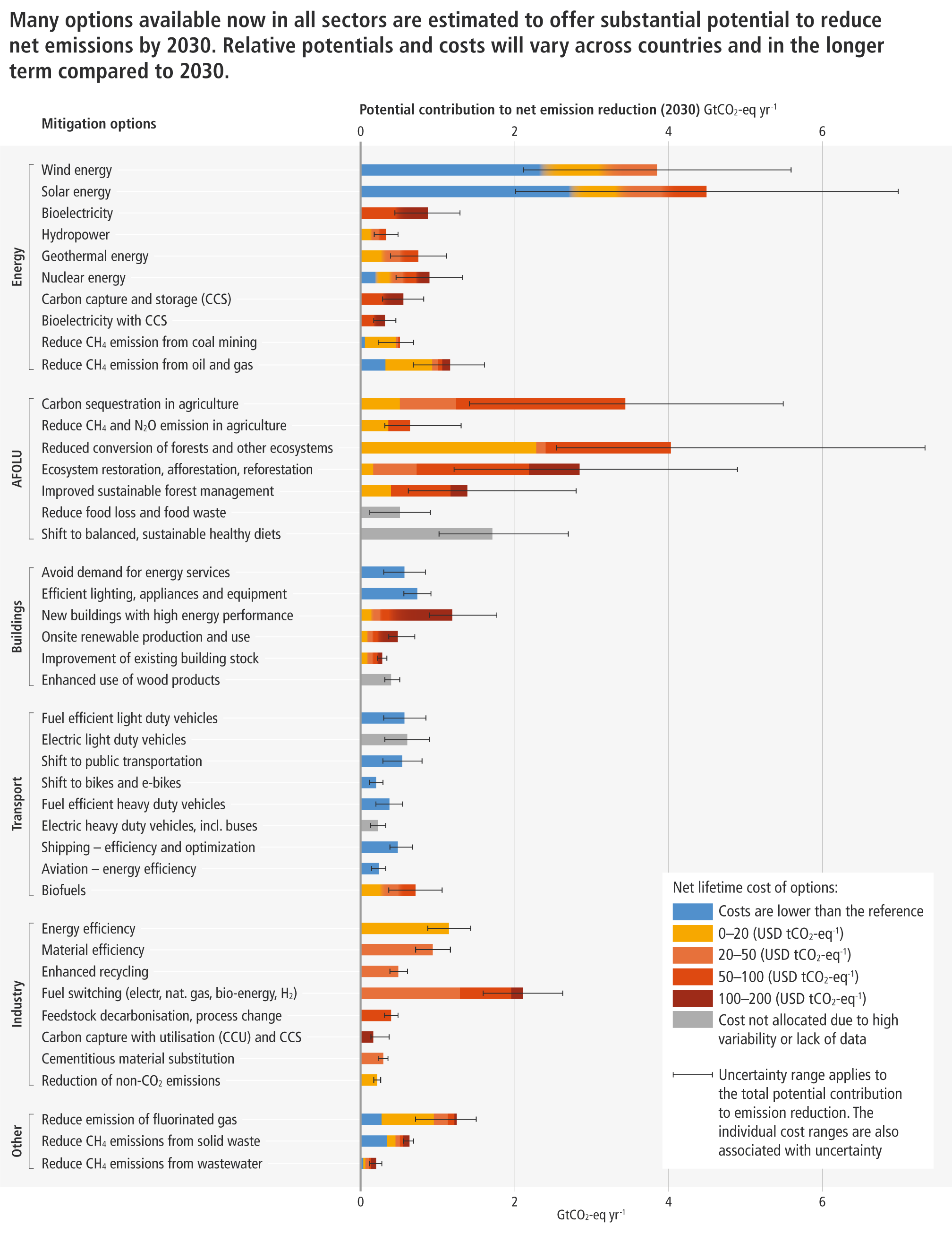
However, tucked away in the recent (and devastating) landmark report from the Intergovernmental Panel on Climate Change (IPCC) is a chart that provides the road map for an escape from catastrophe. It assesses with extraordinary clarity the potential for emissions cuts of more than 40 options. You can view it here.

The simplicity of the chart is deceptive. It was compiled by a team of the world’s best scientists, based on 175 studies. Its power is amplified by the fact that it was signed off by all of the world’s governments, from the cleanest and greenest to the darkest petrostates.

So what does it show? First, solar and wind power are by far the best option, with the potential to cut a staggering 8bn tonnes from annual CO2 emissions by 2030. That is equivalent to the combined emissions of the US and European Union today. Even more startling is that most of that potential can be achieved at lower cost than just continuing with today’s electricity systems.

“What struck me especially was that wind and solar was so big,” Prof Kornelis Blok, at Delft University of Technology in the Netherlands, told me this week. Blok, who led the work on the chart, identified the winners: “The big five are wind, solar, energy efficiency, stopping deforestation and reducing methane emissions.”

Just as important as the winners in this analysis are the losers. Nuclear power and carbon capture and storage (CCS) each have just 10% of the potential of wind and solar, and at far higher cost. The same applies to bioenergy – burning wood or crops for electricity. It’s no wonder that the UK’s energy strategy, published last week, received significant criticism: it goes heavy on nuclear and CCS, while ignoring onshore wind.

After wind and solar, the biggest prize is stopping the destruction of forests and other wild places, the IPCC scientists found. That has the potential to cut 4bn tonnes of emissions a year by 2030, not far off double the fossil fuel emissions from the whole of Africa and South America today. Including the restoration of degraded forests adds almost 3bn tonnes. Much of this could be achieved for less than $50 per tonne – half the price polluters pay for carbon permits in Europe today.

Energy efficiency in buildings, industry, lighting and appliances remains a no-brainer – 4.5bn tonnes a year by 2030 – as does slashing methane emissions, particularly from leaky fossil fuel installations. The latter could save the equivalent of about 3bn tonnes.

There are some interesting details too. A shift to “sustainable diets” – ie eating much less red meat in rich nations – could cut 1.7bn tonnes of emissions, equivalent to all the annual pollution from fossil fuel giant Russia. A push towards public transport, bikes and e-bikes has the potential to cut emissions more than the rollout of electric cars, showing both are needed. An often overlooked option – burying charcoal in fields (biochar) – is relatively costly to implement but potentially huge. Along with avoiding the ploughing of fields, which releases carbon, biochar could save 3.4bn tonnes of CO2 a year.

The IPCC chart is a map of climate optimism. It shows we can cut emissions by half by 2030 with options costing at most $100 per tonne, which is a bargain when set against the further damages that climate inaction will inevitably bring.

The solutions – wind, solar, trees, energy saving and methane cuts – require no new technology. But what they do require is a resource heavily lacking so far: the political will to push aside vested interests and rapidly pursue the policies that will work.

“The chart is a very useful hitlist,” says Blok. “I think every country can take it and see in which areas they could do more. If we don’t achieve [a 50% cut in emissions by 2030], it will not be because of a lack of options.”


To sum up:

  • Solar and wind are the biggies; nuclear and CCS are more or less irrelevant
  • Stop clearing forests
  • Restore degraded forests
  • Energy efficiency 
  • Slashing methane emissions
  • Eating less meat
  • A shift towards public transport, bikes and e-bikes
  • EVs
  • Biochar

Click on chart to see clearer image


Thursday, June 2, 2022

English farmers to use biochar to bury CO2

 From New Scientist


Farmers in England are starting to bury a charcoal-like material in their fields to see if it could offer a new large-scale way of putting the brakes on climate change.

Biochar is the carbon-rich material left over from burning wood and other biomass at high temperatures in an oxygen-free environment. Most of its use today is at the small scale, such as gardeners using it as a fertiliser.

However, a team led by Colin Snape at the University of Nottingham, UK, has started burying up to 200 tonnes of biochar in fields to gauge if it could help meet the UK’s net-zero goal by removing millions of tonnes of carbond dioxide from the atmosphere. It is the biggest biochar trial yet in the UK, and one of several CO2 removal ideas in a £31.5 million research programme, including scattering rock dust on fields and planting more trees.

“The key thing is that all of these greenhouse gas removal technologies, we need to test their viability. We need to figure out how big a slice of the pie biochar is. It’s about not putting all our eggs into one basket, of one magical technology that will save us,” says Genevieve Hodgins, who is managing the biochar project.

Around 15 tonnes of biochar is in the ground already, and more farmers are being recruited across the Midlands region of England this spring and summer to begin widespread burials this autumn. Beyond tackling climate change, a big attraction for farmers is that research indicates biochar can improve soil health, which is in a parlous state in England.

The project will measure how soil health changes over time, including the health of earthworms, as well how it affects crop yield and crop health compared with control plots. Some of the biochar will also be buried on land where tree-planting is planned, in order to see how it affects tree growth. Because the forested areas aren’t used to produce food for human consumption, far more biochar can be put in the ground there: Snape estimates about 50 to 100 tonnes per hectare compared with 10 tonnes for arable land.

Snape says that if the idea were scaled up for widespread deployment across the UK, the biochar would preferably be made from dried-out food waste and waste products from sawmills. However, to ease regulatory approvals by the UK Environment Agency for their trials, the researchers are using biochar made from virgin wood for now, mostly from one producer in Derby.

For the purposes of locking away carbon, that virgin wood would ideally have other uses, such as making timber-framed buildings, which the UK government’s climate advisers say should become more prevalent. Hodgins is looking at alternatives for making biochar, including coconut husks from Germany.

The project should give us a better idea of just how much CO2 biochar can remove. Snape thinks the approach could one day store a “few million” of the 130 million tonnes a year [in the UK] that the Royal Society calculates will need to be removed by 2050. First results may come in autumn 2023, potentially offering new insights into how permanent the removals are by showing how much microbes degrade the biochar.

Read more: https://www.newscientist.com/article/2321288-farmers-in-england-will-bury-burnt-wood-in-fields-to-capture-co2/#ixzz7V3EUxF7J


Biochar, charcoal produced from agricultural waste products, before it is applied to soil

Matthew Bentley/Alamy


Thursday, November 29, 2018

Natural climate solutions

Farmland near Leongatha, Victoria


The key to reducing greenhouse gas emissions is to switch all electricity generation to renewable sources, because, in principle, most activities can be electrified.  For example, we can heat our homes with electricity, not gas; we can electrify transport (and where we can't, we can create carbon-neutral fuels); we may even be able to electrify some industrial processes, such as making iron and steel.  But that will still leave agriculture and land clearing, which are responsible for 20% plus of emissions.   

The good news is that there are inexpensive changes we can make which could reduce net agricultural emissions to zero.

Conserving and restoring American forest, farm and natural lands could cut a substantial chunk of the country's emissions, helping meet greenhouse gas reduction goals without relying on undeveloped technologies, a new report finds.

A team of 38 researchers spent more than two years looking at "natural climate solutions"—a range of strategies that includes planting trees in cities, preventing the conversion of natural grassland to farmland and shifting to fertilizers that produce less greenhouse gas emissions.  

In a study published Wednesday in Science Advances, they report that these solutions, if deployed across agricultural lands, forests, grasslands and wetlands, could mitigate 21 percent of the country's net annual greenhouse gas emissions, getting the U.S. closer to meetings its goals under the Paris climate agreement.

The researchers found that reforestation had the single largest maximum potential to store carbon or take it up from the atmosphere—nearly 307 million metric tons. Most of the potential lies in forests in the Northeast and south-central regions of the country. "Natural forest management" strategies, which include things like extending harvest cycles or reduced-impact logging, could mitigate an additional 267 million metric tons. (The researchers calculated the overall net emissions of the U.S. as 5.8 billion metric tons, factoring in existing carbon sinks.)

The researchers looked at a number of solutions in agriculture, including avoiding the conversion of grassland to cropland, using cover crops planted in the off-season that add carbon to the soil, and using fertilizer more judiciously.  The solutions also included "biochar"—a form of charcoal made from a number of sources, including agricultural residue, that can be used to build healthier soil—and the practice of "alley cropping," or planting trees between crops.

Altogether these agricultural practices have the potential to mitigate nearly 440 million metric tons of carbon dioxide a year, the researchers found.
[Read more here]