Showing posts with label This is Not Cool. Show all posts

Tuesday, July 7, 2026

Solar sounds the knell for fossil fuels

 From This is not Cool


RenewEconomy (Australia)[Article by Ray Wills]:

Solar is not just getting cheaper; it is sprinting down a learning curve that has held for half a century, with module prices falling about ten-thousand-fold as cumulative capacity has exploded. 

That is my first message: a technology whose cost keeps dropping predictably as deployment grows, and where every new gigawatt makes the next gigawatt cheaper again. 

And beating the trend line. [Prof Wills' comment refers to the way the slope of the capacity price trend line has steepened since 2020; i.e., the learning curve has accelerated]


The second message is about speed. 

When we line up all major power sources from the year each first exceeded a bigly amount of energy – 100 TWh – solar and wind are now racing ahead faster than coal, gas, hydro or nuclear ever did – nuclear did move fast for a while there, but then it stopped. Wind hasn’t.

And batteries are climbing even more steeply from their own 100 TWh “year zero”.

This is already the fastest shift in electricity generation in history, and it is still accelerating.


The third story is where it takes us. 

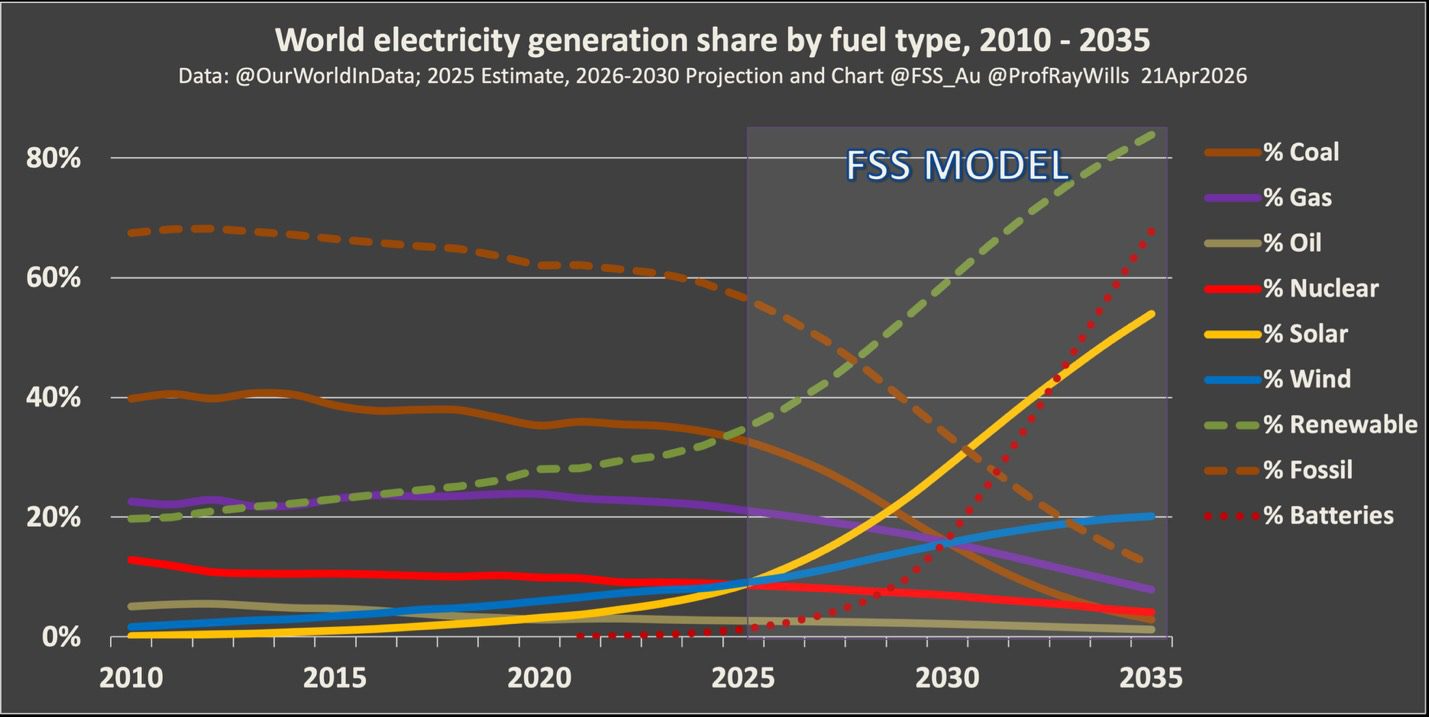
On current trajectories, the Future Smart Strategies  [Prof Ray Wills' consulting company] model has solar, wind and batteries driving renewables towards around 80 per cent of global electricity by 2035, with coal, oil and gas pushed to the margins of the system.


Yet mainstream outlooks such as BNEF’s 2026 New Energy Outlook still assume a convenient slowing of this trend beyond the visible horizon, even though every call for a slowdown since 2015 has been wrong, and every retrospective look has had to revise growth up, not down.

Solar is moving fast. Really fast. Batteries are moving faster.

There is no evidence in either prices or deployment that the system is about to tap the brakes.

For our Future Smart global growth model, the logical response is not to ask why the transition is so quick, but to ask: why on earth it would be slow?

Ray Willis and Peter Newman in The Conversation:

Solar produces cheap, abundant power. Batteries allow it to be used later. These technologies are useful first to clean up electricity generation and boost energy security. 

But these two technologies can unlock much more. They can make it possible to electrify polluting sectors long considered “hard to abate”. 

Electric options for heavy industry are multiplying. Electric arc furnaces are now replacing coal‑fired blast furnaces in steelmaking. High‑temperature electric heat pumps and electric boilers are replacing gas in some chemical and food‑processing plants, while heavy duty battery‑electric haul trucks are being trialled in mining and construction.

These technologies are still at an early stage. They’re often more expensive up-front. But the selling point is the fact they are cheaper to run – as long as electricity is fairly cheap. 

This is exactly the outcome solar and battery combinations deliver.


I have found in the past several years that Prof Ray Wills has been a much better forecaster than 95% of the rest of the renewables futurists, with the only exception being Tony Seba.  What characterises both these blokes is their reliance on exponential growth curves.    I have learnt from both of them.

What my own analysis suggests (still working on the data—I'll try and get my article out later this week) is that wind and solar will reach roughly two-thirds of global generation (output) by 2035, which is slower that Wills's forecasts.  There are many caveats to my forecasts, which I'll get into in the article.  But what this means is that fossil fuels in electricity generation will be mostly phased out by 2035.

If you add the S-curve transition taking place in EVs, emissions are likely to fall very fast from 2030 onwards.  Unless the world becomes an AI hellhole.

Saturday, April 18, 2026

Solar and wind replacing the Hormuz gap

 From This is Not Cool


This seems like Good news.

Center for Research on Energy and Clean Air:

Global power generation from fossil fuels fell in the first month since the start of the Hormuz closure, with the fall in gas-fired generation offset by large increases in solar and wind power, rather than coal.

The power generation dataset prepared for this analysis covers countries that disclose near-real-time data. The dataset covers 87% of global coal power generation and over 60% of gas-fired power generation.

Total power generation from fossil fuels in countries with near-real-time data fell 1% year-on-year, with coal-fired generation flat and gas-fired generation falling 4%. The dataset covers the world’s largest power markets: China, the U.S., the EU, and India, among others.

Seaborne coal transport volumes fell 3%, to the lowest levels since 2021. The data contradicts widespread expectations that coal power generation would rise in response to the crisis.


This is the first oil crisis where we *have* alternatives.  We can replace imported gas with wind, solar and storage.  We can replace petrol and diesel vehicles with EVs.  What's more, *everybody* knows it.  Governments, companies, individuals.  

Global emissions have peaked.  Oil demand has plunged, and only some of that demand is coming back, and then only in the short term.  How ironic that this is thanks to Trump.

So yes, emissions will rise again, but the next peak will be lower than this one.

(Caveat:  So-called "AI" data centres.)

Saturday, February 21, 2026

Trump's "energy dominance"? How we laughed.

Chart from Assaad Razzouk


 From This is not Cool


America’s “Energy Dominance” being pwned by China in the fastest growing and most important markets, the developing world.

The Deputy Prime Minister of Ethiopia, in the video below [here], remarked, “..those that love their children, plant trees.”
The jaded cynical, fossil fueled wise guys currently running Washington are not capable of comprehending the aspirations of the great majority of humanity, who don’t care to live under the thumb of Exxon and the Epstein Class.

Bloomberg:

n 2024, the Ethiopian government banned the import of fossil fuel-powered vehicles and slashed tariffs on their electric equivalents. It was a policy driven less by the country’s climate ambitions and more by fiscal pressures. For years, subsidizing gasoline for consumers has been a major drag on Ethiopia’s budget, costing the state billions of dollars over the past decade. The country defaulted on its sovereign bonds in 2023 after rising interest rates drove up the costs of servicing its debts, and it received a $3.4 billion bailoutfrom the International Monetary Fund the following year. 

In the two years since the ban on internal combustion engine vehicles, EV adoption has grown from less than 1% to nearly 6% of all of the vehicles on the road in the country — according to the government’s own figures — some way above the global average of 4%.

“The Ethiopia story is fascinating,” said Colin McKerracher, head of clean transport at BloombergNEF. “What you’re seeing in places that don’t make a lot of vehicles of any type, they’re saying: ‘Well, look, if I’m going to import the cars anyway, then I’d rather import less oil. We may as well import the one that cleans up local air quality and is cheaper to buy.’”

For decades, Ethiopia’s high import tariffs on vehicles put new car ownership out of the reach of most of the country’s population. Per capita gross domestic product is only about $1,000, and even by the standards of low-income countries, it has among the lowest car ownership rates. At 13 vehicles per 1,000 people, it’s a fraction of the African average of 73. With few cars manufactured in the country, the vast majority are imported, and most are bought used. 

The government’s import policy has upended the market. In parallel, tariffs for EVs were dropped to 15% for completed cars, 5% for parts and semi-assembled vehicles, and zero for “fully knocked down” — vehicles shipped in parts and assembled locally. That has made new EVs cost-competitive with old gasoline cars.

At one of Hallel Cars’ showrooms in central Addis Ababa, a Seagull hatchback made by the Chinese carmaker BYD sells for 3.6 million Ethiopian birr ($23,000), while a BYD subcompact SUV Yuan Up costs 4.9 million Ethiopian birr. Before the import ban, a secondhand compact Suzuki Dzire gasoline sedan cost more than 4.2 million birr.

“The majority of our customers are those making the switch from fuel cars to EVs,” said Moges Negash, Hallel Cars’ sales and marketing manager.

Hallel sells Toyota, Honda and Citroën EVs too, but models from BYD — which last year surpassed Tesla as the world’s biggest seller of EVs — dominate its showroom. Other dealerships around the city sell Chang’an vehicles, as well as those from Volkswagen and the Vietnamese manufacturer VinFast.

Although the price tag is still relatively high for a country where incomes are low, middle class consumers find it easier to get credit to buy new EVs than they did for secondhand gas-powered ones, which banks often wouldn’t lend against.

“Banks are reluctant to provide consumer credit for purchase of vehicles that have an uncertain fate,” said Abdulmenan Mohammed, a financial analyst based in London who covers Ethiopian banks. “EVs are a new technology and increasingly being used in the country, so it’s a better opportunity for banks to provide credit.”

For the government, the growth in EV sales is a vindication of its import policy, which in turn has been made possible by its investments in electricity infrastructure. The Grand Ethiopian Renaissance dam, completed in 2025 at a cost of $5 billion, produces 5,150 megawatts of power. Combined with other generating assets, including wind farms and solar, the country has excess generation capacity, which it sells to neighboring Kenya, Tanzania and Djibouti. 

The price of delivering power to Ethiopian customers is about $0.10 per kWh, which is about half that of neighboring countries, and considerably less than the US average of $0.18 per kWh. Many Ethiopian consumers pay significantly less than that, due to consumption-based subsidies on electricity.

This is now a path open to most countries without a car industry.  Solar panels are cheap as.  Batteries are plunging in costs.  You could run your vehicle fleet on the power of the sun.  Ban the import of petrol and diesel vehicles, encourage the roll-out of household and utility-scale batteries and storage, and end the import of expensive ICEVs and oil.  Clean your air, cut your balance of payments crisis, get cheap transport, and stop global heating.  What's not to like? 

If you do have a car industry, banning ICEV imports would still help you.  And maybe, as EV sales explode, you'll encourage your own car industry to switch to producing EVs.  Globally, land transport is responsible for ~20% of emissions.

Meanwhile, the US has embraced last-century technology.

Tuesday, August 27, 2024

EV skeptic becomes a convert


From This is Not Cool

Christopher Mims in Wall Street Journal:


A week of relying on a new class of family-size electric vehicle taught me a revealing lesson: A lot of us are all wrong in how we think about electric vehicles and charging.

The narrative for many of us has gone something like this: EV adoption will remain inconvenient and incremental until America has an adequate away-from-home charging infrastructure, including a great many fast chargers capable of filling up our vehicles in not much more time than we would normally spend at a gas station. Without such a network, range anxiety and America’s culture of road trips, super commuting and endless errands will make EVs a nonstarter for many people.

I know this logic well, because I’ve articulated it myself.

But then I opted to test a Kia EV9 for a week. This required charging a vehicle with a nearly 100 kilowatt-hour battery—twice the size of a base Tesla Model 3—from a conventional home outdoor outlet that usually isn’t handling anything more intense than a string of Christmas lights. The surprise was that—for seven days of errands, pickups, and even a lengthy road trip—being limited to charging at the slowest possible rate was just fine, and my inability to fast charge away from home was a nonissue.

I knew that surveys show EV fans generally love the experience of charging their vehicle at home—as long as they pay hundreds of dollars for a dedicated level 2 fast charger, and more to have it installed—like my fellow tech columnist Joanna Stern.

The fact that I didn’t need such a fast home charger at all was a minor revelation. It has fundamentally changed my view of the prospects of EV adoption in the U.S.

In particular, what made my week of EV use possible was the relatively high real-world efficiency of this vehicle, as measured by how many miles it can travel for every unit of charge I put into it. This efficiency is a feature of many new EVs, and especially surprising given the fact that the EV9 has the dimensions and rough outline of a Chevy Suburban.

This was true even on days when I was clocking upward of 30 miles. Combine that with the EV9’s relatively large battery pack—another increasingly standard feature of new EVs—and it meant that I had a more than adequate buffer of range for days when I wanted to go further, as I did on a day trip to the beach.

All of this is due to a long string of incremental improvements to the tech in EVs—not just their batteries but their power electronics, aerodynamics, and the efficiency of systems like cabin heating and cooling. Collectively, these innovations and improvements mean that it’s now possible for millions of Americans to slot an EV into our lives with little more than an extension cord—as long as we have a place to charge it at home.

One thing that’s important to note: While online forums are full of people who have been just fine with level 1 charging at home, some vehicles can have trouble with it, so it is important to note that not every EV can handle this approach in all circumstances.

The average American travels more than 40 miles a day, according to one estimate, but that varies a great deal, with many commuters driving less, and a smaller number driving far more. Based on conversations with experts on EV adoption and range, my experience isn’t atypical.

Put simply: the driving patterns of most Americans mean that most of us will rarely exceed the range of today’s modern, longer-range electric vehicles. As Ford CEO Jim Farley—a self-confessed “petrolhead” now making EVs—recently wrote: “our research shows that roughly half of Americans take trips over 150 miles only four days or fewer per year.”

This means that as long as someone can charge a vehicle at home, and they’re not a super commuter, the state of America’s charging infrastructure isn’t a big impediment. Since 60% of Americans live in detached family homes, most of whom could at least run an extension cord as the EV-driving neighbors in my garage-less village in Maryland do, that means a significant proportion of us could switch to charging an EV at home with little fuss.

For my experiment, I parked the Kia in the driveway alongside my house and attached the charging cord that came with the vehicle to a standard extension cord that reached the outdoor outlet by my front door. When I first plugged in after a long day trip, during which I almost completely discharged the battery, the vehicle helpfully informed me that it would only take 70 hours to fully recharge at the paltry rate my standard 120-volt outlet could handle. This seemed like a disaster, but as the week unfolded, it was anything but.

As it turns out, charging the vehicle overnight added more than 15% capacity, or about 40 miles of range, more than twice what I needed for the subsequent day’s errands. The accumulated surplus charging over the course of the week of daily driving meant that by the end the vehicle was nearly 70% charged.

Keep in mind that if I had hooked the vehicle up to a home level 2 charger it would charge six times as fast. That would mean I could go from empty to 100% overnight.


Saturday, August 24, 2024

Batteries + solar = grid stability

Note exponential curve.
Also, excludes household storage


From This is Not Cool (formerly ClimateCrocks)

Denton Record Chronicle (Texas):

With temperatures climbing over 100 [F; 38 C]  in much of the state, the Texas electric grid set an all-time record for energy demand Tuesday.

Despite the heat wave, the Electric Reliability Council of Texas has yet to ask people to conserve electricity. That’s a big change from 2023, when extreme weather and fear of low power reserves prompted ERCOT to issue 11 requests for conservation through the year.

Grid operators and energy experts are pointing to the rapid growth of solar power and grid-scale batteries as key reasons why residents haven’t been asked to conserve this month.

“We’ve seen significant additions of energy storage resources, solar resources and wind resources, with a few additions also on the gas side,” Pablo Vegas, CEO of the Electric Reliability Council of Texas, said at an ERCOT board meeting Tuesday. “All of that has helped to contribute to less scarcity conditions.”

In fact, the growth of some of those energy sources has been downright record-breaking.

As the sun and heat bore down, Sunday, Monday and Tuesday brought the top three days for solar power production in the history of the state grid, according to the website Gridstatus.io, which tracks the performance of regional electricity transmission systems.

On Sunday, the top day for solar production, Texas solar farms produced 20,832 megawatts of power. It’s worth noting that this number does not include energy produced by rooftop panels on homes and businesses.

According to ERCOT, 1 megawatt is enough to power about 250 homes at times of peak demand.

Texas also set new records Monday and Tuesday for the amount of power provided by big utility-scale batteries, something that could have made the difference between a normal day and a grid emergency.

“The previous storage record was shattered by 25%,” Doug Lewin, author of The Texas Energy and Power Newsletter, tweeted. We “almost certainly would have been rolling outages without it.”

The reason for the rapid uptick in solar and battery power on the state grid is pretty simple.

Energy demand has grown rapidly in Texas over the last few years, and frequent moments of energy scarcity have presented a business opportunity for solar farms and battery storage facilities that can quickly set up shop to fill the need.

Hot, sunny days — the very conditions that bring higher energy use — are also the conditions that produce solar power. That solar energy also can be used to fill large batteries that discharge power back to the grid when the sun sets over solar farms, but air conditioners are still running full blast.

San Jose Mercury News:


Four years ago this week, California’s power grid was so strained by a heat wave that rolling blackouts hit hundreds of thousands of residents over two days. It nearly happened again two years ago, when state officials issued 11 “flex alerts” asking businesses and homeowners to voluntarily reduce electricity use to avoid power disruptions.

But this year when a record heat wave scorched the state over three weeks from mid-June to July — sending temperatures across the Bay Area and the Central Valley soaring over 110 degrees — there was plenty of power. No warnings. No shortages. No flex alerts.

A big part of the reason, experts say, is a boom in the construction of giant battery projects.

California’s high-tech battery centers built with thousands of lithium-ion batteries similar to the batteries in cell phones and electric cars are solving the main shortcoming of the push for more renewable energy: the fact that the sun doesn’t shine at night.

Battery storage has increased sevenfold in the past five years in California, from 1,474 megawatts in 2020 to 10,383 megawatts now. A megawatt is enough electricity to run 750 homes.

Before, when the sun went down every summer evening, giant solar farms stopped producing electricity, sometimes leading to power shortages statewide in the early evening. Now, the growing number of battery storage plants across the state can store that solar power during the day when it is plentiful. The battery storage plants then release it back to the power grid in the evening as the sun goes down but hot weather keeps electricity demand high because millions of Californians are running air conditioners.

“Think of it like an energy bank account,” said Elliott Mainzer, president and CEO of California Independent System Operator, an agency in Folsom that manages the state’s power grid. “In the middle of the day, you are making big deposits. At the end of the day, we withdraw from that account.”


Tuesday, July 16, 2024

Renewables, batteries help California grid breeze through heatwave

 From This is Not Cool.


No rolling blackouts or grid emergencies as California continues on path to a carbon free grid. Several strategies, including upgrades to vulnerable parts of the grid at play here, but key enabler is more clean energy, especially solar, and above all, battery storage, now equivalent to 5 very large nuclear power plants.

In fact, California seems to have reached a level of storage that is creating some kind of a phase-change in the grid, yielding benefits that are surprising even expert observers. More and more days where renewables supply greater-than 100 percent of California’s power – enabling exports even under these challenging conditions.


Bogus anti-solar claims exposed


From This is Not Cool (formerly Climate Denial Crock of the week, or as I called it, ClimateCrocks)


Great new resource from Columbia University – Rebutting Claims about Solar, Wind, and Electric Vehicles. Of course, I’ve been doing this for some time, but it’s great to have a resource like this bookmarked.

There are takedowns for 33 common claims, I’ll post a few every day or so. By all means bookmark the original document – where all the assertions of fact are footnoted.

Columbia University:

False Claim #1: Electromagnetic fields from solar farms are harmful to human health.

“The EMF (electromagnetic field) from solar farms poses serious health risks especially to those who have electromagnetic hypersensitivity.”

The electromagnetic fields generated at a solar farm are similar in strength and frequency to those of toaster ovens and other household appliances—and harmless to humans. A detailed analysis from North Carolina State University concluded that there is “no conclusive and consistent evidence” of “negative health impact[s] from the EMF [electromagnetic fields]
produced in a solar farm.”

EMF exposure levels vary according to the EMF source, proximity to the source, and duration of the exposure. On a solar farm, EMFs are highest around electrical equipment such as inverters. However, even when standing next to the very largest inverter at a utility-scale solar farm, one’s exposure level (up to 1,050 milligauss, or mG) is less than one’s exposure level while operating an electric can opener (up to 1,500 mG), and well within accepted exposure limits (up to 2,000 mG).

When standing just nine feet from a residential inverter, or 150 feet from a utility-scale inverter, one’s exposure drops to “very low levels of 0.5 mG or less, and in many cases . . . less than background levels (0.2 mG).”33 For comparison, a typical American’s average background exposure level is 1mG, reaching 6 mG when standing three feet from a refrigerator, and 50 mG when standing three feet from a microwave.

The electromagnetic fields present on a solar farm constitute “non-ionizing radiation,” which, by definition, generates “enough energy to move atoms in a molecule around (experienced as heat), but not enough energy to remove electrons from an atom or molecule (ionize) or to damage DNA.”

In addition, EMFs are extremely low in frequency, which means
they contain “less energy than other commonly encountered types of non-ionizing radiation like radio waves, infrared  radiation, and visible light.”


False Claim #2: Toxic heavy metals, such as lead and cadmium, leach out from solar panels and pose a threat to human health.


Roughly 40% of new solar panels in the United States and 5% of new solar panels in the world contain cadmium, but this cadmium is in the form of cadmium telluride, which is non-volatile, non-soluble in water, and has 1/100th the toxicity of free cadmium.

Most solar panels, like many electronics, contain small amounts of lead.40 However, the Massachusetts Department of Energy Resources (DER) has assessed that “because PV panel materials are enclosed, and don’t mix with water or vaporize into the air, there is little, if any, risk of chemical releases to the environment during normal use.”

The Massachusetts DER has further assessed that, even in the unlikely event of panel breakage, releases of chemicals used in solar panels are “not a concern.”

All materials in a solar panel are “insoluble and non-volatile at ambient conditions,” and “don’t mix with water or vaporize into air.”

Moreover, they are encased in tempered glass that not only withstands high temperatures, but is also strong enough to pass hail tests and is regularly installed in Arctic and Antarctic conditions. It is theoretically possible that, when exposed to extremely high heat exceeding that of a typical residential fire, panels “could emit vapors and particulates from PV panel components to the air.” But that risk is limited by the fact that “the silicon and other chemicals that comprise the solar panel would likely bind to the glass that covers the PV cells and be retained there.” 

When a cadmium telluride panel is exposed to fire of an intensity sufficient to melt the glass on the panel, “over 99.9% of the cadmium [is encapsulated in] the molten glass.”

Furthermore, a 2013 analysis found that, even in the worst-case scenarios of earthquakes, fires, and floods, “it is unlikely that the [cadmium] concentrations in air and sea water will exceed the environmental regulation values.”


Sunday, May 5, 2024

Detroit Panicking at China’s Ultra Cheap EVs


From This is Not Cool (used to be Climate Denial Crock of the Week, or what I used to call Climate Crocks)

They're talking about the BYD Seagull in particular, but it applies to Chinese EVs in general.  The legacy carmakers and politicians in key car manufacturing countries were contemptuous about EVs, refused to take them seriously, and refused to embrace the EV market.  It was obvious that the EV market share was doubling every 18 months, had been for a decade, and that it would likely continue to double.  But they ignored this.  And what do they do now?  They run squealing to mama and papa government for protection.  They might be able to protect their home market, but they can kiss exports goodbye.

Bloomberg:

The car’s most extraordinary feature, though, is its $9,698 price tag. That undercuts the average price of an American EV by more than $50,000 (and is only a little more than a high-end Vespa scooter). Such aggressive pricing by BYD, which surpassed Tesla Inc. in late 2023 to become the world’s largest producer of electric vehicles, is indicative of how Chinese auto manufacturers will likely force US makers to pivot away from mainly producing expensive second cars for the affluent and toward more reasonably priced EVs for the Everyman.

Just as the long-feared prospect of a revolutionary EV from US tech giant Apple Inc. has receded, American carmakers now face a possibly greater challenge from Asia. China, long a manufacturing hub for Western companies’ products, is hellbent on expanding its own companies’ reach around the globe. It’s already the biggest market for EVs, and it’s using that scale and manufacturing know-how to help expand sales of competitively priced Chinese models to an increasingly climate-conscious world.

For now, the Chinese onslaught is being kept at bay in America by stiff tariffs and moves to erect even tougher trade barriers against the US’s geopolitical adversary. But the Chinese market accounts for about 70% of all EVs sold globally, so China’s push to lower prices is causing a ripple effect that can’t be ignored in the long term—even if political maneuvering by American lawmakers manages to slow the Asian giant’s automotive advance toward the US, the world’s most profitable car market.

“This threat has put everybody on alert,” says Jeff Schuster, global vice president for automotive research for consultant GlobalData. “It forces innovation in a way that might not have happened as quickly.”

Auto executives and politicians in Washington are sounding the alarm about a potential existential threat to American car brands—and the millions of workers employed building them. The Alliance for American Manufacturing, a trade group backed by major manufacturers and labor unions, is calling for new protectionist trade measures against China to prevent an “extinction-level event.”

“Chinese companies are ultra-competitive today,” says Michael Dunne, an auto industry consultant who previously worked for General Motors Co. in Asia. “The question in every boardroom right now is, how do we compete with them?”

Ford Motor Co., Tesla and other carmakers are quickly tearing up their EV playbooks to compete against these cheap new vehicles sold outside the US. Ford Chief Executive Officer Jim Farley calls the Seagull “pretty damn good” and cautions that any automaker that can’t compete with the Chinese globally in the near future risks losing as much as 30% of its revenue. One of Farley’s top EV executives called Chinese EVs “a colossal strategic threat.”

South China Morning Post:

BYD, the world’s largest electric vehicle (EV) maker, has priced another model under the 100,000 yuan (US$13,912) threshold as a discount war in China’s EV market intensifies.

The Shenzhen-based company, backed by Warren Buffett’s Berkshire Hathaway, announced on Wednesday that the updated fully electric e2 model will start at 89,800 yuan, 12.6 per cent less than the previous price of 102,800 yuan.

The compact sport-utility vehicle, with a range of 405 kilometres, becomes the fifth BYD model available for less than the psychologically important threshold price – viewed as affordable even for low-income wage earners in the mainland China market.

“BYD appears to be extremely aggressive in driving a transition from petrol cars to EVs in the country’s automotive industry,” said Eric Han, a ­senior manager at Suolei, an advisory firm in Shanghai. “The cheap models will also draw middle-income consumers who have become price sensitive amid a bearish economic outlook.”


The lethargic legacy carmakers can sleep slightly better knowing that the cheap EVs in China are not so cheap when they're sold outside China.    In Australia, the Seagull will prolly be sold for around $31 K, which removing sales tax and allowing for the US/A$ exchange rate, is roughly US$18K.   

Remember, CATL (the world's largest lithium-ion battery maker)  has halved the cost of batteries this year, to just $56/kWh.  Battery costs will continue to fall.  The fierce competition in EVs in China will not go away, and since Chinese carmakers have much higher margins on exports, expect them to export as much as they can.  The US and Europe might be able to protect their domestic car markets, but the rest of the world will, if they have no domestic carmakers, embrace cheap EVs, or, if they do have a domestic car industry, will persuade BYD and others to set up car plants in their countries.