Showing posts with label learning curve. Show all posts

Tuesday, July 7, 2026

Solar sounds the knell for fossil fuels

 From This is not Cool


RenewEconomy (Australia)[Article by Ray Wills]:

Solar is not just getting cheaper; it is sprinting down a learning curve that has held for half a century, with module prices falling about ten-thousand-fold as cumulative capacity has exploded. 

That is my first message: a technology whose cost keeps dropping predictably as deployment grows, and where every new gigawatt makes the next gigawatt cheaper again. 

And beating the trend line. [Prof Wills' comment refers to the way the slope of the capacity price trend line has steepened since 2020; i.e., the learning curve has accelerated]


The second message is about speed. 

When we line up all major power sources from the year each first exceeded a bigly amount of energy – 100 TWh – solar and wind are now racing ahead faster than coal, gas, hydro or nuclear ever did – nuclear did move fast for a while there, but then it stopped. Wind hasn’t.

And batteries are climbing even more steeply from their own 100 TWh “year zero”.

This is already the fastest shift in electricity generation in history, and it is still accelerating.


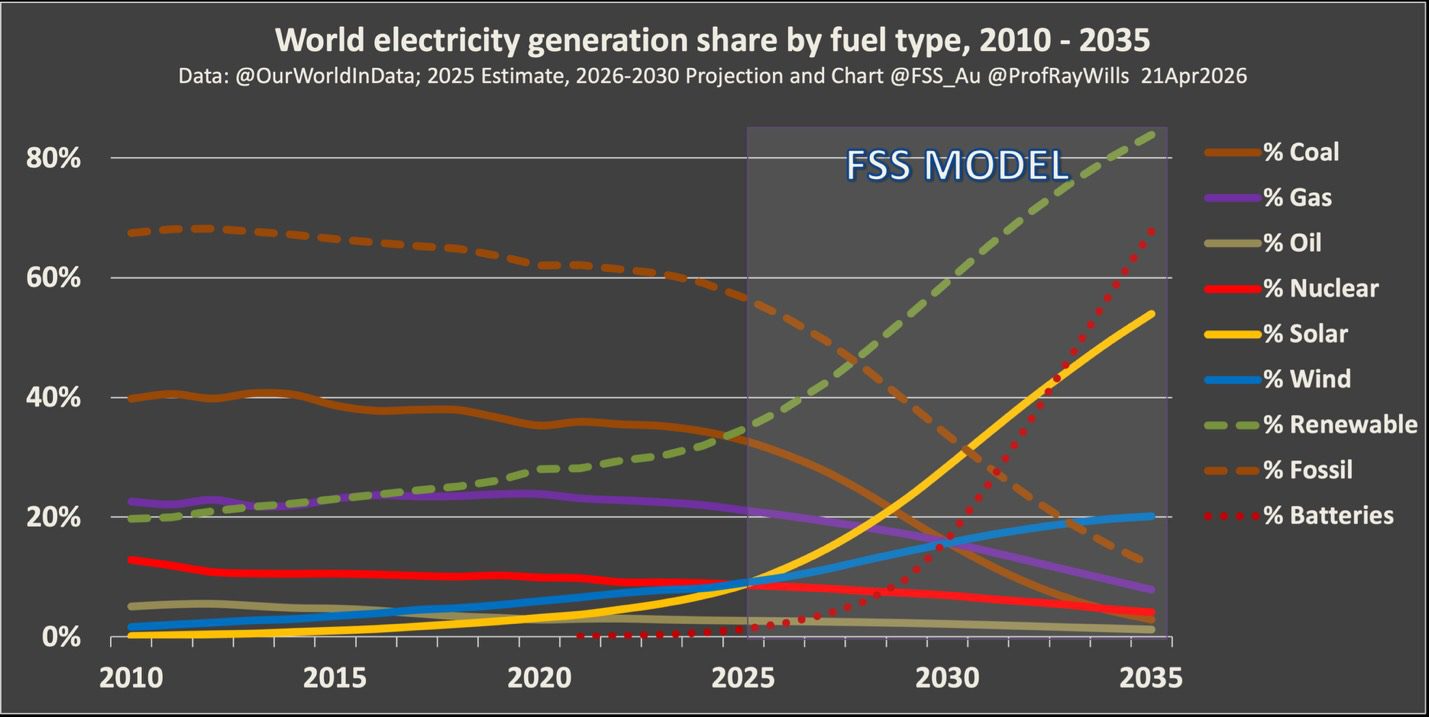
The third story is where it takes us. 

On current trajectories, the Future Smart Strategies  [Prof Ray Wills' consulting company] model has solar, wind and batteries driving renewables towards around 80 per cent of global electricity by 2035, with coal, oil and gas pushed to the margins of the system.


Yet mainstream outlooks such as BNEF’s 2026 New Energy Outlook still assume a convenient slowing of this trend beyond the visible horizon, even though every call for a slowdown since 2015 has been wrong, and every retrospective look has had to revise growth up, not down.

Solar is moving fast. Really fast. Batteries are moving faster.

There is no evidence in either prices or deployment that the system is about to tap the brakes.

For our Future Smart global growth model, the logical response is not to ask why the transition is so quick, but to ask: why on earth it would be slow?

Ray Willis and Peter Newman in The Conversation:

Solar produces cheap, abundant power. Batteries allow it to be used later. These technologies are useful first to clean up electricity generation and boost energy security. 

But these two technologies can unlock much more. They can make it possible to electrify polluting sectors long considered “hard to abate”. 

Electric options for heavy industry are multiplying. Electric arc furnaces are now replacing coal‑fired blast furnaces in steelmaking. High‑temperature electric heat pumps and electric boilers are replacing gas in some chemical and food‑processing plants, while heavy duty battery‑electric haul trucks are being trialled in mining and construction.

These technologies are still at an early stage. They’re often more expensive up-front. But the selling point is the fact they are cheaper to run – as long as electricity is fairly cheap. 

This is exactly the outcome solar and battery combinations deliver.


I have found in the past several years that Prof Ray Wills has been a much better forecaster than 95% of the rest of the renewables futurists, with the only exception being Tony Seba.  What characterises both these blokes is their reliance on exponential growth curves.    I have learnt from both of them.

What my own analysis suggests (still working on the data—I'll try and get my article out later this week) is that wind and solar will reach roughly two-thirds of global generation (output) by 2035, which is slower that Wills's forecasts.  There are many caveats to my forecasts, which I'll get into in the article.  But what this means is that fossil fuels in electricity generation will be mostly phased out by 2035.

If you add the S-curve transition taking place in EVs, emissions are likely to fall very fast from 2030 onwards.  Unless the world becomes an AI hellhole.

Friday, January 16, 2026

Australia reaches 50% renewables


In Q4 2025, the percentage of renewables in Australia's main electricity market, the NEM, reached 50%, or to be precise, 49.9%.  This is the best quarter of the year for renewables' share because wind and sun are strong, but since it is spring, demand for electricity for air conditioning is low.   The average percentage of electricity demand provided by renewables for the whole year was just 42.9%, up from 5.8% in 2008.  The percentage of renewables in the NEM is rising by ~3.5% per annum, which means that we're still 16 years before it provides 100% of demand throughout the year.

All the same, it's a landmark.  In 2008, almost all the renewables provided came from hydro, and the growth of wind power was slow, because in those early days, it was more expensive than coal, especially existing coal power stations.  Governments, both state and national, provided high feed-in tariffs for rooftop solar, which in Q4 2025 provided an astonishing 17.6% of total electricity demand, even though subsidies for rooftop solar have now been withdrawn.  The rapid growth in rooftop solar led to everybody in the system becoming familiar with it, with the result that soft costs (permitting, etc.) are low.  A very successful policy.  Rooftop solar in Australia is much cheaper than in the USA because of this factor.  Obviously, the panels cost the same, it's the soft costs which are so high.

The Right has opposed renewables all the way, and even now that renewables are cheaper than even existing coal power stations, still is hostile.  For example, Queensland (run by a right-wing party) has banned new wind and solar farms, despite their cost advantage.  And at national level, the so-called Liberal Party and the Murdoch press continue to say that high electricity costs are because of renewables--they're not, they're because of gas.  And they continue to spruik nuclear, which in Australia is entirely unnecessary, and also insanely expensive, more expensive than new coal.

It seemed such a long way to go, back in 2008, and progress was so slow.  And yet, we are half-way there!  I hope that as solar, wind and batteries continue to drop in price, the transformation of Australia's electricity grid will accelerate, but here in Australia, as elsewhere, vested interests are doing their damnedest to stop it.  But the public knows that installing solar will save them money, and rooftop solar installations continue.  Outside Queensland, Labor-controlled states have fairly aggressive renewables targets, driving continued growth in wind and utility-scale solar.  

Despite the opposition, we'll get to 100%, sooner than we got to 50%.

[If you want to play around with the data, you can do so here]


Friday, May 30, 2025

China's solar panel manufacturing

This chart shows the level of Chinese solar panel manufacturing in 10,000 kW.  I have interpolated some gaps, particularly with respect to the usual Chinese practice of not publishing data for January and February separately, or at all.  I have seasonally and extreme-adjusted the time series.  These would be solar panels for both local use and exports.

It is plotted on a log scale because of its rapid growth.  It is up 17-fold since 2014, an annual average growth rate of 33% per annum since 2014.  Recently, the growth in output has been accelerating again, which is consistent with the very rapid growth in domestic installations.

Despite all the talk, developed countries didn't really believe in solar, and didn't support it enough.  (Ironically, Australia once led the world in solar, but the government decided to withdraw developmental subsidies, and the Chinese graduate student who'd helped develop solar in this country, returned to China to start theirs.)  

China decided to support the new technologies needed to fight climate change for three reasons.  

First, its coal-led growth had produced terrible, lethal pollution.   You could even see it from space.

Second, they knew climate change was real.  They had no rancid Right, to try and stop the revolution.  And no oil and coal companies to seduce politicians with bribes and poison the public debate with lies.

Third, it saw that these new technologies (wind, solar, lithium-ion batteries, and EVs) were going to be vastly important, and even though they were starting off small, they would grow fast, and would enable China to get rich.  They saw the future and they grabbed it.  

The West kept on believing that growth would be linear, not exponential.  (Many forecasts and projections continue to make this mistake.)   China supported these industries in early years with subsidies and directives.   This forced them down a rapid learning curve.  Cut-throat domestic competition forces the companies in these sectors to past the cost declines on to their customers, which in turn expands the markets.   That's called industrial policy.   It uses the learning curve to carve out new markets.  

End result:  China dominates, and these industries outside China are +-5 years behind, except perhaps for wind.   Chinese EVs, batteries, and solar panels are cheaper than the rest of the world, and only protectionism keeps other domestic markets safe.  

Have developed countries learned their lesson?  You have to wonder.  The US certainly hasn't.  I suspect that this is what Trump is dimly grasping at with his Trump tariffs.  But the Chinese have also made a point of training and educating their work force, and companies spend more than their profits on research to improve the technologies.  BYD is an excellent example.  And they also don't chop and change policies every five minutes.  

Will this kind of industrial policy work in other sectors in China?  Chinese technology firm, DeepSeek, seems to following the same government-driven development path, but for AI.   There was a time when I would have said, but would you trust a Chinese AI?  But would you trust an AI from the USA these days?  And yet, if you're Pakistan or Thailand or Indonesia, do you even care?

If you're a small or a poor economy--in other words, anyone outside the Big 8--it makes sense to buy these products from China.   They're cheap, and will raise your GDP and living standards, while cutting your emissions and your air pollution.  If you're one of the Big 8 economies, you need to spend heavily on promoting production of these technologies to catch up.  Or you might as well give up.  

Meanwhile, the US (the world's largest economy!), has stupidly decided to deal death blows to its own EV, battery and solar industries.  

There are lots of lessons here, but I doubt the West, still in thrall to neo-liberalism, still wedded to the belief that the market always knows best, will learn them.


Tuesday, March 25, 2025

BYD leads unstoppable charge

BYD's plug-in hybrid, The Shark


From The Driven 


In 2024, China registered 31.436 million new automobiles, a rise of 4.5 per cent over the previous year, with the growth of NEVs (new energy vehicles) jumping an astonishing 35.5 per cent.

In the passenger vehicle market, China achieved an annual penetration rate of NEVs of 47.6% throughout 2024, with the percentage of new sales exceeding 50% for five consecutive months in the second half of the year.

That trend has continued into 2025, with China’s February NEV sales reaching 892,000, up 87 per cent from February 2024. BEV and PHEV sales were up 85% and 90% year on year respectively, far outpacing the overall demand growth (including ICE vehicles) of 34 per cent.

As the country’s biggest car maker BYD says, the facts demonstrate the unstoppable trend of electrification and accelerated replacement of ICE vehicles with NEVs.

As the world’s largest NEV producer, BYD is leading the charge both domestically and internationally on transforming the possibilities of electrified mobility and household electrification. Its rival, Tesla, has effectively left the race when it comes to sales growth.

The BYD profit report released overnight reveals that BYD generated RMB 777.1 billion ($US107 billion) in revenues in 2024, up 29.02% yoy, driven by a 40% yoy growth in NEV sales.

This translated to a 34% yoy growth of net profit to RMB 40.3bn ($US5.55bn) over the year for BYD, even as it invested RMB 54.2bn ($US7.48 billion) into R&D in 2024, taking its total investment into R&D to RMB 180bn ($US24.83 billion), most of it into its world-leading technology in batteries, electronics and EVs.

The company has 20,000 R&D engineers, and submits an average of 45 patent applications and 20 patent licenses every day. One of the latest is the ‘Super e-Platform’, enabling 1,000 kW charging power. Stepping into the era of “charging as fast as refuelling” with the ability to charge 400km in just 5 minutes.

The impact of that R&D is there to see. Battery prices have fallen 82% in the last 10 years alone. In the same time, battery densities have risen 5-fold.

In 2024, lithium-ion battery prices fell a further 20% to a record low of US$115/kWh as manufacturing overcapacity continues to surge.

In 2024, 3,100 GWh of fully commissioned battery-cell manufacturing capacity was online, more than 2.5x that of annual demand. This has driven massive demand growth for EVs and stationary energy storage (BESS) systems globally, with China continuing to dominate.

BYD is already showing incredible growth in 2025, with sales up 93% in the first two months of the year to 623,300 vehicles.

While Tesla’s profitability contracted over 2024, and its share price continues to dive as the US regresses on climate, clean energy and trade, BYD’s share price is up more than 51% in 2025 on the Hong Kong Exchange.

China was already the winner. Now it is clear, the runner-up has left the race. Incredible to see the EV revolution and China’s leadership in real time.

I've been saying for nearly a decade that the growth of EVs to market dominance was inevitable.  You just had to extend the lines plotted on log scale to see what was likely.

What I got wrong was that I assumed that Tesla would remain the market leader.  But Musk became obsessed with right-wing culture wars, and took his eye off the ball.  Anybody who has ever managed a business will know that that is fatal.   Market leadership has now switched to BYD, and more broadly, China.  The US had the lead; and together Musk and the Republicans have thrown it away.  Even assuming a changed administration in 2028, the US auto industry's lag behind China will have expanded to 5 years.   With the speed with which the market is shifting, that might as well be a lifetime.  Things are moving so fast in China that competitors will be unable to respond.

BYD is also driving down battery prices for grid storage.  And this will accelerate the replacement of coal and gas by solar with storage.   Learning curves with a vengeance, fuelled by billions of dollars of Chinese research.  Under these circumstances, no rational investor will put money into coal, oil or gas.  They're done.  Over.  Antediluvian.  As outdated as the Lockheed Constellation, or the Vickers Viscount, technological marvels of their time.   

So, whatever Trump or the Republicans or Big Oil think or do, electricity generation and road transport will go fully electric.  And as battery energy density rises, so will rail transport, shipping, and (eventually) air transport.  50% of global emissions will be eliminated.

[BYD's sales include plug-in hybrids.  These will surely be replaced with fully electric vehicles as cost falls and energy density increases.  At some point the cost of a second engine will outweigh the cost of bigger batteries, while at the same time, the rapid deployment of fast chargers will remove range anxiety.]


Monday, March 24, 2025

EV sales could reach 25% mkt share this year

 In December 2018, I wrote a piece called  Red letter day: EVs pass 3% of car sales.  In that piece, I pointed out that EV/PHEV sales made up just 0.4% of global car sales in 2014, but by early 2018, they had reached 3.1%.  I argued that if this growth rate continued, EV/PHEV sales would reach a 50% market share by 2025.    Well, they haven't.   

In January 2025, they had reached 19%, globally.    This is still 6 times as large as in 2018, but one can't deny, it's not 50%.   Was this a bad forecast?  From their behaviour, most of the legacy car-makers clearly assumed that the growth rate in EVs/PHEVs would be linear, not exponential.  In other words, that the market share would rise by, say, 1% a year (or less!), meaning that their forecasts for the EV/PHEV market share by end 2024 would be 9% or below, not the actual 19%.  So it was a better forecast than legacy auto. 

What went wrong with my forecast?   First, Covid.  Second, I didn't understand that in the EU, they set 5-year targets for EV penetration, rather than a year-by-year increase, and the car-makers wait as long as possible before they comply, so you get a step-up every five years, rather than a smooth upward trajectory.   In the US, high tariffs on EV imports, especially from China, shielding legacy car manufacturers from competition, also meant the EV prices were higher than they could have been.  So EV sales in the USA are growing more slowly than before. And then there's been the impact of the leading EV brand, Tesla.  Its sales have plunged, globally, and competitors are still filling that gap.  

The result has been that the annual growth rate in EV/PHEV sales has slowed from 50% a year to 30% (see the second chart below)  At this growth rate the global EV market share won't reach 50% until 2028.  China is already there, with its plug-in share rising from 35% a year ago to 50% now, because EVs have reached price parity with ICEVs in China.  And in Brazil and SE Asia, EV sales are skyrocketing, though the EV market share is still low.

So what's my new forecast? Outside the USA, the plunge in battery costs will I think cause EV sales growth to pick up.  Market share in Latin America and SE Asia will rise fast, and they will become much more important markets for EV/PHEVs than they have been so far.  Chinese car-makers will sell to them as well as setting up assembly plants in them.  And at some point, the US will see how stupid it's been about EVs, and will reverse course, so EV sales there will start to grow fast again.   I'm confident EVs/PHEVs will reach 50% market share by 2028, and 90% by 2030.  We'll see, if I'm still around.


Thursday, March 20, 2025

Why Trump and big oil won't win

 This is my chart using data from Our World In Data of the price of PV panels in US$ per watt, in constant 2024 dollars.  In other words, a 5000 kW system, ignoring inverter, grid connections, land, and installation would cost 5000x30 cents, or $1500.  (Of course, this pricing is for wholesale systems with economies of scale; a rooftop solar system would be more expensive.)   This is a 99.8% fall from 1975.


Note logarithmic scale

On its own, this is not enough to show that solar will provide most of our power, inevitably, eventually.  After all, the denialists will gleefully tell you the sun doesn't shine at night (goodness me, who knew?) 

So you've got to add the cost of storage.  And the fact is, battery prices are falling even faster than PV prices

This chart shows BNEF's battery costs survey data, also in constant dollars, with my estimates for 2025 and 2026.  If you do the numbers, it turns out that adding 4 hours of storage to a solar farm will add just $12/MWh of electricity generated to the cost.  Adding 8 hours storage would cost $24/MWh, which is still cheaper than new coal, or (outside the US) new gas.


Note log scale


But, I hear the denialists wail, what about dunkeflaute, those periods in high latitudes when there is no wind, and little solar, and it's cold?  Well, until we get long-term storage, we will need gas peaking.  We can make the gas using electrolysis of water, and using the hydrogen produced to make methane via the Sabatier system, which would in effect be long-term storage.  Or we can go on using fossil gas.  But even if we do the latter, we will still have cut emissions from electricity generation by 95%.  


A final chart from Our World in Data.  It shows a classic "learning curve".  A new technology starts.  It's expensive, and has only a few uses out in the wild.   But usage increases.  Manufacturers get a bit better at making it.  Demand increases, costs fall.  Falling costs lead to still more demand, which in turn leads to still lower prices, and so on, until the technology has gained a 100% market share. 

The chart uses a double log scale.  On the vertical axis, each tick mark shows a halving of PV module prices.   On the horizontal axis, each tick mark shows a 10-fold increase in cumulative installations.  So each 10-fold increase in installations leads to a halving of module prices --- and vice versa.

There is probably another 10-fold increase in solar installations in prospect over the next 10 years.  Which will be associated with another halving of the cost of solar.  Meanwhile, the rapid progress of EVS and the need for stationary storage will drive down battery costs, which will continue to halve every four years.

This is irresistible.  The learning curve is being driven by fierce competition, which in turn drives rapid technological advance.  There is nothing Trump or Big Oil or coal miners or the rabid Right can do about this.  They can delay the technological advances in the USA, which will just retard the US economy, but in the rest of the world, the advance of solar plus storage to market dominance in inevitable.  Except in high latitudes.


Saturday, July 8, 2023

Let's start with the cow

From a tweet thread by Tony Seba


Let me start with #insulin. In the 1970s, insulin was extracted from the pancreas of animals. In the 1980s, @Genentech, working with Eli Lilly (@LillyPad), developed insulin using a new technology that I call #PrecisionFermentation. It wasn’t animal insulin. It was human insulin.

The mainstream would say: “health care is slow, it can’t be disrupted.” Well, here’s the S-curve of #PrecisionFermentation human insulin. Human insulin disrupted animal insulin in about 13 years.


#PrecisionFermentation is a concept that I coined in my  @rethink_x report ‘Rethinking Food and Agriculture’ with @CatherineTubb in September 2019.

Think about beer #fermentation. You take a microorganism (a yeast) and feed it sugar, wheat, nitrogen.. and out comes beer.

The difference with #PrecisionFermentation: you genetically modify the yeast, so it can produce the ingredient you want. In this case, a #protein.

The #protein itself cannot be #GeneticallyModified. The yeast is, but there’s no genetic material in proteins. None. Anyone who tells you “#GMOprotein” is lying to you. Proteins have exactly no generic material.

How is #PrecisionFermentation going to disrupt #milk? — Milk is almost 90% water. 3.3% of milk is #proteins, and that is the commercially valuable part of #dairy. So, essentially, you disrupt 3% of that milk bottle and the entire dairy industry is gone.

The #PrecisionFermentation disruption of #dairy is a #B2B ingredient #disruption. No consumer behavior change is needed. All the industry needs to do is disrupt protein shakes, protein bars etc. and ⅓ of #dairy industry revenues go away.

This technology has existed for 40 years and they’ve gone through an incredible capability cost curve. #PrecisionFermentation dairy proteins are already in the market (cheese, chocolate, ice cream etc). This is not in the future. This is now.

To give you an idea of the cost curve of #PrecisionFermentation, between 2000 and 2020, the cost per kilo/pound went down by about 10,000x in 20 years from ~$1m to ~$100. That cost curve makes #MooresLaw (computing) look like a straight line into the future.


Over the next ten years, we’re going to experience the #disruption of #food and #agriculture. And I am going to focus on the cow.

Because the cow is — by far — the most inefficient food production technology on the planet.

Every #animal that we use for #livestock is going to be #disrupted. If the cost curve keeps improving the way it has over the last few decades, the cost-per-kilo of #PrecisionFermentation proteins will reach price parity with the cow by ~2025. That’s only three years away.

We know that in #food and #ingredients, #disruptions happen quickly and they happen as S-curves. Think about Pepsi and Coca Cola. In the 1980s, in the United States, they went from all cane sugar to all corn-based sugar in only four years.

This is not a “veggie revolution”.  What is happening today is the ‘Second Domestication of Plants and Animals’. We’re going from domesticating large organisms — cow sheep horse chicken — to microorganisms as a source of food.

#PrecisionFermentation proteins are 5-100x more resource-efficient than the cow. #PFproteins, casein and whey, can be made today using 100x less land than the cow. Think about it. 100x less land.

An Israeli company called @Remilk_Foods announced that they’re going to open the world’s largest facility to create cow-free milk in Denmark. They’re going to make the dairy equivalent of 50,000 cows on 750,000 sq-ft = a standard industrial-size facility. A fermentation farm.

Canada’s dairy industry has about 1 million cows (whole country). Take 20 @Remilk_Foods facilities, i.e. #PrecisionFermentation farms, and they could produce the equivalent of 1m cows. This would take 344 acres and disrupt the whole dairy industry in Canada. That’s it. Gone!

How quickly is this going to happen? — The CEO of @Remilk_Foods says they can produce dairy as cheap as animal protein by 2024, which is within the cost curve that I published 3 years ago. That’s only 3 years away, not 20 or 30 as the mainstream would suggest. We need to prepare.

#FermentationFarms are the new #FoodFarms where we are going to create our proteins. New business model innovations and possibilities will open up, in this case, for example: #FoodAsSoftware.

The #proteins we eat today come from just a few #plants and #animals that we domesticated thousands of years ago. 12 plants and 5 animals account for 75% of food. There are millions of plants & animals on Earth. There’s a huge possibility space out there. #PrecisionFermentation

With #FoodAsSoftware and #PrecisionFermentation, we can make proteins from any animal, from any plant, at speed and scale. The number of possible #proteins mathematically is infinite. I did the numbers. It is larger than the number of atoms in the universe.

And it’s not just about the cow. It’s not even about food. #PrecisionFermentation is disruptive across many sectors. It’s being used for #cosmetics. #Collagen, for instance. #HumanCollagen is being made with precision fermentation. Today!

#SweetProteins are going to be so disruptive! One of those proteins — #brazzein — is ~1000x sweeter than cane sugar. 1 pound of brazzein can sweeten the equivalent of 1000 pounds of sugar. Think about that! Without the #insulin reaction.

The magic #ingredient that makes  @ImpossibleFoods’ meat smell and taste like meat is #heme. Heme is only 2% of their burgers. Think about how  @generalelectric got disrupted with only 2% market penetration of solar, wind & batteries (#SWB). Same thing is happening with #meat.

And you may think: “will this fly in x” or “will they eat it in #Texas?” — Yes, they will. I was at the airport in #Houston, and sure enough, they’re selling #ImpossibleNachos & #ImpossibleQuesadillas. And the menu doesn’t even say it’s vegetarian.


This is not just the #disruption of the cow. This is the disruption of all food that comes from animals: pork, fish eggs etc. All of them can be, and will be, disrupted by #PrecisionFermentation and #FoodAsSoftware.

I expect three phases in the “#Disruption of #Food & #Agriculture”. What we’re undergoing now is the first phase, which is #ingredients, #B2B etc.

The second phase, which starts around 2024, is more complex proteins & meats that will be made with #PrecisionFermentation, and later, #CellularAgriculture.

I expect that the animal extraction industry, the livestock-as-food industry, will be gone by 2035. It’s pretty much over. I expect the dairy industry to be bankrupt by 2030 — that’s less than 10 years away — and the whole livestock industry by 2035.

That doesn’t mean you can’t eat a cow after 2035. You can, but it’s going to be a little bit like the horse and the car. You can still ride horses, but it’s not a mainstream form of transportation, and it’s very expensive. Eating cows will be just like owning a horse today


For those of you who think Tony Seba's views are way out there .... you're wrong. He has consistently called it right for at least a decade. He understands that new technologies grow *exponentially*, not linearly.  And given how high emissions from beef, mutton and other meats are, this could save the world.  Because if we're all eating vat meat and vat eggs and drinking vat milk, then all that land freed up by ending animal husbandry will be able to revert to forest.  And that will be the most powerful carbon capture and storage process we could have.


Tuesday, May 16, 2023

The imminent petrol car bloodbath

 A fascinating video by The Electric Viking.   China has already achieved price parity between EVs and petrol cars.   Its car exports are up 4-fold over the last 3 years.  Most legacy carmakers are still losing money on EVs, because they have left it too late to transition.   The EV S-curve is flexing up, and heavily indebted legacy carmakers just can't keep up.  They didn't listen.  They didn't accept that EVs would triumph.  And now it's too late.


Friday, January 20, 2023

Super climate action tipping points


When I saw the headline, I thought of climate tipping points. But these are tipping points in things which will reduce and reverse emissions.

With wind and solar and batteries and EVs, there were steep learning curves. Initially, the new technologies were very expensive, and volumes produced/sold were very low. In fact, they had to be subsidised at first, with wind and solar receiving high feed-in tariffs and EVs getting tax refunds or subsidies. But the learning curve processes worked. As production expanded, costs fell, which allowed sales to increase which led to further cost declines, and so it went. Today, wind and solar are the cheapest source of bulk energy. In Australia, early and vigorous support for rooftop solar led to precipitous declines costs as everybody in the system (electricians, local councils, the grid managers, panel/inverter importers) learnt how to install solar panels, connect them to the grid, etc. Today, rooftop solar is widespread and "normal" in Australia.

I have seen the argument that if we had started the subsidies for wind and solar and EVS earlier, we'd have started moving down the learning curve earlier, and we'd be closer to a zero-carbon grid. And I think that's true. What the Guardian's piece suggests is that we can repeat this process with other sources of emissions. Which makes a lot of sense (try telling that to the Right, though)


Three “super-tipping points” for climate action could trigger a cascade of decarbonisation across the global economy, according to a report.

Relatively small policy interventions on electric cars, plant-based alternatives to meat and green fertilisers would lead to unstoppable growth in those sectors, the experts said.

But the boost this would give to battery and hydrogen production would mean crucial knock-on benefits for other sectors including energy storage and aviation.

Urgent emissions cuts are needed to avoid irreversible climate breakdown and the experts say the super-tipping points are the fastest way to drive global action, offering “plausible hope” that a rapid transition to a green economy can happen in time.

The tipping points occur when a zero-carbon solution becomes more competitive than the existing high-carbon option. More sales lead to cheaper products, creating feedback loops that drive exponential growth and a rapid takeover. The report, launched at the World Economic Forum in Davos, Switzerland, said the three super-tipping points would cut emissions in sectors covering 70% of global greenhouse gas emissions.

Speedy action is vital to help avoid triggering disastrous tipping points in the climate system. Scientists said recently that global heating had driven the world to the brink of multiple tipping points with global impacts, including the collapse of Greenland’s ice cap and a key current in the north Atlantic.

“With time running out, there is a need for action to be targeted,” said Mark Meldrum, at the consultancy Systemiq, which produced the report with partners including the University of Exeter, UK. Each super-tipping point crossed raises the chance of crossing others, he said. “That could set off a cascade to steer us away from a climate catastrophe.”

The tipping point for electric vehicles is very close with sales soaring, the report says. Setting dates around the world for the end of sales of fossil-fuel powered vehicles, such as the 2030 date set for new vehicles by the UK and 2035 in China, drives further growth, the report adds.

This scale-up means the batteries used will become cheaper and these can be deployed as storage for wind and solar power, further accelerating the growth of renewables. More green energy means lower electricity bills, in turn making heat pumps even more cost-effective.

The second super-tipping point is setting mandates for green fertilisers, to replace current fertilisers, which are produced from fossil gas. Ammonia is a key ingredient and can be made from hydrogen produced by renewable energy, combined with nitrogen from the air.

Governments requiring a growing proportion of fertiliser to be green will drive a scale-up and cost reductions in the production of green hydrogen, the report says. That then supports long-distance aviation and shipping, and steel production, which will rely on hydrogen to end their carbon emissions. Mandates are being considered with India, for example, targeting 5% green fertiliser production by 2023–24 and 20% by 2027–28.

The third super-tipping point is helping alternative proteins to beat animal-based proteins on cost, while at least matching them on taste. Meat and dairy cause about 15% of global emissions. Public procurement of plant-based meat and dairy replacements by government departments, schools and hospitals could be a powerful lever, the report says.

Increasing uptake would cut the emissions from cattle and reduce the destruction of forests for pasture land. A 20% market share by 2035 would mean 400m-800m hectares of land would no longer be needed for livestock and their fodder, equivalent to 7-15% of the world’s farmland today, the report estimated. That land could then be used for the restoration of forests and wildlife, removing CO2 from the air.

Tipping points already passed within countries include electric car sales in Norway and the plunge in coal-powered electricity in the US in the past decade.

“We need to find and trigger positive socioeconomic tipping points if we are to limit the risk from damaging climate tipping points,” said Prof Tim Lenton at the University of Exeter. “This non-linear way of thinking about the climate problem gives plausible grounds for hope: the more that gets invested in socioeconomic transformation, the faster it will unfold – getting the world to net zero greenhouse gas emissions sooner.”


The same argument potentially applies to things like small modular reactors (SMRs), electric planes, green steel production, etc.  


Monday, October 24, 2022

Wind and solar reach 10.5% of global generation


From BNEF


The world’s wind and solar projects combined to meet more than a tenth of global electricity demand for the first time in 2021, according to research company BloombergNEF (BNEF). At the same time overall electricity demand, production from coal-fired power plants, and emissions all surged in 2021 as the global economy regained its footing following the Covid-19 pandemic.

With nearly 3,000 terawatt-hours of electricity produced, wind and solar accounted for a combined 10.5% of global 2021 generation, BNEF found in its annual Power Transition Trends report. Wind’s contribution to the global total rose to 6.8% while solar climbed to 3.7%. A decade ago, these two technologies combined accounted for well under 1% of total electricity production. In all, 39% of all power produced globally in 2021 was carbon free. Hydro and nuclear projects met just over one quarter of the world’s electricity needs.

Every year since 2017, wind and solar have accounted for the majority of new power-generating capacity added to global grids. In 2021, they hit a record three-quarters of the 364 gigawatts of new capacity built. Including hydro, nuclear and others, zero-carbon power accounted for 85% of all new capacity added.

“Renewables are now the default choice for most countries looking to add or even replace power-generating capacity,” said Luiza Demôro, head of energy transitions at BloombergNEF. “This is no longer due to mandates or subsidies, but simply because these technologies are more often the most cost-competitive.”

Solar continued to expand at a particularly fierce pace in 2021, both in terms of new capacity additions and new markets. Solar was half of all global capacity added, at 182 gigawatts. Its contribution to global grids topped 1,000 terawatt-hours for the first time. Solar has also become essentially ubiquitous. In nearly half of all countries tracked by BNEF where some capacity was added, solar was the top choice in terms of volume. At least 112 countries now have at least one megawatt of solar capacity installed.

If you extend the trend linearly, from 1% 10 years ago to 10.5% in 2021, then it will take 90 years for wind and solar to reach 100% of electricity output.  If, on the other hand, growth is exponential (it is―it's a classic S-curve) then it is possible that the 10-fold increase over the last decade could be repeated over the next.  Which would take wind and solar to 100% of electricity generation.  What actually happens will lie somewhere between the two extremes.  But think about it.  The percentage of total electricity output from wind and solar has been growing by 25% compound per annum.  Let's say this growth rate falls to 15% per annum.  Then 40% of total output will come from wind and solar by 2031.   Another 30% of power comes from other carbon-free sources (nuclear and hydro, mainly).  So by 2031 only 30% of electricity generation will come from fossil fuels.  And at that same growth rate, by 2035, 100% will be carbon-free.

There's still hope.  We may yet slow climate change.


Sunday, July 3, 2022

Carbon capture at $1000/tonne

 From the Guardian


A solar-powered and tent-sized Australian prototype machine that can suck CO2 from the air has secured a $700,000 contract to capture and store carbon.

The deal, part of a project backed by corporates including the owners of Google and Facebook, is thought to be the first time an Australian company has secured a deal to remove CO2 using direct air capture (DAC) technology.


AspiraDAC will deploy about 180 of the machines, developed and made in Australia, to capture and store 500 tonnes of CO2 by 2027 at an agreed US$1,000 (AU$1,469) a tonne.

In April several major corporates, including the owners of Facebook and Google, announced a new venture called Frontier that would commit US$925m (AU$1,359) to projects that pull CO2 from the air and then store it.

In the first major purchase under the venture, technology company Stripe, one of the partners in Frontier, announced this week it was spending US$2.4m (AU$3.5m) on six direct air capture projects around the world, including AspiraDAC.

The executive director of AspiraDAC, Julian Turecek, said up to 180 modules would be needed to fulfil the contract and these would cover an area of less than half a hectare.

He said the company had not confirmed the location or the geological storage for the site, but confirmed depleted oil and gas reservoirs at Moomba, in South Australia, were being considered.

“We really think this is a launch moment for direct air capture in Australia,” Turecek said. “This is the start of what could be a significant industry.”

He said the carbon removal off-take agreement with Frontier was likely to be the first of several that AspiraDAC would deliver.

Southern Green Gas has developed the machines in partnership with the University of Sydney, and will build and deliver them to AspiraDAC.

The business development manager and co-founder at Southern Green Gas, Brett Cooper, believed the contract to deliver the emissions reductions using DAC was a first in Australia. Each module can capture two tonnes of CO2 a year.


Cooper said: “This is a quintessential Australian solution because not everyone has the land area that also has the intensity of solar energy that we have.”

The amount of CO2 reduction under the new contract is tiny, but Cooper said the deal is a major step for the industry which he believes has big growth potential in Australia.

At the core of the Australian machine is a sponge-like material developed at the University of Sydney that holds on to CO2 molecules as air passes through it.

Fans draw air into canisters containing the sponges, and then heat is used to extract the pure CO2 that can be pumped and stored underground. All power comes from the solar panels that cover the units like an A-frame tent.

The Sydney team of scientists and student researchers won a $250,000 prize last

year to support the development of the material from tech billionaire Elon Musk’s US$100m (AU$147m) X-Prize that is trying to establish large-scale carbon removal projects.

Prof Deanna D’Alessandro, who supervises the Sydney team, said: “Carbon drawdown is going to be absolutely essential. This is directly addressing the problem and that is really powerful.”

“The students are seeing the materials they’re making having a real-world impact on carbon drawdown.”

Turecek said: “Nature has designed the perfect air capture machine and that’s a tree. But DAC is doing that mechanically and once we can do that at scale we can control that CO2 removal and make it permanent.”

An International Energy Agency plan for the world’s economies to reach net zero emissions by 2050 says direct air capture technologies will need to deliver more than 85m tonnes of CO2 capture by 2030. Currently, the agency says the technology can deliver just 10,000 tonnes around the world.

In May, the US government announced a US$3.5bn program to build four major hubs for direct air capture projects.

The world’s biggest direct air capture plant is in Iceland and the company behind the plant, Climeworks, announced this week it was expanding capacity to 36,000 tonnes of CO2 a year.

Dr Paul Feron, a scientist working on carbon capture technologies at CSIRO, said the agency was working on three different DAC technologies that he hoped would be commercialised within a decade.

“We have got to the point in terms of the CO2 levels in the atmosphere that we need to have an ‘all of the above’ approach,” he said.

“We need to be good at using as little energy as we can and we need to replace our fossil fuels with renewable energy as quickly as we can. But that most likely won’t be enough and we need to manage the carbon that is already delivering climate change. That’s why there is enormous interest in DAC.

“We need to plant as many trees as we can, but it’s a reflection on the severity of the problem that we now have to look at [DAC] as well.”


$1000/tonne!  This is absurdly expensive.  It may be that a steep learning operates, as has happened with wind, solar and batteries.   So we shouldn't dismiss it.   All the same ...... CO2 emissions are currently 35 BILLION tonnes per annum.

Source: Our world in data


Tuesday, April 26, 2022

A fascinating interview with futurist Ramez Naam

 From Noahpinion


When I want to know what the future is going to be like, I go ask Ramez Naam. Over the years, his spyglass has seemed to peer just a little farther into the future than other people’s.

My favorite example: In 2011 he wrote a guest post for Scientific American entitled “Smaller, cheaper, faster: Does Moore's law apply to solar cells?” that alerted the world to the startling, consistent, and seemingly unstoppable cost declines for solar energy. This came at a time when almost everyone in public discourse still thought of solar as an unworkably expensive pipe dream. But Ramez (or “Mez”, to his friends) was right. Over the next decade, his prediction became conventional wisdom, not just for solar but for batteries as well. The resulting explosion in solar installation and electric vehicles has utterly changed scientists’ outlook for climate change — catastrophe may still strike, but the most apocalyptic scenarios now look distinctly unlikely. This isn’t Mez’ doing, of course, but he saw it before others did.

Why is Mez so good at predicting the future of technology? Part of it is his personal experience — as a Microsoft engineer, he led the teams working on a number of core software products. But he’s a dreamer as well as a doer — his science fiction series, the Nexus trilogy, deserves to be among the classics of the cyberpunk genre. He has also written two nonfiction futurist books, More Than Human: Embracing the Promise of Biological Enhancement and The Infinite Resource: The Power of Ideas on a Finite Planet. Readers of my blog will notice that biological enhancement and sustainable/renewable technology are two of the things I’m most excited about. Well, it’s because I read Ramez Naam.

In this email interview, Mez and I discuss a lot of things related to the future of technology — how to get off oil and gas and weaken Vladimir Putin’s regime, how to decarbonize the U.S. rapidly, what technologies to be optimistic about, and how to get involved building the techno-optimist future. As always, I learned a lot.


I won't reproduce the whole interview here, so I strongly urge you to read it, especially the first question and answer, which shows how Putin's invasion of Ukraine will greatly accelerate not just the European transition away from fossil fuels, but the global transition via learning curve effects.

Read the rest of the interview here.


Saturday, November 27, 2021

Germany's stunning new EV targets

 From The Driven

The newly formed governing coalition in Germany – dubbed the “traffic light” coalition has unveiled a stunning new target for electric vehicles that will require around two-thirds of all new vehicle sales to be fully electric over the next eight years.

After more than 10 weeks of negotiations, the left-leaning SDP (Social Democrats), the Greens and the pro-business Free Democrats (FDP) announced a deal to share government, with the focus on ambitious climate and energy policies, including transport.

As we report on our sister site RenewEconomy, the headline decisions include fast-tracking the exit of coal from the grid to 2030 from 2038, and boosting the renewable energy share by 2030 to 80 per cent from 65 per cent.

In transport, the new government to be led by the SDP’s Olaf Sholz, will aim to make Germany a leader in the market for e-mobility, and aim for a minimum 15 million fully electric passenger cars on German roads in 2030.

Germany currently has around one million electric vehicles on the road, and total vehicle sales of around three million a year. So to reach that target of 15 million, another 14 million EVs need to be sold in the next eight years, or nearly two million a year.

That compares with sales to date in 2021 of just over 300,000. One in every three cars sold in October was electric, partly due to supply shortages and production delays elsewhere, but this share will have to double in quick time.


It will not be as difficult a task as The Driven is making out.  Just taking sales from 2008 to 2021, the compound growth rate is ~50% per annum.  Yet sales have done even better over the last year, more than doubling so far this year, and we don't even have data for November or December when EV sales are usually strong.  At 50% compound growth, EV sales will reach  464K in 2022, 695K in 2023, 1043K in 2024, 1565K in 2025, and 2347K in 2026, or 80% of the total market.  But if sales double again in 2022 and 2023, they'll reach 618K in 2022 and 1236K in 2023, just under half the market.  In October this year, EVs were already 1/3rd of total sales.

This is how an S-curve adoption curve works.  Look at the chart.  It starts off very, very slowly, and all the sceptics say it will never work.  'EVs will never be a thing,' they said.  Even 5 years ago, EV sales were still just 1% of the market.   They're now 30%.  They will reach 100% of the market long before 2035 or 2040, the dates that cautious forecasters, who extend lines linearly instead of exponentially, have been forecasting.  Germany will reach 100% EV sales by 2025.   And where Germany goes, Europe will follow. 


Friday, August 20, 2021

Across the Atlantic and to Mars

In 1900, a first class ticket cost £30/US$150 to cross the Atlantic one way by steamer.  The average weekly wage in 1905 in the US was $10.05, so a first class one way ticket across the Atlantic cost about 1/3rd of year's wages.  Wages overseas were lower (the US already had a higher standard of living than most of the rest of the world, excluding places like New Zealand and Argentina), so as a percentage of annual income, the cost of a ticket for the immigrants to the US would have been higher, relatively.  That didn't stop immigration, though.  Between 1900 and 1914, immigration into the US averaged nearly 900,000 a year.   But of course, 3rd class ("steerage" or "emigrant class") was around $40 one way, one third of the first class fare, which worked out at a month's wages.  

OK, so using transatlantic migration as a template, how many immigrants to Mars will there be?

I estimate here that a one-way ticket to Mars will cost $220,000, if SpaceX's Starship is successful.  Average wages in the USA are ±$63,000 per annum.   So that's 3 and a half years of an average person's income.  On the other hand, the $220,000 assumed that each passenger would also take a 600 kg of baggage and 300 kg of food for the journey to Mars.   What if they just go with a backpack and food (provided to them by the space line, but it still has to be costed).  Then the cost falls to $110,000, or 1.7 times a year's income.   There won't be many immigrants at those prices.  

And given how long the journey takes, and how confined the spaceship will be, it is unlikely that there will be third class fares.  Millionaires only, at first.  A few hundred "immigrants" a year, most of whom will be scientists/astronauts.  However, there are 1.5 million "deca-millionaire" households in the US, i.e. households with a net worth of more than $10 million.  They will be able to afford the tickets, and will go as tourists.   The ultimate after dinner gloat:  "When we flew over Valles Marineris ...."  

Yeah, I know―but these early visitors will bring down the costs for everybody, as we move down the learning curve.  Because any new technology is expensive at first.  As we learn how to do things better, its costs fall.  So at first, even though only the "deca millionaires" and above, and staff from government agencies like NASA, will be able to afford a ticket to Mars, that will change.   

It's impossible to tell just how rapid the learning curve will be, but just have a look at SpaceX's learning curve so far.  Before SpaceX started it cost $22,000 to lift a kg into orbit.  When Starship starts regular flights to LEO (low Earth orbit) next year this will have fallen to round $20/kg.  Even if cost declines in future are much slower, it's surely plausible to assume that there will be significant declines in the cost of a ticket to Mars over the next 2 decades.  Could the costs decline 75% as space liners get bigger and propulsion systems improve over the next couple of decades, pushing the cost of the ticket to Mars down to $50k?  Meanwhile, wages on Mars, as Musk has remarked before, will be high, because there will be a shortage of labour, just as there was in the US before WW1.  As the price of a ticket to Mars falls, and development on Mars builds, the number of people willing to pay will rise exponentially.  

Let's assume that the number of people travelling to Mars starts at 500 in 2025 (5 ships), and increases  by 50%  every "orbit sync", i.e., every two Earth years, or each Martian year.  That suggests something like 60-70,000 immigrants/visitors a Martian year by 2050, and a couple of hundred thousand a year by 2060.   Of course, the growth rate will slow, but Musk will have achieved his goal of making civilisation multi-planetary.  By then, there will be bases on the Moon, space stations in orbit round the Earth and Mars, and we will be mining the asteroids.  

And before you dismiss this as pie in the sky, consider that SpaceX started 20 years ago with a handful of employees, and was mocked for its plans to enter the space race.  5 years ago, though the Falcon 9 was a huge success, Starship was just a twinkle in Musk's eye.  Construction of Starship was only switched to steel in December 2018.  3 years later, we are close to the first orbital flight.  Of course, the first launch, and the second (and the third ....) are likely to fail.  But each failure will give SpaceX more data.  And then there will be successful launches, one after the other.  It took SpaceX several tries to get landings of its Falcon booster right.  Now they are routine.  And all this from a company which didn't exist 20 years ago, and which has already  cut the cost of launching a kilo to space by an order of magnitude.  

Becoming a space-faring civilisation with colonies on the Moon and Mars will also be a powerful technological forcing function, engendering rapid change in a hundred different fields, ranging from health, water and air purification, rocketry and electricity generation, through to biology and agriculture.  Just because the change isn't right in front of you, don't assume it isn't happening.  At breakneck speed.