Showing posts with label Melbourne. Show all posts

Friday, December 27, 2024

More asphalt doesn't reduce road congestion .....

.... but light rail does.


From Transport & Environment (T & E)


We will have to get used to the fact that traffic jams are here to stay. After all, if traffic can move one per cent faster during rush hour, this will increase car commuting by just over one per cent. This follows from research by Rijkswaterstaat, the Dutch Road Authority. The study provides a simple insight into the behavioural effects of various mobility measures. These are average effects that can vary in specific situations.

Rijkswaterstaat's findings are in line with international research. A synthesis of five studies concludes that in urban areas, one per cent extra motorway capacity leads to one per cent extra traffic. For urban trunk roads, the figure is 0.75 percent. This confirms the 'fundamental law of road congestion', as one of the five underlying studies is called. A study of the impact of 16 motorway widenings in the Netherlands also shows that the additional traffic growth on the main road network exceeds the increase in capacity.

Congestion regulates mobility behaviour. Excessive congestion encourages drivers to choose a shorter journey, to avoid the rush hour, to travel with someone else or to use another mode of transport. Less congestion has the opposite effect. After the opening of the Zeeburger tunnel near Amsterdam, 16% more cars crossed the North Sea Canal during rush hour, the average occupancy of these cars fell by 7% and 31% of drivers returned to driving during rush hour.

So, congestion remains. Back in 1988, McKinsey advised in its report 'Ending traffic jams' that more asphalt would not solve congestion. The statistics bear this out: after some ups and downs, the time lost per kilometre driven on Dutch motorways today is about the same as it was twenty years ago. Traffic jams slow traffic down by an average of one tenth of a kilometre per hour.
This analysis also implies that converting roadways to pedestrian zones, i.e., making roads traffic-free, will not increase congestion, even while it makes using the streets more pleasant for pedestrians.

Meanwhile, building light rail leads to less congestion, shorter travel times, and less pollution: 


I find evidence that an increase in the supply of [light]rails [in European cities] leads to less congestion, less travel time and less pollution. Furthermore, I find that cities with a new rail system have 7% less congestion, 1% less travel time and 3% less pollution than cities with no rail systems. I find no evidence of different pre-trends of treated and control cities. The impact of rails on congestion, travel time and pollution is gradual, and increases over time.

The analysis would imply that expanding a light-train or tram system after the first section has been constructed will lead to further traffic/congestion reductions, especially with network effects.

This paper suggests that in Melbourne (with the world's largest tram network) the impact is somewhat larger, despite stops being much closer together than on most light rail systems:

In inner Melbourne trams have a much higher impact in reducing congestion; vehicle time travelled and total delay on the road network decreases by 3.4% as a result of tram operations. The average road network speed rises from 41.6 km/h to 41.9 km/h (an increase of 0.9%). The operation of trams in inner Melbourne increases actual travel time on average from 2.14 minutes/km to 2.13 minutes/km. Although trams contribute to reduce the number of car trips on the road network, the average travel speed increases slightly. This is because the travel speed on links with non-exclusive tram rights-of-way decreases due to the low speed of trams and boarding/ alighting passengers. The tram network contributes to reduce 16% of the number of moderately congested links in inner Melbourne

The moral of the story is clear:  if your freeways are getting congested, don't add more lanes or more freeways.  Build light rail.  And add pedestrianised streets, which, the Melbourne experience shows, work particularly well with trams.

See also :  Metcalfe's law

Thursday, September 1, 2022

Oz house prices falling fast

 This is from CoreLogic's house price indices.  I've shown metropolitan Melbourne's index and the 5 major metropolitan areas index.   Since interest rates in Australia are likely to go on rising until inflation slows, house prices here are likely to continue to fall for many months.

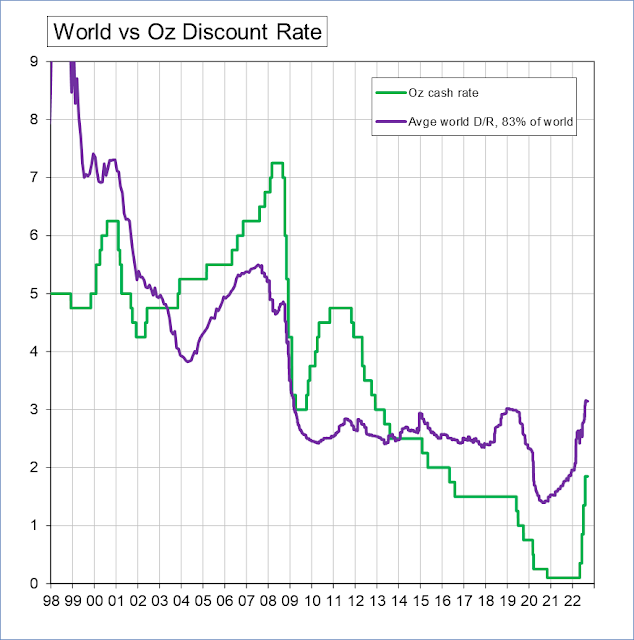
The consensus is that house prices won't fall very much further.  But then at the peak in prices, the consensus was that prices wouldn't fall.  The cash rate has gone from near zero to 1.85%, and is certain to rise again.  But it's not just that --- our economy is very likely to go into recession, and wages are rising much more slowly than inflation.  Bad news for house prices.


Sunday, June 5, 2022

Tower of power

 From The Guardian


Australia’s first office tower with a “solar skin” is expected to be built next year in a landmark moment for the construction industry and decarbonisation efforts.

The eight-storey building at 550-558 Spencer Street in West Melbourne will cost $40m and has been designed by the architecture firm Kennon on behalf of Dr Bella Freeman.


It will be covered by 1,182 solar panels the same thickness as a regular glass facade.

The system – called Skala – is manufactured by the German company Avancis and relies on a “thin-film PV module” sitting atop a network that channels the electricity generated into the building’s main power supply.

It is capable of producing 50 times the energy of the average rooftop photovoltaic solar array used in residential housing and will eliminate 70 tonnes of carbon dioxide emissions each year.

When complete, the system will supply almost enough power to cover the building’s energy needs. With the addition of extra panels on the roof, the building is expected to have almost no ongoing power costs and will be carbon-neutral after a few years.

As construction relies on heavy machinery, transport and manufacturing processes powered by fossil fuels, many buildings start with a significant carbon footprint, referred to as “embedded carbon”.

The building sector accounts for 39% of CO2 emissions globally. According to the World Green Building Council, cement production contributes to 7% of all emissions globally, while steel production is responsible for between 7% and 9% of emissions.

The architect, Pete Kennon, said the Spencer Street building would pay off its carbon debt and “actually be carbon neutral”, without relying on offsets and other accounting measures.


Sunday, September 13, 2020

Health minister: vaccine in Q1

 From Melbourne's The Age newspaper.


Health Minister Greg Hunt says he’s becoming more hopeful and optimistic there will be a coronavirus vaccine roll out in the first quarter of next year, after trials resumed for the Oxford University vaccine.

The late-stage trials of the experimental vaccine being developed by Oxford and AstraZeneca were suspended last week after an illness in a study subject in Britain.

But a UK expert committee has concluded its investigations and recommended to that trials are safe to resume.

Mr Hunt said the suspension was “an ordinary part of a safeguards process” and it was cause for optimism as it showed the trial was being undertaken cautiously and safely.

“Wherever there is adverse event and people don’t know at the time of the event whether it’s related to the vaccine or not [there is a suspension],” Mr Hunt told Sky News on Sunday morning.

“And it’s obviously been cleared by the independent expert panel, cleared by the regulatory agency in the UK, and the vaccine trial continues.

“We have one of the strongest universities of the world in Oxford, one of the strongest medicine companies in the world in AstraZeneca, and one of the strongest regulatory agencies in terms of the British MHRA – all of which provide safeguards, process, confidence.”

He said he was optimistic that a coronavirus vaccine could be available in the first three months of next year.


A vaccine is essential for a return to normality.  To make it effective, it will need to cover 60% plus of the population, which means millions of doses in Australia and billions worldwide.  When an effective vaccine becomes available, it'll first be given to healthcare workers, then to people in old age homes, then to others who interact with the public or work in places where social distancing isn't possible, and eventually to everyone else.  So, even without the usual lags which are a part of the business cycle, a return to normality could still take many months.  And that's just in rich countries―poor countries don't have the universal health systems or money for widespread vaccination.


Since you're prolly sick of images of vaccines in phials, here's a picture of a Melbourne Victorian/Edwardian terrace house.  From a time when architecture tried to design beautiful buildings instead of buildings which look like prisons or public conveniences.