Showing posts with label nuclear power. Show all posts

Sunday, December 15, 2024

Thorium

 Here's an interesting video about using thorium instead of uranium to provide nuclear power.  Thorium is much, much cheaper than uranium, because there is more of it in the earth's crust and because it is 200 times more productive than uranium.  It is safer, and its waste is radioactive for only a few decades compared to 10,000 years or more for the waste from conventional reactors.  

The video gives no estimates of cost per MWh of output, so it's not clear whether it would be cheaper than conventional uranium-fired nuclear.  Demonstration power stations are due to start running next year (2025) and in 2026, so we shall see.  But don't expect it to make a difference over the next ten years, which is when we need to slash emissions as much as we can to prevent a 2.5 to 3 degrees rise in global temperatures by 2100.


Rubbery nuclear cost estimates

The world’s largest crane lifts a steel dome onto Hinkley Point C’s first reactor building. The cost of building the UK’s latest power plant has soared. Photograph: Ben Birchall/PA


In Australia, the right-wing Coalition ("Liberal"/National Party) opposition, in government when Australia became the first country in the world to abolish a carbon tax, is enthusiastically spruiking nuclear power. Their numbers defy belief.

Here's part of an article from The Guardian:


The primary reason the world is not embracing nuclear energy on a grand scale is simple: cost (although in Japan’s case, it’s also about safety).

The Frontier Economics report, which the Coalition is using to make its case, is written in an opaque way that makes direct comparisons difficult. Essentially, the report admits that the capital cost of nuclear is $10,000/kW, while solar and wind are $1,800 and $2,500 respectively.

So how is it that the Coalition’s modelling suggests that a world where nuclear makes up more than a third of the east coast energy grid could possibly be cheaper?

It’s easy to come up with the answer you want when you base your modelling on rubbery assumptions.

Firstly, we should appreciate that even a $10,000/kW estimate for nuclear is considerably optimistic if we look at the experience of comparable countries over the past decade. The cost at the off-cited Hinkley C plant in the UK has, to date, risen to $27,515/kW. Three others – France (Flamanville 3), Finland (Olkilutoto 3) and the US (Vogtle) – are between $15,000 and $16,900. [In other words, nuclear in the West is a minimum of 7 times as expensive as wind and solar]

Delays have been a key factor in driving up the cost of nuclear power. The longer it takes to build and operate a plant, the higher the cost of finance. The Coalition believes we can overturn national and state legislation and acquire land and planning approvals virtually overnight. And then we’ll just install an ‘off-the-shelf’ nuclear power plant, ready to run.

By its own admission, having to tweak nuclear power plants so they operate at maximum safety and efficiency can blow out build times and costs. It beggars belief that the Coalition claims Australia, which has no nuclear energy capability, could ship, build and integrate into the grid with no challenges, with a 50,000-strong nuclear workforce appearing by magic.

There is no mention of the costs of extending the life of existing ageing coal-fired power stations, or the likelihood that these plants will increasingly fail as they reach end-of-life, raising energy costs as supply falls short and, increasingly, the likelihood of blackouts. And, apparently, nuclear waste can be transported and stored without cost.

The Coalition also argues that, because wind and solar energy are not always “on”, we’ll need to build a lot more capacity, along with transmission and storage. It calls this “overbuild”, but its assumptions have overegged what that need might realistically look like, especially as battery storage becomes cheaper over time (unlike the experience of nuclear) and of longer duration. [Battery pack prices have halved this year]

Finally, to arrive at these rose-tinted costs, the Coalition has had to cut back on estimates of the amount of energy we will demand over the next two decades by almost half what the Australian Energy Market Operator says we need. That’s because it’s assumed we won’t worry about EVs or electrification. 
[This has led the Coalition to claim that this will cut electricity costs by 44%.  They have deliberately confused capital cost with cost per kWh of output. Of course capital costs are 44% lower if you are going to produce 44% less electricity!] This is why the Coalition will undo Australia’s 2030 43% emissions reduction target, which we are set to get very close to, taking us back to our Morrison-era status of global climate pariah. [The Coalition plans to abolish Labor's 43% target] 
And this is the kicker. Under the Coalition’s plan, our modelling shows Australia’s domestic emissions will rise by around one billion – yes billion – tonnes, at a cost of $240bn to the economy, society and environment, based on Infrastructure Australia’s cost of carbon methodology.


Most commentators who are not creatures of the Murdoch media think that this is just a ploy to prolong the use of coal and gas.   If it will take at least 15 years to build out a nuclear fleet, in the meantime we will need to extend the lives of our coal power stations.   Since they are already long in the tooth, and will be very expensive to refurbish, that will mean building new coal power stations.  But new coal in Australia costs 3 times as much per MWh of output as new wind and solar backed up by 4 hours of storage.  Which is why no utility is interested in building new coal power stations.  

In addition, the Coalition hasn't said what they're going to do about rooftop solar.  Rooftop solar, in summer, contributes 16% of total electricity supply, beating out all other sources except black coal.  Since old-fashioned nuclear power stations can't easily be ramped up or down, i.e., they're always "on", rooftop solar output will have to be curtailed to allow nuclear to keep running.  In other words, the money millions of people have spent installing rooftop solar to save on electricity bills will be wasted.  Not a winning proposition, for sure.

Sunday, July 14, 2024

Ball Gates's Natrium Reactor

 A nice summary from Sabine Hossenfelder of the new sodium-cooled reactor, plus also a detour to explain why you can ramp conventional nuclear up and down (slowly), but it's not very efficient to do so.  

Sodium-cooled reactors are simpler and safer than conventional reactors.  According to TerraPower's website, its reactor will be 3 times as efficient as light-water reactors, and produce 40% less waste.  It operates at atmospheric pressure instead of being highly pressurised, so should be much safer.    They're also promising much faster construction – 36 months from nuclear concrete pour to fuel load.  Compare that with the 15–20 years large conventional reactors take.  It will also use 50% less safety-related concrete, steel and labour.  In other words, it's likely to be much cheaper than conventional reactors.

Concentrated solar power (CSP) came unstuck because the tanks cracked because of the expansion and contraction as molten salt was fed in and then withdrawn.  So this new reactor will face the same problem.   Vast Solar (now Vast Energy), an Ozzie start-up, claims it has solved this problem (see my piece:  Concentrated solar power revived?)  Perhaps they're talking to each other?


Sunday, June 23, 2024

Why offshore wind is a good fit

 (Background:  The Australian right-wing coalition of the so-called Liberals and the so-called Nationals has decided to go all out for nuclear.  They knew perfectly well that new nuclear power stations won't be up and running for 20 years, though they deny this.  The real reason they "support" nuclear is because, in the meantime, we'll need to build lots more fossil fuel plants to generate electricity, because our aging coal power stations will be shuttered before nuclear comes on stream.  They've also said that they'll cap large-scale renewables.)


From The Conversation.


On the weekend, an area 20km off the Illawarra coast south of Sydney became Australia’s fourth offshore wind energy zone. It’s the most controversial zone to date, with consultation attracting a record 14,211 submissions – of which 65% were opposed.

The zone’s declaration has inflamed fierce debate over the pathway to decarbonisation, particularly in industrial regions. The Illawarra hosts heavy industries such as Australia’s largest steel manufacturer, BlueScope Steel.

In response to the announcement, National Party Leader David Littleproud declared Australia doesn’t need “large-scale industrial windfarms”. He argues the focus should instead be on household solar and battery storage.

So what is the role of offshore wind in our future energy mix? Here we argue offshore wind energy has three main advantages: scale, availability and proximity. It’s just what Australia needs.

1. Scale


Offshore wind has substantial energy-production potential. A single 100-turbine project is capable of generating up to 1.5 gigawatts (GW) of energy and the Illawarra zone could contain two projects (2.9GW).

To put this in perspective, Eraring, Australia’s largest coal-fired power station near Lake Macquarie in New South Wales, also produces 2.9GW.

Because offshore wind is more consistent than either onshore wind or rooftop solar, it is the most practical way to provide time-sensitive renewable energy grid security for large energy users.

This high-capacity, consistent energy source is particularly crucial for Australia’s industrial decarbonisation efforts. BlueScope Steel, for example, estimates it will need approximately 15 times its current energy consumption to transition to green steel-making operations in the Illawarra region.

2. Availability


Offshore wind blows more consistently than onshore wind. We can quantify this by comparing so-called “capacity factors”.

The capacity factor is the actual output of a power station over a given period of time, divided by the theoretical power that could be generated if the plant operated at full output for the same period of time.

Onshore wind has a capacity factor of 30%, meaning 1GW of onshore wind farms can be relied upon to deliver 0.3GW of output at any time.

Offshore wind has a capacity factor of at least 50%.

For reference, coal plants in Australia, due to their age and condition, have a capacity factor of 60% and this falls further every year.

It is a common myth that coal is reliable. The reliability of Australian coal fired generators is currently at an all time low and falling.

The Coalition’s plan for nuclear power plants announced on Wednesday might look like an alternative answer to the energy availability challenge. But the plan relies on coal in the meantime and coal-fired power plants have a limited lifespan. It’s highly unlikely those nuclear power stations could be built in time to take over from coal.

The International Atomic Energy Agency publishes a step-by-step guide to going nuclear. This internationally recognised manual says it takes 10–15 years for a country to go from initial consideration of the nuclear power option to operation of its first nuclear power plant.

So the first big problem with nuclear in Australia is, how do we ensure we have reliable power for the five to ten year gap between when most of the coal exits and the first nuclear power plant could possibly be commissioned?

3. Proximity


Most of Australia’s population and industry is near the east coast. Placing electricity generation near to where it is needed is more efficient. It also avoids having to construct many kilometres of new overhead electricity transmission lines to connect onshore wind farms far inland.

Australia is leading the world in the uptake of home solar panels and batteries. This is definitely worthwhile. But contrary to Littleproud’s suggestion, it’s not the whole solution to Australia’s decarbonisation effort. For example, it won’t solve the problem of the need to electrify heavy industry.

BlueScope has stated that to decarbonise its current steel-making operations, it will need 15 times more electricity. This is the equivalent of the solar exported by a staggering 3.6 million homes – more than one-third of the total number of homes connected to the National Electricity Market.

Putting this into perspective, the Illawarra region has 130,000 homes. By our calculations, the BlueScope steelworks currently uses the same amount of electricity each day as the total solar exported by 240,000 homes – assuming generous export of 10kWh per home and Bluescope’s daily use of 240,000 kWh of energy.

Even if the Illawarra had enough homes exporting solar power to electrify BlueScope’s operations, getting this electricity to where it’s needed is technically impossible. Home solar systems are connected to the lowest capacity part of the energy grid – the wires in the street. We simply don’t have the capacity to move gigawatts of power from rooftop solar to large energy users such as steel and aluminium plants.


Australia needs large-scale energy, including wind


Australia needs large-scale electricity generation. The Coalition has recognised this, and is now promoting large nuclear power plants as well as small modular reactors.

The clean energy transition requires multiple renewable energy sources to meet different needs. There is no “one size fits all” solution – and there is clearly an important role for offshore wind in this mix.

We can expect to see Australia’s first offshore wind farms operating in Victoria’s Gippsland by the end of the decade.

The Coalition remains committed to the Gippsland project. But it has signalled its intention to scrap proposed offshore wind zones in the Illawarra and Hunter, if elected.

This decision would have flow-on effects. An industry is emerging around the pipeline of potential wind energy projects. The latest announcement will almost certainly heighten tensions surrounding the already bitter debates raging in our communities.


Source: Australian National University


Sunday, May 28, 2023

Big project cost overruns

 We all know how often big projects end up costing much, much more than the original plans.  But how much more?  


This toot from Kees van der Leun  references a study which has actually measured this.   Fascinating.


Average cost overrun for new power plants:
Nuclear 120%
Hydro dams 75%
Fossil 16%
Wind 13%
Solar 1%

The table is from p. 192 in How Big Things Get Done.-done-book


Via author @bentflyvberg on the birdsite.


Click on graphic to see clearer image

 Nuclear reactors usually end up costing 2 to 3 times as much as they were supposed to, rail projects 1.4 to twice as much, and so it goes.    the book looks really interesting.

Sunday, May 21, 2023

Nuscale SMR costs jump to $119/MWh

From IEEFA


Last week, NuScale and the Utah Associated Municipal Power Systems (UAMPS) announced what many have long expected. The construction cost and target price estimates for the 462-megawatt (MW) small modular reactor (SMR) are going up, way up.

From 2016 to 2020, they said the target power price was $55/megawatt-hour (MWh). Then, the price was raised to $58/MWh when the project was downsized from 12 reactor modules to just six (924MW to 462MW). Now, after preparing a new and much more detailed cost estimate, the target price for the power from the proposed SMR has soared to $89/MWh.

Remarkably, the new $89/MWh price of power would be much higher if it were not for more than $4 billion in subsidies NuScale and UAMPS expect to get from U.S. taxpayers through a $1.4 billion contribution from the Department of Energy and the estimated $30/MWh subsidy in the Inflation Reduction Act (IRA).

It also is important to remember that the $89/MWh target price is in 2022 dollars and substantially understates what utilities and their ratepayers actually will pay if the SMR is completed. For example, assuming a modest 2% inflation rate through 2030, utilities and ratepayers would pay $102 for each MWh of power from the SMR—not the $89 NuScale and UAMPS want them to believe they will pay.

The 53% increase in the SMR’s target power price since 2021 has been driven by a dramatic 75% jump in the project’s estimated construction cost, which has risen from $5.3 billion to $9.3 billion. The new estimate makes the NuScale SMR about as expensive on a dollars-per-kilowatt basis ($20,139/kW) as the two-reactor Vogtle nuclear project currently being built in Georgia, undercutting the claim that SMRs will be cheap to build.

NuScale and UAMPS attribute the construction cost increase to inflationary pressure on the energy supply chain, particularly increases in the prices of the commodities that will be used in nuclear power plant construction.

For example, UAMPS says increases in the producer price index in the past two years have raised the cost of:
  • Fabricated steel plate by 54%
  • Carbon steel piping by 106%
  • Electrical equipment by 25%
  • Fabricated structural steel by 70%
  • Copper wire and cable by 32%

In addition, UAMPS notes that the interest rate used for the project’s cost modeling has increased approximately 200 basis points since July 2020. The higher interest rate increases the cost of financing the project, raising its total construction cost.

Assuming the commodity price increases cited by NuScale and UAMPS are accurate, the prices of building all the SMRs that NuScale is marketing—and, indeed, of all of the SMR designs currently being marketed by any company—will be much higher than has been acknowledged, and the prices of the power produced by those SMRs will be much more expensive.

Finally, as we’ve previously said, no one should fool themselves into believing this will be the last cost increase for the NuScale/UAMPS SMR. The project still needs to go through additional design, licensing by the U.S. Nuclear Regulatory Commission, construction and pre-operational testing. The experience of other reactors has repeatedly shown that further significant cost increases and substantial schedule delays should be anticipated at any stages of project development.

The higher costs announced last week make it even more imperative that UAMPS and the utilities and communities participating in the project issue requests for proposal (RFP) to learn if there are other resources that can provide the same power, energy and reliability as the SMR but at lower cost and lower financial risk. History shows that this won’t be the last cost increase for the SMR project.


The problem with this analysis is that renewable costs have also risen (see chart from Lazards' latest LCOE calculations below).  Supply chain difficulties because of Covid, the Ukraine War, China's Covid lockdowns, "onshoring" (returning manufacturing to your own country, to reduce supply chain difficulties) and rising interest rates have increased wind and solar costs for the first time in decades.   And, presumably, as we improve the supply chain, these costs will fall.   Also, if more NuScale's SMRs can be built, unit costs will fall, in a classic learning curve feedback loop.

We may well need SMRs at high latitudes, while SMRs even in lower latitudes will add to grid security, because the more different sources of electricity available to the grid, the more balanced and secure it is.  It would be a pity not to at least try NuScale's SMRs, given the strong possibility that component prefabrication will cut costs compared to the hugely expensive giant nuclear power plants which are a decade behind schedule everywhere.  

I have said before that if nuclear is necessary for de-carbonising the world's electricity grid, I would grit my teeth and support it, because the climate emergency is so severe.  But the problems with nuclear remain:  expense and delay.  This SMR will only start operating in 2030, if there are no further delays.  By then, if we are to avoid an increase in global temperatures since pre-industrial times of more than 1.5 degrees C, we will need to have increased the share of renewables in the grid to 80%.  The last 20% will be the hardest to de-carbonise.   SMRs may be necessary for that.   

Source: Lazards
Click on graphic to see clearer image


Sunday, August 14, 2022

Nuscale's SMR reactors get much more expensive

SMR stands for Small Modular Reactor, and the argument was that because all the parts can be built on an assembly line in a factory, SMRs should produce much cheaper electricity than the giants we have tended to build so far.  Unfortunately, estimated costs have more than doubled in 5 years.


From a tweet by @NuclearEngnrng


Estimated cost of NuScale 12-pack SMR is $6.1B in 2020, was $3.6B in 2017.

Estimated cost of NuScale 6-pack is $5.3B in 2022.

HT for chart: @ecopolitain


The chart doesn't estimate the LCOE, but in 2017 Nuscale estimated it at below $60/MWh. Estimated costs have doubled, so that suggests $120/MWh now.  That may still be acceptable if nuclear turned out to be necessary for the last 10% of de-carbonisation of the grid.

Wednesday, August 3, 2022

Renewable additions vs Nuclear

 From  Twitter thread by David Mitchell, founder of FindMyEV.com.au


Some one wanted a “normalised” graph of renewable additions vs nuclear. Here it is. Normalised against global population (kWh/capita). It’s not in kW because it’s not capacity, it’s production. So it’s global electricity production additions per capita, hence in kWh, [added production per person per year]


Renewables are in a classic exponential curve.
Nuclear peaked in the 80s and has been falling ever since.


Here are the IEA's data and forecasts for annual contributions to electricity demand, in TWh

Global changes in electricity generation, 2015-2024
yellow = renewables; green = gas; dark blue = coal; light blue = nuclear
Observe how *all* incremental electricity demand in 2024 is met via wind, solar and nuclear
See original chart here
I don't know why IEA thinks the additional renewables supply will be falling from 2022 to 2024.
Given the shock to the system from Russia's attack on Ukraine, I would have expected rollout of renewables to accelerate, not slow.


Sunday, June 26, 2022

French nuclear under threat from global heating


 From ClimateCrocks


In France, much vaunted nuclear capacity has been hit by the discovery of widespread corrosion problems in critical systems, and many plants have been shut for repairs. Now as summer arrives, the rivers relied on for cooling the massive, inefficient systems have warmed rapidly, further derating reactors. 
Across the planet, climate impacts are putting more pressure on energy generators.

New York Times:


Inspections unearthed alarming safety issues — especially corrosion and faulty welding seals on crucial systems used to cool a reactor’s radioactive core. That was the situation at the Chinon atomic plant, one of France’s oldest, which produces 6 percent of EDF’s nuclear power.

EDF is now scouring all its nuclear facilities for such problems. A dozen reactors will stay disconnected for corrosion inspections or repairs that could take months or years. Another 16 remain offline for reviews and upgrades.

Others are having to cut power production because of climate change concerns: Rivers in the south of France, including the Rhône and the Gironde, are warming earlier each year, often reaching temperatures in the spring and summer too warm to cool reactors.

Today, French nuclear production is at its lowest level since 1993, generating less than half the 61.4 gigawatts that the fleet is capable of producing. (EDF also generates electricity with renewable technologies, gas and coal.) Even if some reactors resume in the summer, French nuclear output will be 25 percent lower than usual this winter — with alarming consequences.

Monday, June 6, 2022

Why are coal supporters so keen on nuclear?

 From The Guardian

I think it's because they know how long nuclear plants will take to build.  While they're being built, we will (they think) have to go on using fossil fuels.   But then I'm a bit cynical.

The Coalition didn’t do much on nuclear energy while in office. Why are they talking about it now?

Last week, the Nationals’ new leader, David Littleproud, said it was time for Australia to have a “mature” conversation about nuclear energy while his predecessor, Barnaby Joyce, called for a national moratorium to be lifted and argued nuclear power would be “really important” if the country was serious about reaching net zero emissions. [The National Party was one of the parties in the former Coalition government in Australia which is strongly in favour of coal power and against renewables]

Advocates [for nuclear] have acknowledged nuclear power is the most capital-intensive energy technology, takes the longest time to recoup on investment and has not benefited from the economies of scale experienced in solar and wind energy. Costs have increased as technology has advanced.

Despite the global push to cut greenhouse gas emissions, the large-scale nuclear energy industry is going backwards. More units closed than opened in 2020. Construction began on only five reactors; four of those were in China, which is investing in all energy types. Excluding China, global nuclear generation is at its lowest level in 27 years.

The few major plants under construction in developed democracies have suffered years of delays and cost blowouts. In the UK, the Hinkley Point C station – the country’s first new nuclear plant in decades – is running 10 years behind schedule and is expected to cost at least A$45bn, nearly 50% more than initially expected. [The Vogtle 3 and 4 reactors in Georgia, USA, have more than doubled in cost and still aren't completed

What about SMRs?


At this point they barely exist.

SMRs are proposed to be 60 and about 200 megawatts, a fraction of the size of the traditional nuclear plant. Proponents say they would employ similar technology used in nuclear-powered submarines and icebreakers and would be easier to keep safe than bigger plants.

But a report by the World Nuclear Industry last year found talk and media coverage about SMRs was “not reflected by any major industrial achievements on the ground”.

It said SMRs in China and Argentina had been beset by delays. There had been no concrete steps towards construction anywhere else except Russia – which is pursuing a model that barely qualifies as an SMR, is years behind schedule and does not have the regulatory process expected in developed countries.

In South Korea, an SMR model was approved in 2012 but there had been no orders because it costs too much. Plans in the US had stalled; a government-backed model by the company NuScale was approved by the safety regulator, but the design was later changed and several municipalities dropped plans to host them. Backers agree that no reactors are expected before 2029 at the earliest.

The industry report concluded there was growing evidence that “SMRs, like large reactors, will continue to be subject to delays and cost overruns and the high likelihood that they would not be economical even under the most favourable circumstances”.

Is nuclear power needed in Australia?


It is a different story in some other countries, but there are plenty of analyses that say nuclear isn’t necessary here given the range of available energy options.

For example, the Australian Energy Market Operator’s integrated system plan – a blueprint for an optimal future grid – lays out a vision under which the country would run overwhelmingly on solar and wind, supported by better transmission links and backed by “firm” capacity that can be called on when needed: batteries, pumped hydro, some gas (at least initially) and demand management.

Cost is the key issue. While estimates are difficult, CSIRO’s latest analysis of different energy costs suggested SMRs would be far more expensive than solar and wind energy and at least as expensive as fossil fuel power with carbon capture and storage, which has not proven economically viable.

Why does the case for nuclear energy persist?


There is an assumption by some people, including Coalition MPs [the coal-supporting party in Australia], that renewable energy cannot do the job, despite the expert advice that says otherwise. These critiques rarely address that advice head on.

But there is also a long history of nuclear energy being used as a delaying tactic for acting on climate change in Australia, including by fossil fuel interests.

It is possible SMRs could play a role globally beyond 2030, but anyone arguing for them in Australia should be asked why they disagree with the nuclear advocates who say otherwise – and why [their] efforts aren’t better directed into backing zero-emissions technologies that are affordable and available now.


Sunday, May 29, 2022

EU's renewable energy ambition

From EMBER


The G7 has already agreed to cut reliance on Russian energy. Last Wednesday, Europe came forward with its plan to cut Russian energy imports. The new plan, dubbed REPowerEU will, when combined with existing green measures, enable Europe to save €100 billion each year on gas, oil and coal imports, the EU executive said. Under the plan, Russian gas usage will be reduced by two thirds by the end of 2022.

REPowerEU has three major elements: energy savings, boosting renewables, and diversifying European supplies of oil and gas. It promises investment of €300 billion by 2030, of which only 3% (€10 billion) is for fossil fuel diversification, and the remaining 97% (€290 billion) is for clean energy investment.

The EU increased its 2030 target to get 45% of all its energy from renewables, up from the previous 40% target. For the power sector, 69% of electricity needs will come from renewables (previously the implicit target was 65%). Most of this increase is from building more wind and solar. When nuclear power is included, an estimated 87% of Europe’s electricity is expected to be clean by 2030, up from 63% in 2021.

This should help propel Europe’s grids towards 100% clean power by 2035, aligning with Biden’s pledge of 100% clean power by 2035. In May 2021, the G7 agreed to “commit to achieve an overwhelmingly decarbonised power system in the 2030s”. This year the G7 could be positioned to push that wording further to commit to 100% clean power by 2035, but an open question is where Japan stands on that target.

Last week, Japanese coal prices set a record high, as the Asian-benchmark Newcastle coal traded at an all-time high of $442 per tonne. That’s four times the price it was only 12 months ago. Meanwhile, Japan’s gas LNG import price (JKM spot price) has receded from its high, but is still $20/mmbtu, which is twice the level 12 months ago.

Japan has already committed to cut reliance on Russian energy. With sky-high fossil fuel prices, an accelerated transition from coal and gas electricity to clean electricity makes more sense now than ever.

Japan is behind in its electricity transition. In 2021, the country had half the proportion of clean electricity compared to the EU, and 11% wind and solar generation compared to the EU’s 19%. If implemented, the Ministry of Economy, Trade and Industry’s (METI) Strategic Energy Plan from October 2021 shows Japan’s clean power will actually rise faster than the EU. However, this is only because Japan plans to reactivate many of its idled nuclear reactors.

Compared to Japan, the rise in EU renewables is planned to be meteoric. In the next nine years, the EU is forecast to move an additional one third (32%) of its total electricity production to renewables. Japan’s plan is for only a 13% shift.

If Japan embraces the same momentum on clean power as the EU, could it be enough to put Japan on target for 100% clean power by 2035?

This will depend on the extent of ambition for solar and wind. The EU targets commit it to about 52%. However, METI is projecting just 20% for Japan. In the IEA’s “Achieving Net Zero Electricity Sectors in G7 Members”, wind and solar reach 42% of G7 electricity generation in 2030.

The latest set of 1.5-aligned scenarios used by the IPCC broadly align with the IEA’s milestones of 40% of solar and wind by 2030, and needing near-100% clean power in the OECD by 2035. Here’s what Japan can do to meet these targets:

Solar: The EU is planning 750 GW (DC) of solar by 2030, which means 64 GW per year from 2021 to 2030. Central to this plan is building new rooftop solar. The EU proposes making solar panels mandatory for all public and new residential buildings by 2025 and 2029, respectively. As a result, rooftop solar will make up over half the EU’s total solar capacity by 2030.

By contrast, Japan last year installed only 6 GW of solar, according to IEA data, which is a tenth of the EU projected build-rate. Only one tenth of Japan’s solar went onto rooftops, with the vast majority of solar additions in the form of solar farms. This ignores what has been the bedrock of Australia and now the EU’s approach to expanding their solar capacity. It also means that Japan has a significant opportunity to tap into the potential for rooftop solar, just as the EU is now planning to do. The EU’s ambition on rooftop solar shows that the current perception that Japan is doing everything it can to expand renewables is incorrect.

What’s more, the costs for rooftop solar are not high. The latest results for Germany’s rooftop solar auctions on 15 May 2022 were for prices of $90 (€85) per megawatt hour. The price was 23% higher than the first auction in July 2021, as international inflation pushed up costs. However, compared to coal and gas price rises, renewables are deflationary. Expanding Japan’s rooftop solar industry represents an incredible untapped opportunity to further increase the security and sustainability of Japan’s energy system.

Wind: For onshore wind, Germany is planning to set aside 2% of the country’s landmass for the development of onshore wind energy. For offshore wind, just four EU countries – Belgium, Denmark, Germany, and the Netherlands – have announced an offshore wind target of 65 GW by 2030. A further 50 GW is promised from the UK alone by 2030, including floating wind. Combined, that’s more than ten times Japan’s current 10 GW target, announced back in 2020.

The global electricity transition is ramping up. The EU is aiming for 80%+ clean electricity by 2030 with its new renewable energy targets.

In the lead-up to the G7, many will ask if it is possible for Japan to achieve a 100% clean energy system by 2035. While this target will certainly be a challenge, it is definitely achievable. The obvious place to start is scaling up rooftop solar and wind energy, which could help Japan create a far more secure and sustainable energy system by 2035.

Japan can reach a target of 100% clean power by 2035. Setting this target at the G7 in June would also send a powerful message to the global community that Japan is focussed not just on an efficient energy system, but on rapidly scaling up renewables in a manner that would increase long term energy security and keep costs low.


Thursday, March 31, 2022

Hydrogen-boron fusion demonstration hugely successful

 I've talked about this before, when it was still in the planning stage.  Now it's actually being tested.  This is by far the most promising fusion process I've seen.

(From New Atlas)

[The Australian company,] HB11 is approaching nuclear fusion from an entirely new angle, using high power, high precision lasers instead of hundred-million-degree temperatures to start the reaction. Its first demo has produced 10 times more fusion reactions than expected, and the company says it's now "the only commercial entity to achieve fusion so far," making it "the global frontrunner in the race to commercialize the holy grail of clean energy."

We've covered Australian company HB11's hydrogen-boron laser fusion innovations before in detail, but it's worth briefly summarizing what makes this company so different from the rest of the field. In order to smash atoms together hard enough to make them fuse together and form a new element, you need to overcome the incredibly strong repulsive forces that push two positively-charged nuclei apart. It's like throwing powerful magnets at each other in space, hoping to smash two north poles together instead of having them just dance out of each other's way.

The Sun accomplishes this by having a huge amount of hydrogen atoms packed into a plasma that's superheated to tens of millions of degrees at its core. Heat is a measure of kinetic energy – how fast a group of atoms or molecules are moving or vibrating. At these temperatures, the hydrogen atoms are moving so fast that they smack into each other and fuse, releasing the energy that warms our planet.

Most fusion reactor designs aim to replicate these conditions, by magnetically confining hydrogen atoms in a plasma, and then using gyrotrons and other specialized equipment to create small pockets of insane temperatures – over 100 million °C (180 million °F) – in which they hope they'll get enough random collisions between nuclei to create a chain reaction. This is the basic idea underpinning the multi-billion dollar stellarator and tokamak projects that have dominated fusion research for decades.

HB11 is using a different approach that's closer to a snooker shot. It doesn't require huge amounts of heat, or tricky, radioactive fuels like tritium. Instead, it takes advantage of recent advances in ultra-high powered "chirped pulse amplification" lasers that can produce monstrous, unprecedented power levels over 10 petawatts.

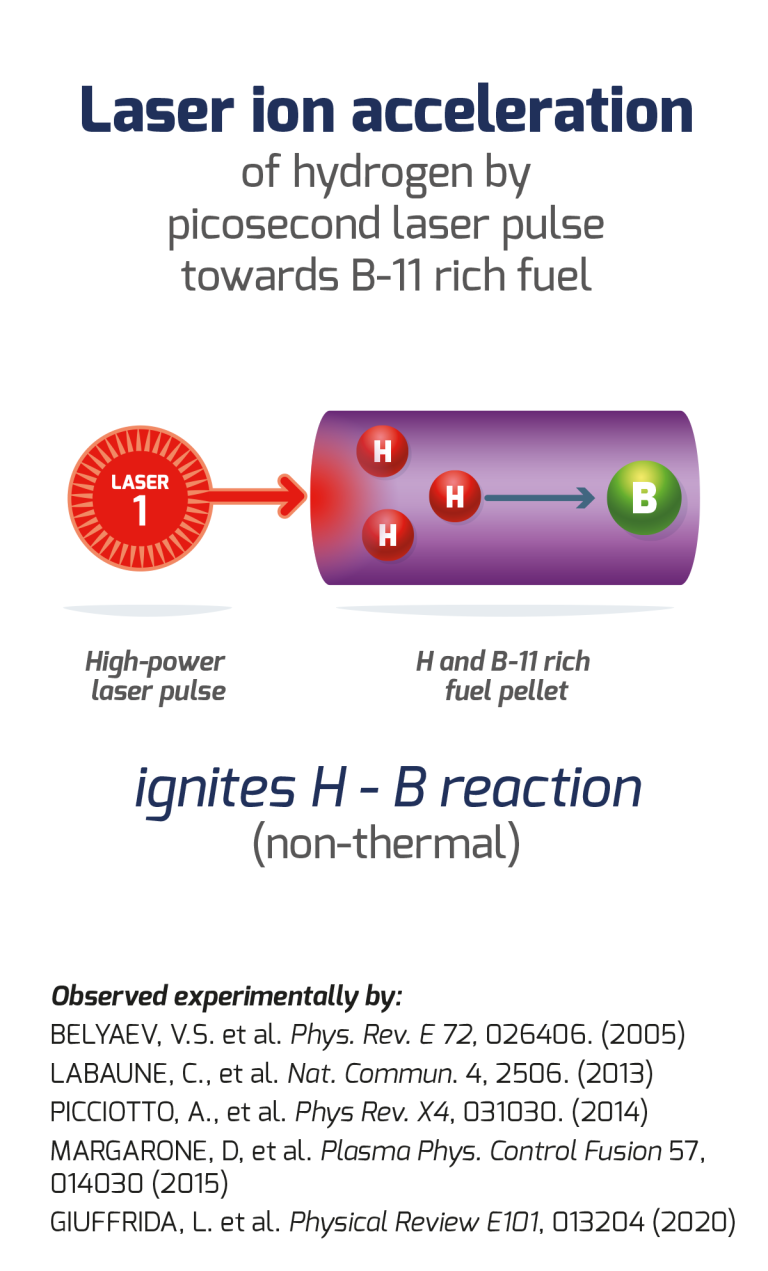
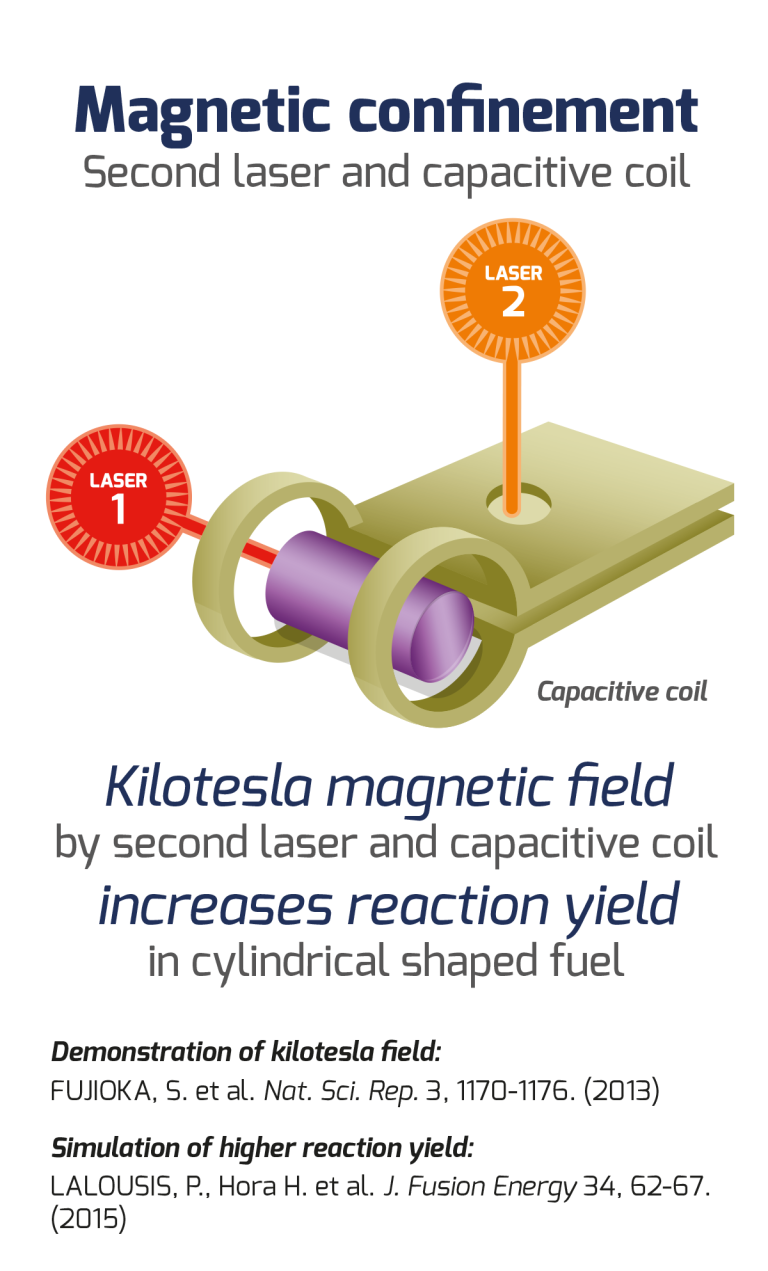
An HB11 reactor would be a mostly empty metal sphere, with a "modestly sized" boron fuel pellet held in the middle, and apertures in two spots on the sphere for a pair of lasers. One laser, in combination with a capacitive coil, is used to establish a powerful kilotesla magnetic containment field for the plasma, and the second is used to massively accelerate hydrogen atoms through the boron sample. So you're not heating things up in the hope that they'll smack together at speed, you're literally aiming the hydrogen right at the boron and using these bleeding-edge lasers to make it go so fast that it'll fuse if it hits a nucleus.

Hydrogen-boron fusion doesn't create heat, it merely creates "naked" helium atoms, or alpha particles, which are missing electrons and thus positively charged. HB11 plans to simply collect that charge to create energy, rather than needing to superheat steam and drive lossy turbines. No nuclear waste is created.

Initial experiments on laser-triggered chain reactions returned reaction rates a billion times higher than anticipated, leading HB11 to claim in 2020 that it "stands a high chance of reaching the goal of net energy gain well ahead of other groups."

"As we aren’t trying to heat fuels to impossibly high temperatures, we are sidestepping all of the scientific challenges that have held fusion energy back for more than half a century,” HB11 Managing Director Dr. Warren McKenzie told us at the time. “This means our development roadmap will be much faster and cheaper than any other fusion approach."

You can see why this is a very exciting company to keep an eye on, and today's news lends further academic credibility to the idea. In a new research study, led by HB11 Energy Lead Scientist Dimitri Batani and collaborator Daniele Margarone and funded by the Czech Republic's Ministry of Education, Youth and Sports and the EU's EUROfision consortium, HB11's technology has been demonstrated at Osaka University's Institute of Laser Engineering.

The study, published in the peer-reviewed journal Applied Sciences, showed what HB11 claims is a "world-first 'material' number of fusion reactions by a private company, producing ten times more fusion reactions than expected based on earlier experiments at the same facility."


STEP 1: shoot hydrogen into boron fuel


STEP 2: keep result confined by powerful magnet


STEP 3: increase reaction


STEP 4:utilise charged He ions to generate electricity


Friday, March 11, 2022

Micro nuclear reactors

I've already talked  about the small nuclear reactors NASA has developed for use in space and on Mars, called KRUSTY.  These will produce 1 kW of power, with the scaled-up version producing 10 kW.   I've also mentioned small modular reactors, here.

Ex-SpaceX engineers are developing a micro, portable nuclear reactor that can produce 1 MW of electricity, 100 times more than the scaled up version of NASA's KRUSTY nuclear reactor, designed to portable on the back of a lorry and with safety features allegedly making it much safer than the behemoths that catastrophically melted down at Chernobyl and Fukushima.  Since the company is still in the process of acquiring patents, there aren't many details.  

For me, one of the interesting aspects of this development is that SpaceX seems to have a division designing small nuclear reactors for use on Mars.  And on Starship?  No wonder SpaceX's latest video update about Starship shows it journeying to Mars without deploying solar panels!  

Using helium as a coolant certainly reduces the risk of explosions.  No mention of how nuclear waste is to be disposed of, though.

It's intriguing to see lots of private sector companies producing new designs for nuclear fission reactors.  The old super large designs seem to have got stuck in an expensive cul-de-sac.  Nuclear reactors will be very useful right here on Earth, if they can be made cheap enough and safe enough, as a complement to renewables in our electricity grids.  Lots of competing designs and companies might get us there quicker than large government bureaucracies, with both nuclear fission and fusion.


From New Atlas

California company Radiant has secured funding to develop a compact, portable, "low-cost" one-megawatt nuclear micro-reactor that fits in a shipping container, powers about 1,000 homes and uses a helium coolant instead of water.

Founded by ex-SpaceX engineers, who decided the Mars colony power sources they were researching would make a bigger impact closer to home, Radiant has pulled in US$1.2 million from angel investors to continue work on its reactors, which are specifically designed to be highly portable, quick to deploy and effective wherever they're deployed; remote communities and disaster areas are early targets.

The military is another key market here; a few of these could power an entire military base in a remote area for four to eight years before expending its "advanced particle fuel," eliminating not just the emissions of the current diesel generators, but also the need to constantly bring in trucks full of fuel for this purpose.

Those trucks will still have to run – up until the point where the military ditches diesel in all its vehicles – but they'll be much less frequent, reducing a significant risk for transport personnel.

Radiant says its fuel "does not melt down, and withstands higher temperatures when compared to traditional nuclear fuels." Using helium as the coolant "greatly reduces corrosion, boiling and contamination risks," and the company says it's received provisional patents for ideas it's developed around refueling the reactors and efficiently transporting heat out of the reactor core.

Radiant joins a number of companies now working on compact nuclear reactors, and a smaller number focusing specifically on portable units, which would include the floating barges proposed for mass-manufacture by Seaborg. It'll be a while before we see one up and running, but a clean, convenient, low-cost, long-life alternative to diesel generators would be very welcome.


Sunday, January 23, 2022

Despite risks & cost, most states want more nuclear

 From EcoWatch


A new survey by The Associated Press has found that about two-thirds of the 50 states analyzed mention nuclear energy in their energy policies. The remaining third, and Washington, DC, do not plan to incorporate nuclear energy, but instead rely on renewable energy sources, such as solar power, as well as battery storage and reducing demand for power.

Some officials are concerned that renewable energy sources, like solar and wind, will not generate enough energy to power the country. They say that for a faster transition from fossil fuels, nuclear energy is needed.

To the Biden administration, nuclear is an essential component for moving away from fossil fuels. U.S. Energy Secretary Jennifer Granholm told The Associated Press that the Biden administration has a goal to reach zero-carbon electricity, and to reach that target, “that means nuclear, that means hydropower, that means geothermal, that means obviously wind on and offshore, that means solar.″

In its recent $1 trillion infrastructure package, the Biden administration has included $2.5 billion to invest in advanced reactor demonstration projects. Advanced reactors may use gas, liquid metal, or other materials aside from water to cool the core.

But nuclear power is controversial and risky. While nuclear power plants don’t produce carbon emissions, they do require the mining and refining of uranium ore, which requires a lot of energy and produces emissions. Used reactor fuel from nuclear power plants is also radioactive and remains hazardous for thousands of years.

Edwin Lyman, director of nuclear power safety at the Union of Concerned Scientists, also noted that smaller reactors may be cheaper to build, but the electricity they produce will be more expensive for consumers. As the market expands, Lyman is also concerned that the industry will potentially take shortcuts on safety in order to save money.

“I’m not optimistic we’d see the kind of safety and security requirements in place that would make me feel comfortable with the adoption or deployment of these so-called small modular reactors around the country,” Lyman told The Associated Press.

And while the U.S. is planning for more reactors, it currently has no long-term solution for storing the radioactive waste. If the waste or reactors are mishandled or targeted in an attack, the results would be catastrophic.

Currently, the U.S. is the largest producer of nuclear energy in the world, responsible for more than 30% of all nuclear electricity generation, as reported by the National Resources Defense Council (NRDC). In the country, one-fifth of all electricity comes from nuclear power, and more states plan to incorporate this energy source in the near future despite the risks.

“New nuclear plants are more expensive and take longer to build than renewable energy sources like wind or solar,” Greenpeace said on its website. “If we are to avoid the most damaging impacts of climate change, we need solutions that are fast and affordable. Nuclear power is neither.”


There are three key problems with nuclear as a solution to global warming:

  1. Nuclear power plants take years to build, and most are way behind plan.  We need to slash emissions now, not in 15 years.  Even the much-vaunted Small Modular Reactors (SMRs) are 5 years (before inevitable delays) away from commercialisation, let alone construction.
  2. Nuclear waste remains an unsolved problem, and even if we could deal with that, there remain risks, as Chernobyl and Fukushima have shown.
  3. Even ignoring the first 2 issues, nuclear is much more expensive than renewables.  In a state closer to the equator, nuclear is 5 times as expensive as solar plus storage.  In high latitude regions and countries, such as Finland, Canada, Norway, northern Russia and China, nuclear may be relatively less expensive.  May be.  But at these latitudes, wind is an excellent renewables resource.


Saturday, January 22, 2022

Price tag for Vogtle reactors surges past $30 billion

 From IEEFA


Once estimated at more than $14 billion, the price tag for two new reactors at Georgia Power Company’s Plant Vogtle site has now climbed past $30 billion, and both units will be more than six years late in coming online, according to a report by the Institute for Energy Economics and Financial Analysis.

The Georgia Public Service Commission staff and its nuclear consultants have attributed the project’s massive cost overruns and repeated delays to Georgia Power’s adoption of unreasonable and unachievable construction schedules, as well as its attempts to achieve the schedules at any cost. The issues have been blamed on a corporate culture that values production over quality; poor or non-existent quality inspections; high personnel turnover; and high testing failure rates for an unproven reactor design.

“The company was warned back in 2008 that using a new unproven reactor design from Westinghouse for the new Vogtle reactors was likely to lead to cost overruns and major schedule delays,” said David Schlissel, the report’s author and IEEFA’s director of resource planning and analysis. “However, the company challenged and the commission disregarded these warnings.”

Last year was difficult for the Vogtle project. Even though the project costs have risen rapidly, the projected online date has slipped over the last year at a rate of roughly one month per calendar month of work. As of January 2021, Georgia Power estimated it would need $2.5 billion more to finish building the new reactors. However, after spending $1.9 billion during the first nine months of the year, it increased its estimate for completing the job to almost $2.7 billion.

“There is clear evidence that Vogtle 3 and 4 will be very expensive sources of power,” Schlissel said. “Our analysis found the costs of power from Vogtle 3 and 4 will be five times as expensive as the same amount of electricity obtained from renewable sources, such as a solar-plus-battery-storage facility.”

But Georgia’s utility customers won’t only be paying for the new Vogtle units for the 60 years after they go into service. Customers have already paid more than $3.5 billion in financing costs for the project since 2011, or more than 11 years before either of the new units will produce any electricity for them. The public service commission staff expects the figure will grow to $4 billion by the time the two units are completed.

“Georgia Power has repeatedly misled the public service commission and its staff about the project’s likely cost and schedule and the costs to customers will be extremely high,” Schlissel said. “The commission denied rate recovery for $951 million of the cost overruns at Vogtle 1 and 2; it should deny rate recovery for a much larger share of the far more expensive Vogtle 3 and 4.”


It isn't just Vogtle 3 & 4.  Large GW-scale nuclear power stations are everywhere over budget and delayed.