Showing posts with label offshore wind. Show all posts

Monday, June 1, 2026

Hybrid wind-battery systems better than coal


Loy Yang A power station
Source: AGL

 From RenewEconomy


Hybrid wind and battery projects could cover off almost all of the energy generation and grid services currently provided by Australia’s remaining coal plants, but without the breakdowns or the pollution, and with a bunch of added extras coal plants can’t do.

Daniel Ryan, who is technical lead of future grid at Envision Energy, says the China-based company can “clearly see the value” of hybrid renewables power stations in Australia, where wind and battery energy storage could be integrated behind a single grid connection point.

While grid-coupled solar-battery hybrid projects are all the rage in Australia’s renewables development pipeline at the moment – highly prized for their numerous economic and technological advantages – the wind sector is playing catch-up on this trend.

Ryan says that while Australia has many “renewable power parks” and has also built have some of the world’s largest onshore wind farms, most of the operational wind and battery projects are what he describes as “un-orchestrated;” separate control systems, and “very simplistic.”

Given the lack of operating examples in Australia, Envision has built its own large-scale “living laboratory” in Chi Feng in China, to get a better understanding of what true, AC-coupled wind and battery energy storage systems (BESS) can offer a modern-day grid.

“This is not a pilot or a small demonstration,” Ryan told the 2026 Wind Industry Forum in Melbourne on Tuesday. 

“It’s a self-developed, fully integrated renewable generation system, combining gigawatts of renewables, grid-forming storage, power electronic loads, and high voltage infrastructure.

“Bringing these elements together, we can clearly see the value of coordinated hybrid systems in Australia,” Ryan said.

“By integrating wind and BESS behind a single connection point, we move from a collection of assets to a fully orchestrated power plant.” 

But with an eye to the Australian market, Envision has taken its R&D efforts a step further than the living lab in China to a “thought experiment” based on one of Australia’s largest remaining coal plants.

“To get a better understanding of what a future wind-BESS hybrid generator needs to deliver, we thought that it’s useful to look at what we’re trying to replace,” Ryan told the conference. 

“As we’re based in Victoria, we did a thought experiment on Loy Yang Power Station,” he said, referring to the until recently Alinta Energy-owned Loy Yang B plant in the Latrobe Valley that is likely to one of the last to close, with a 2046 date pencilled in.

“(Loy Yang) delivers a wide range of system services, including around 1.2 gigawatts [GW] of reactive power capability, 10 GVA [giga-volt amperes] of bulk current contribution … and frequency control services; 200-400 megawatts [MW] of contingency and regulation FCAS  [Frequency Control Ancillary Services]. 

“So, the key question becomes, can a wind-BESS hybrid not only replace the energy output but also exceed the system performance of a coal power station?

To replace Loy Yang with a wind-BESS hybrid, Envision landed on a 3.35 GW wind farm paired with a 1 GW grid-forming BESS, which Ryan says reflects the size and scale of projects that are beginning to emerge in markets like Australia. 

“Starting with system services, it’s immediately clear that a wind-BESS hybrid doesn’t just match coal in many areas, it actually exceeds it,” he told the conference. 

Ryan says that on regulation and contingency FCAS [frequency control ancillary services] the BESS would provide two- to six-times as much as Loy Yang – and could also participate heavily in the one-second FCAS market.

The hybrid power station also offers the primary frequency response contribution of the wind farm, Ryan adds, which is “slower, but still very significant due to a scale.” 

“We can conclude, I think, from this that the frequency performance of this power station far exceeds any coal power station,” he told the conference.

“For reactive power capability, the plant gives us around 1300 megavar , which is slightly more than Loy Yang, and should be definitely sufficient for any voltage regulation purposes in the network. 

“And finally, in terms of fault level, this falls a little bit short, of course, of the coal power station,” Ryan says.  

“However, we note that because we have a grid forming desk and a wind farm behind a single connection point, it should still be quite significant at a system level, and I think, as technology provider, we’d argue … that maybe fault level isn’t the best defining characteristic for system strength.

“So, what are the key takeaways with hybrid renewable power plant? You don’t just get around the same performance as a coal power station, but you actually get a lot of other benefits,” Ryan told the conference. 

“You can operate at low SER [specific energy rating], you can perform black start and islanding, and you can operate without power generation. 

“All of these a coal power station usually can’t do.”

For wind industry veteran and Envision Energy’s head of wind in Australia, Peter Cowling, the increasingly urgent need to replace coal with cleaner and smarter hybrid renewables technology is one [of] the “super attractive” fundamentals of the Australian market.

“We have a coal sector that literally must retire at some point, particularly Victoria, given the age of [its] facilities and their emissions intensity,” he told the same conference on Tuesday. 

“The resource is phenomenal, still, by any global standard, and the transition is actually incredibly advanced. There is – despite the difficulties of closing new generation programs – … still extraordinary momentum.

“We’ve obviously got a bunch of transmission and planning issues to resolve, and ultimately cost issues to resolve, to get more electrons being generated … but the projects are there. 

“There’s 60-odd gigawatts of projects. We’ve just got to push those through, and I think we will fairly quickly find ourselves with the opposite problem, which is a crazy boom in two years’ time, where we can’t find enough people and cranes. 

“So …we really do believe the market is going to take off,” Cowling said.

This power station is about 5 k's from where I live.  In this part of the world, though the wind isn't necessarily strong, it's nevertheless still a good location for wind farms, and an even better one for offshore wind farms.  (Mean onshore wind speed is 12.5 kph in the morning and 19.3 kph in the afternoon, and minimum wind speed needed for turbines is 11 kph) And of course, because of the coal power stations, the HVDC [high-voltage direct current] power lines are already installed.  

I hadn't thought that wind needed short-term storage, but I was wrong.  Combining wind with batteries will improve grid stability and reliability.


Sunday, June 23, 2024

Why offshore wind is a good fit

 (Background:  The Australian right-wing coalition of the so-called Liberals and the so-called Nationals has decided to go all out for nuclear.  They knew perfectly well that new nuclear power stations won't be up and running for 20 years, though they deny this.  The real reason they "support" nuclear is because, in the meantime, we'll need to build lots more fossil fuel plants to generate electricity, because our aging coal power stations will be shuttered before nuclear comes on stream.  They've also said that they'll cap large-scale renewables.)


From The Conversation.


On the weekend, an area 20km off the Illawarra coast south of Sydney became Australia’s fourth offshore wind energy zone. It’s the most controversial zone to date, with consultation attracting a record 14,211 submissions – of which 65% were opposed.

The zone’s declaration has inflamed fierce debate over the pathway to decarbonisation, particularly in industrial regions. The Illawarra hosts heavy industries such as Australia’s largest steel manufacturer, BlueScope Steel.

In response to the announcement, National Party Leader David Littleproud declared Australia doesn’t need “large-scale industrial windfarms”. He argues the focus should instead be on household solar and battery storage.

So what is the role of offshore wind in our future energy mix? Here we argue offshore wind energy has three main advantages: scale, availability and proximity. It’s just what Australia needs.

1. Scale


Offshore wind has substantial energy-production potential. A single 100-turbine project is capable of generating up to 1.5 gigawatts (GW) of energy and the Illawarra zone could contain two projects (2.9GW).

To put this in perspective, Eraring, Australia’s largest coal-fired power station near Lake Macquarie in New South Wales, also produces 2.9GW.

Because offshore wind is more consistent than either onshore wind or rooftop solar, it is the most practical way to provide time-sensitive renewable energy grid security for large energy users.

This high-capacity, consistent energy source is particularly crucial for Australia’s industrial decarbonisation efforts. BlueScope Steel, for example, estimates it will need approximately 15 times its current energy consumption to transition to green steel-making operations in the Illawarra region.

2. Availability


Offshore wind blows more consistently than onshore wind. We can quantify this by comparing so-called “capacity factors”.

The capacity factor is the actual output of a power station over a given period of time, divided by the theoretical power that could be generated if the plant operated at full output for the same period of time.

Onshore wind has a capacity factor of 30%, meaning 1GW of onshore wind farms can be relied upon to deliver 0.3GW of output at any time.

Offshore wind has a capacity factor of at least 50%.

For reference, coal plants in Australia, due to their age and condition, have a capacity factor of 60% and this falls further every year.

It is a common myth that coal is reliable. The reliability of Australian coal fired generators is currently at an all time low and falling.

The Coalition’s plan for nuclear power plants announced on Wednesday might look like an alternative answer to the energy availability challenge. But the plan relies on coal in the meantime and coal-fired power plants have a limited lifespan. It’s highly unlikely those nuclear power stations could be built in time to take over from coal.

The International Atomic Energy Agency publishes a step-by-step guide to going nuclear. This internationally recognised manual says it takes 10–15 years for a country to go from initial consideration of the nuclear power option to operation of its first nuclear power plant.

So the first big problem with nuclear in Australia is, how do we ensure we have reliable power for the five to ten year gap between when most of the coal exits and the first nuclear power plant could possibly be commissioned?

3. Proximity


Most of Australia’s population and industry is near the east coast. Placing electricity generation near to where it is needed is more efficient. It also avoids having to construct many kilometres of new overhead electricity transmission lines to connect onshore wind farms far inland.

Australia is leading the world in the uptake of home solar panels and batteries. This is definitely worthwhile. But contrary to Littleproud’s suggestion, it’s not the whole solution to Australia’s decarbonisation effort. For example, it won’t solve the problem of the need to electrify heavy industry.

BlueScope has stated that to decarbonise its current steel-making operations, it will need 15 times more electricity. This is the equivalent of the solar exported by a staggering 3.6 million homes – more than one-third of the total number of homes connected to the National Electricity Market.

Putting this into perspective, the Illawarra region has 130,000 homes. By our calculations, the BlueScope steelworks currently uses the same amount of electricity each day as the total solar exported by 240,000 homes – assuming generous export of 10kWh per home and Bluescope’s daily use of 240,000 kWh of energy.

Even if the Illawarra had enough homes exporting solar power to electrify BlueScope’s operations, getting this electricity to where it’s needed is technically impossible. Home solar systems are connected to the lowest capacity part of the energy grid – the wires in the street. We simply don’t have the capacity to move gigawatts of power from rooftop solar to large energy users such as steel and aluminium plants.


Australia needs large-scale energy, including wind


Australia needs large-scale electricity generation. The Coalition has recognised this, and is now promoting large nuclear power plants as well as small modular reactors.

The clean energy transition requires multiple renewable energy sources to meet different needs. There is no “one size fits all” solution – and there is clearly an important role for offshore wind in this mix.

We can expect to see Australia’s first offshore wind farms operating in Victoria’s Gippsland by the end of the decade.

The Coalition remains committed to the Gippsland project. But it has signalled its intention to scrap proposed offshore wind zones in the Illawarra and Hunter, if elected.

This decision would have flow-on effects. An industry is emerging around the pipeline of potential wind energy projects. The latest announcement will almost certainly heighten tensions surrounding the already bitter debates raging in our communities.


Source: Australian National University


Tuesday, May 28, 2024

How many birds do wind farms kill?


From Sustainability By Numbers


Bird species are under threat from climate change.

It would be worrying, then, if a move to low-carbon energy increased pressures on bird populations. That’s a common concern as countries move to wind power.

It’s true: wind turbines do kill birds (and bats). But how many, and are they a bigger threat than other hazards?

In this post, I take a look at estimates of bird deaths from turbines and try to put them in context. I also explore ways that we can reduce them.


How many birds do wind turbines kill?


Measuring bird kills from turbines is hard. An obvious way to do so is to have humans go out and count bird carcasses in the area. Many studies have done that.

The problem is that humans often miss small birds, such as songbirds. That’s where dog searches come in.

The estimates that I found in the literature vary quite a bit. Partly due to measurement challenges, but also because risks vary by location: some areas will be prime hotspots for wildlife while others will be more barren.

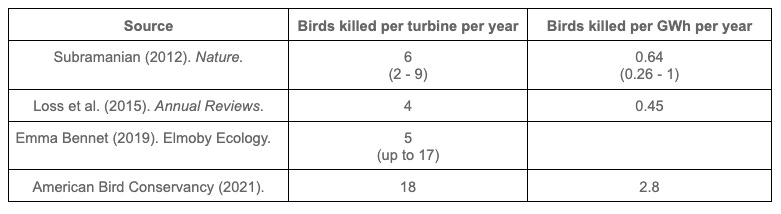
Estimates ranged from 4 to 18 birds killed per turbine per year. More than four times the difference. I’ve detailed some of these studies in the table below.1


Sources: Subramanian (2012); Loss et al. (2015); Emma Bennet (2019); American Bird Conservancy (2021).

The large spread of these estimates isn’t very satisfying, but at least gives us some sense of magnitude. What would this mean for the total number of birds killed each year?

Let’s apply these numbers to the United States (which is where most of the studies came from).

In 2022, the US produced 434 TWh of wind power.2 Taking the numbers above, that gives us a range of 200,000 to 1.2 million. The upper figure seems more likely since it tries to correct for the under-detection of smaller birds. Let’s call it around one million birds per year.

Assume that these risks are the same across the world, and global deaths are probably over 5 million.3


Cats, buildings, and cars kill far more birds than wind power


Around one million birds are killed in the US. Is that a big number?

Not really, compared to other pressures.

The chart below shows estimates of the number of birds killed by different hazards in the US.

You can see that wind turbines kill a few million at most. Cars, buildings, and pesticides kill tens to hundreds of millions each. Cats kill at least a billion.

Do these figures seem credible? I did a bit of a sense check on a few of the numbers below. If you want to follow along, feel free. If not, skip to the next section.


[see the article for detailed discussion of the data.  The author also discusses how any birds are being and will be killed by climate change, and concludes that the data are unreliable.]


Wind power is a threat to particular types of birds, particularly birds of prey


It’s not just the total amount of birds that are killed that matters, but what types. If a particular species of bird is disproportionately affected it could have real impacts on population dynamics and risk of extinction.

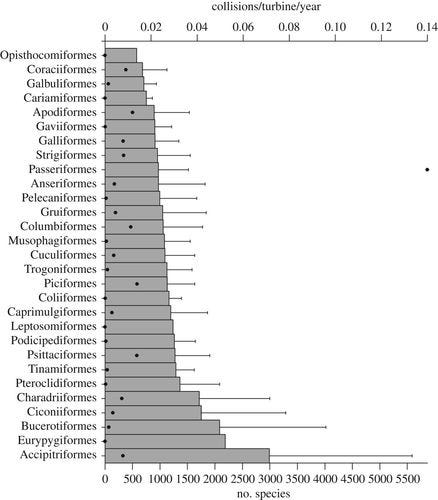
A study by Chris Thaxter and colleagues (2017) looked at the collision rates of different bird species from a large literature review. [See chart in original text]

In short, birds of prey such as eagles, raptors, and hawks; shorebirds; and storklike orders are at much higher risk of collisions than other families, such as songbirds. This disproportionate risk has been found across many other studies.

These species can be at a higher risk for several reasons. First, they will often use ridgetops to get lift from the wind. Incidentally, this is also a good spot for wind turbines. Second, they are often migratory birds; if wind farms are in their migratory route this puts them at higher risk. More indirect impacts of wind farms – which might not be reflected in death statistics – is their effect on the disruption of migratory patterns.

While the total number of birds killed by turbines is low compared to other hazards, the threat to particular species is more concerning. We need better mapping of key hotspots for these species so that wind farms can be deployed in suitable locations. More on how we can reduce these deaths later.


Wind power is probably a bigger threat to bats


I’ve mostly focused on bird fatalities, but wind power also kills bats. I found it harder to get good numbers here, but estimates suggest it’s in the range of 6 to 20 bats per turbine per year. Some estimates are even higher.

The Thaxter et al. (2017) paper that we just looked at also measured collision rates among bats. If you look at the scale of the ‘collisions/turbines/year’ you’ll see that it’s an order of magnitude higher.

Again, this tallies with other research that suggests that bats have higher mortality rates than birds for wind farm collisions.

We can reduce bird and bat deaths from wind power


We’re not completely helpless in this dilemma. There’s a lot that we can do to limit the biodiversity impact of wind farms, even if fatality rates are not reduced to zero.4

Here’s what we can do:

1. Turn off wind turbines at very low speeds when bats are around


Bats tend to get hit by wind turbines when wind speeds are very low. They struggle to fly in windier conditions. That means we can prevent a lot of bat deaths by curtailing – switching off – our turbines when there isn’t much wind.

You might think that this would hinder energy supply and eat into owner profits. But studies suggest it doesn’t make much difference.

A study from Pennsylvania reduced bat deaths by 44% when wind turbines were turned on at 5, rather than 3.5 metres per second.5 And they fell by 93% when this was increased to 6.5 metres per second.

A study in Australia found that raising the wind speed threshold from 3 to 4.5 metres per second reduced deaths by 54%, and the wind farm only lost 0.1% of revenue.6

Another study in Cadiz, in Spain, found that bird deaths were halved with only a 0.07% loss in energy production. That’s because the biggest risk was migratory birds – which pass through very occasionally. Shutting down production during this time was quick and saved many lives.

2. Don’t put wind farms in high-risk areas for birds and bats


Areas like ridgetops are prime spots for migratory birds and raptors that use the winds for uplift.

As we saw earlier, these species tend to be disproportionately affected by wind farms, so we should strive to avoid these areas.


3. Fewer larger turbines are better than many small ones


Birds and bats might be more likely to collide with a large turbine than a small one. But the question is whether a wind farm should have a few large turbines or lots of small ones.

The study by Thaxter et al. (2017) suggests the former. Fatality rates for both birds and bats tend to be higher in wind farms with turbines of very low capacity.

Having a small number of large turbines would therefore reduce fatality rates.


4. Paint the turbines black


When birds get close to turbines, the blades spin so quickly that it blurs their vision. But, if you paint the turbines black, it makes them much more visible.

Some tests of this approach in Norway reduced bird deaths by more than 70%.7

It might not be as effective for offshore farms, so that still needs to be tested.

5. Play alert noises to bats and birds to deter them


For some bat species, playing high-pitch sounds (which humans can’t hear) can deter them from the area. A study in Texas reduced the deaths of the deaths of two species of bats by 54% and 78%.8 It was then rolled out to many wind farms in the area.

Other systems can be used to identify eagles in the nearby area, and either emit distracting noises or switch the turbines off automatically.

6. Use GPS to track and find the optimal height for turbines


Surveillance technologies, such as GPS, can help scientists understand the flying patterns of migratory species. That means we can pick more optimal heights for turbines when they’re being constructed.

It can also alert wind farm generators that migratory flocks are in the area, so they can switch turbines off during high-risk times.


While some wildlife deaths from wind power might be unavoidable, there’s a lot that we can do to reduce them. It might come at very little cost to energy output and profit, so at a time when the world’s birds are under threat, it’s worth doing.

[Read more here]

Friday, January 27, 2023

Record renewables in Australian grid

Even with relatively calm days producing the lowest recent quarterly utilisation rate, total wind farm output exceeded any previous December quarter. Photograph: Russell Freeman/AAP


From The Guardian

Milder temperatures and record levels of renewable energy drove [net] electricity demand to its lowest levels for any December quarter, according to the Australian Energy Market Operator.

Wholesale power prices also retreated during the period, particularly after the Albanese government imposed price caps on black coal and gas that are used to generate power, AEMO said in its quarterly report released on Wednesday.

“Electricity futures prices saw steep falls in the mainland states through to the end of the quarter” after the price limits were imposed on 9 December, said Violette Mouchaileh, an AEMO executive.

The average price of $93/megawatt-hour across the national electricity market (NEM) that serves eastern Australia was less than half the $216/MWh cost in the September quarter. Still, it was almost 80% higher than for the final three months of 2021.

Renewable energy from wind, solar and hydro supplied an average of 40.3% of power in the NEM, a record for any quarter since the NEM started in 1998.

It exceeded the previous high, set a year earlier, of 35.8%, AEMO said.

The tail end of the third La Niña event in as many years trimmed power demand for daytime air-conditioning.

A 16% increase in electricity output from rooftop solar panels, or 410MW on average, also decreased demand from the grid.

As a result, [net] operational demand fell 2% from a year earlier to an average 19,431MW, the lowest December quarter reading. New record lows for a quarter were set in South Australia, Victoria and New South Wales, while the 11,892MW use on 6 November was a new low for the NEM in the December quarter.

Power generation from black and brown coal-fired plants was the lowest since the NEM started. Higher prices for the fossil fuel in Queensland and NSW – at least before the price caps began – was one factor for the reduced use but also plant failures, particularly in Queensland.

Increased output from renewable energy, with its near-zero fuel cost, also nudged more coal and gas out of the generation market.

New instantaneous renewable penetration records were set in the NEM at 68.7% on 28 October – up 4.6 percentage points on the previous record – and in the Western Australian market at 84.3% on 12 December, up 3.7 percentage points. The records were “largely driven” by rooftop solar, AEMO said.

During a fault that cut South Australia off from other states for several days in November, renewables’ share of generation peaked at 91.5%.

“Output from wind and grid-scale solar grew strongly as new facilities were connected and commissioned,” AEMO said. Even with relatively calm days producing the lowest recent quarterly utilisation rate, total wind farm output exceeded any previous December quarter.


The percentage of renewables in the Ozzie grid is rising by rough 5% per annum.  At this rate, by 2035, we will have reached 100%.  However, the opening of new offshore wind farm lease areas off the cost of Victoria will most likely accelerate the switch.   We will still need some gas backup for cold, cloudy, windless days ("dunkelflaute"), which on average will be about 5% of total output.   Until, that is, we find a cheap means of long-term storage, such as molten-salt storage (CSP) or power to gas.   So the practical limit for non-hydro renewables now is prolly 85%.   And we could reach that by 2030.

Tuesday, November 1, 2022

World's biggest offshore wind coy comes to Australia


From RenewEconomy

Ørsted, the world’s biggest offshore wind developer, has confirmed it plans to make major investments in Australia, with the initial focus on the country’s first offshore wind zone in Gippsland, Victoria.

The Danish company’s newly appointed head of Asia Pacific, Per Mejnert Kristensen, says the company has been monitoring developments in Australia for many years, and opportunities in offshore wind, as well as onshore wind, solar and “power to X” (green hydrogen), are getting very interesting.

“We feel that with our experience and track record, we will be able to play a strong role here in the renewable sector,” Kristensen told RenewEconomy in an interview on the weekly Energy Insiders podcast.

Kristensen says Ørsted’s initial focus is on gigawatt scale projects in the Gippsland offshore wind zone in Victoria, which is likely to be officially declared shortly, allowing for the first detailed feasibility studies to be conducted.

The company is also about to open its first permanent Australian office in Melbourne.

“We are talking to a number of different stakeholders and partners here,” Kristensen says. “At this point in time, I’m not able to say anything specifically regarding that. We really feel that now we are kicking off our efforts in Australia.”

Major players converging on Victoria offshore wind


Ørsted, whose interest in Australian offshore wind was first reported by RenewEconomy earlier this year, joins a host of major international energy players jockeying for position in the nascent Australian offshore wind industry.

These include Iberdrola, Shell, Equinor, Macquarie Group’s Corio, Copenhagen Infrastructure Partners, and Vena Energy, plus a host of smaller players such as OceanEx, Flotation Energy, Bluefloat, and more.

There are now more than 20 declared projects representing more than 50GW of proposed capacity. See RenewEconomy’s Offshore Wind Farm Map of Australia

All eyes are on Victoria, which has set a target of 2GW of offshore wind in production by 2032, 4GW by 2035, and 9GW by 2040. Its newly announced 95 per cent renewables target for 2035 counts heavily on offshore wind.

But the federal government has also flagged five initial offshore wind zones, mostly grouped around Victoria and NSW, and also likely to expand to Tasmania, South Australia and Western Australia.

Gippsland is already the focus of at least five competing projects, including the 2.2GW Star of the South project, regarded as the most advanced in the country, and the most recently announced 2GW Blue Marlin project, unveiled by Singapore-based Vena this week.

Joint venture with Copenhagen Infrastructure Partners


Interestingly, Ørsted just this week announced a major joint venture with Copenhagen Infrastructure Partners, the majority owner of the Star of the South project, to develop 5.2GW of offshore wind capacity in Danish waters.

Ørsted already has 13GW of offshore wind capacity under operation, and a stated goal to expand this to 30GW by the end of the decade.

Kristensen says the industry – and consumers – are suffering from rising costs “everywhere in the world”, particularly for steel prices, but also for interest rates.

“It is putting some of both pressure on cost. I think that would be fair to say. And I think that’s acknowledged by everyone. Now, this, of course, cannot cannot keep going like this. So we expect it to be a temporary thing with the extreme levels that we’ve seen in many parts of the world now.

“It is … putting pressure on the companies and the capital, we have to … have a very robust balance sheet. We have strong support from our investors. And we have a very good credit ratings.

“So I think (Ørsted) remains in the strongest position to keep developing our offshore wind ambitions. And we are indeed on track to to achieve this 30 gigawatt into 2030.

“It would be fantastic if we could get the first offshore wind farms going, for example, here in Victoria, just before the turn of 2030.

Ørsted has 30GW offshore wind target for 2030


“We know that this would require the frameworks to be in place rather quickly. But we also have the sense that this is what the Commonwealth Government and the Victorian state government are working very hard on.

“So I would say that, that it will be be tight, but I think it’s still it is possible with the right framework. And indeed, for me personally and for (Ørsted), we would indeed love Australia to be part of this 30 gigawatts.”

Ørsted recently set a 100 per cent renewables target for all its 22,000 suppliers by 2025, and Kristensen says the company is hopefully of sourcing Australian content – where it makes sense – when it does begin projects in coming years.

Ørsted built the world’s first offshore wind farm in 1991 and now lays claims to a 30 per cent share in the global industry.

Power-to-X technology


Kristensen also says the company is interested in onshore wind and solar projects in Australia, as well as the “Power-to-X” technology that is included in its newly announced deal with CIP in Denmark.

Power-to-X describes the production of green hydrogen or green fuels to help power heavy industry and heavy transport. “We are a long term player,” Kristensen said.

Ørsted has been cited as a potential bidder for CWP Renewables, which has a gigawatt scale portfolio of existing and pipeline projects in wind, solar and storage. Ørsted declined to comment on specific opportunities.

The proposed wind farms off Victoria's Gippsland coast will together provide at least 80% of Victoria's electricity, and 20% of the nation's.  Ignoring rooftop and utility scale solar, they will add enough renewable capacity to take the nation's renewable energy output to nearly 60% of the total o ver the next 10 years.

Monday, August 8, 2022

Labor government announces 6 new offshore wind zones


From The Guardian.


The Energy minister, Chris Bowen, has outlined proposals for six offshore wind projects around the country, including a 200-turbine windfarm off the Gippsland coast, claiming the industry could support up to 8,000 jobs and help shore up the nation’s energy security.

“We have some of the best wind resources in the world - just one rotation of one offshore wind turbine provides as much energy as an average rooftop solar installation generates in one day,” Bowen said.

A day after the government’s 43% emissions reduction bill passed the House of Representatives, Bowen laid out plans to harness what he called “world-class offshore wind energy potential”.

It included a project off the Gippsland coast in Victoria, with possible locations off Inverloch and Woodside beach. A 60-day public consultation period opened on Friday.

Five other proposals include developments off the Hunter and Illawarra coasts in New South Wales, near Portland in Western Victoria, in Bass Strait north of Tasmania, and in the Indian Ocean off Perth and Bunbury. Consultation periods for those proposals are yet to be announced.

Bowen said the sites were chosen because of “good to excellent” wind resources, existing energy generation facilities, connections to transmission networks, and locations near ports or industrial hubs.

The windfarms would be built in Commonwealth waters, starting 5.5km from shore, and feature up to 200 turbines.

Australia currently had no offshore wind generation, which has previously been considered too expensive and difficult to build compared to onshore wind or solar. In September, the Morrison government introduced legislation to establish a framework for the construction and operation of offshore power generation, including wind.

The director of climate change and energy at Ai Group, Tennant Reid, said offshore wind had “enormous” energy potential, utilising the more consistently strong winds off the coast.

The Labor government plans to generate 82% of Australia’s energy from renewable sources by 2030. Bowen said Australia was “way behind the rest of the world” in generating wind power.

The Nationals MP for Gippsland, Darren Chester, said his electorate had “abundant” wind resources, and he expected the proposal to build a 200-turbine wind farm off the Gippsland coast would be warmly received by most constituents.

The turbines would be placed between 7km and 25km offshore and could meet up to 20% of Victoria’s electricity needs.

“Respectful community consultation and engagement is now critical to ensure the region understands the potential impacts and benefits of offshore wind projects,” Chester said.

“It’s important that issues surrounding transmission lines through private property to link large-scale renewable projects to the national grid are handled sensitively and transparently.”

Bowen said he expected there would be “very genuine concerns” raised by some locals and the fishing industry about the Gippsland project, dubbed the Star of the South, and that his department would listen.

“Around the world people have found a way for recreational and commercial fishing to work together with offshore wind,” he said.

 I talked about the Star of the South wind farm here and here.  Just by itself, it'll provide 20% of Victoria's electricity and 5% of the nation's. 


Saturday, August 6, 2022

Global offshore wind investment up 52% in H1 2022

From IEEFA


Investment in the offshore wind sector in the first half of this year amounted to USD 32 billion, 52 per cent more than in the same period in 2021, according to BloombergNEF (BNEF).

The financing of the 1 GW China Three Gorges (CTG) Yangjiang Yangxi Shapa Qingzhouwu Offshore Wind Farm for USD 2.1 billion was the largest deal during this period, BNEF’s report says.

The increase in offshore wind investment comes on the heels of newly approved projects and a rise in governmental efforts to up the share of renewable energy in national energy mixes.

“Investments in 2022 will flow into projects coming online in the next few years as the offshore wind installed base is set to grow tenfold from 53GW in 2021 to 504GW in 2035. Offshore wind projects enable companies and governments to make progress towards their decarbonization goals at scale”, said Chelsea Jean-Michel, offshore wind analyst at BNEF.

“The United Kingdom, France and Germany are just a few of the countries that have increased their offshore wind targets in the first half of 2022, signaling further support for investment in the technology”.

In the renewable energy sector, global investment reached USD 226 billion in the first half of 2022, an 11% year-on-year rise, setting a new record for the first six months of a year, according to BNEF’s Renewable Energy Investment Tracker 2H 2022.

[Adrijana Buljan]

More: Global Offshore Wind Investment Up 52 Pct in First Half of 2022


Offshore wind is less variable than onshore wind, but is also more expensive.

A 50% increase is substantial, yet overall investment in renewables rose only 11%.  And emissions/temperatures continue to rise.


Sunday, July 10, 2022

UK wind cheapest ever

 From The Guardian


The price of offshore wind power in the UK has fallen to an all-time low, which could ease the pressure on future household energy bills.

Following the biggest ever UK renewables auction, the government said on Thursday the contract price for windfarms was nearly 6% lower than the previous auction, despite the rising cost of materials to build windfarms. [In just the last year, UK consumer prices have risen 7%, so this is a material decline in real prices]

A string of new contracts should add about 7 gigawatts of clean power capacity to Britain’s turbine fleet by 2026. The government hopes to have 50GW by 2030 and has embarked on a push to expand Britain’s renewables industry in the face of rocketing fossil fuel prices.

Russia’s invasion of Ukraine has exacerbated an already volatile oil and gas market and left countries scrambling to shore up their energy supplies.

UK ministers have been forced to ask coal-fired power plants to continue their operations through the winter for fear of blackouts caused by energy shortages.

However, renewable energy including wind power is seen as central to Britain’s goal of hitting net zero carbon by 2050.

Offshore windfarm operators will sell power for as little as £37.35 per megawatt hour [US$44.82, which is *very* cheap], 5.8% below the lowest bid in the most recent auction in 2019.

The “contracts for difference” guarantee wind-power companies fixed prices to sell electricity for the following 15 years. If the market price falls below the contract price, the government subsidises the difference. If the market is higher, the companies pay money back to the government.

Since wholesale energy prices began to rocket last year, windfarms have begun paying back money to the government.

The easing of an effective moratorium on new onshore windfarms – which was imposed in 2015 – meant onshore wind and solar energy were both included in an auction for the first time in seven years. Onshore wind is now about 45% of the price secured in the auction in 2015. [A real fall of 60% after allowinf for inflation]

Among the winners from the auction were the Danish power company Ørsted, Scottish Power and Sweden’s Vattenfall.

Ørsted landed the contract for the world’s biggest offshore wind project, at Hornsea Three, 100 miles (160km) off the east Yorkshire coast. It is hoped the project will produce enough renewable electricity to power 3.2m UK homes.

Scottish Power secured a contract for the East Anglia Three offshore wind project, five onshore wind projects and 10 solar sites. Vattenfall agreed terms for the Norfolk Boreas offshore windfarm, which it said would meet the needs of about 1.5m homes.

It is hoped the projects will help to eventually bring down bills for consumers, which are expected to top £2,800 from October.

The business secretary, Kwasi Kwarteng, said: “Eye-watering gas prices are hitting consumers across Europe. The more cheap, clean power we generate within our own borders, the better protected we will be from volatile gas prices that are pushing up bills.”

Ørsted turbines at the Hornsea One field. The Danish company has won the contract for the world’s biggest offshore wind project at Hornsea Three. Photograph: Ørsted/EPA


Offshore wind used to be much more expensive than onshore wind.  But we've moved fast down the learning curve.  Offshore wind is prized because they wind blows more and more often offshore than onshore, which brings wind power closer to baseload.

Saturday, March 5, 2022

Victoria's game-changing offshore wind target

 From RenewEconomy


Victoria has announced an ambitious new plan to accelerate the rollout of offshore wind energy generation projects in the state, setting rolling targets of 2GW installed by 2030, 4GW by 2035, and 9GW by 2040.

In a State of the State speech at a CEDA luncheon in Melbourne on Friday, Victoria’s Labor Premier Daniel Andrews announced the “new and even more ambitious” renewable energy goals for the state, which he said his government planned to “meet and exceed.”

In a release detailing the new targets, the state government said the first power from offshore wind was expected as soon as 2028 following a competitive process.

“For the first time anywhere in Australia, we will set a minimum target for offshore wind power generation,” Andrews said.

“By 2032, Victoria will reach a massive 2GW of offshore wind energy production, that’s the equivalent of 20% of Victoria’s energy needs today, [and] set a target of 4GW by 2035 and, finally, 9GW by 2040 – targets, ladies and gentlemen, that we will meet and we will exceed.”

Victoria, which has legislated a target for a 50% renewable energy powered electricity grid by 2030, was the first state in Australia to have an offshore wind project proposed off its coast – albeit in federal waters.

That project, the 2.2GW Star of the South, is proposed for waters off the south coast of Gippsland in Victoria, and remains on track to be the first offshore wind farm in Australia.

In 2021, the project entered into a $43.1 million partnership with the Victorian government designed to accelerate its development, and establish the beginnings of a local Victorian offshore wind industry.

It’s overall progress has been delayed, however, by the wait for federal legislation – finally passed in November of last year – enabling offshore electricity projects to be built and operated in Australia; the Offshore Electricity Infrastructure Bill 2021.

The new, rolling targets from Victoria are clearly an effort by the state to make up for that lost ground, in an area that will be crucial to its shift to renewables beyond 50 per cent.

“[This] is the clearest and best signal that we can send to investors – to those who will build and operate and those who want to invest in this resource,” Andrews said on Friday.

“It’s more than a signal, though, it’s a message from a government with a proven track record of getting things done. And a government not prepared to simply say, well that’s a matter for the Feds, who we know will do precious little about it.”

Victoria has plenty to gain from fast-tracking investment in offshore wind. Studies have shown the state has the potential to support 13GW of capacity from coastal regions by 2050 – five times the state’s current renewable energy generation.

The Australian Energy Market Operator’s latest Integrated System Plan – its planning blueprint – now adopts as its central scenario a “step change” model that assumes all of Victoria’s brown coal generators will cease operations by around 2032.


Sunday, December 19, 2021

5 stories of clean energy progress

 From CleanTechnica

1. Solar roars

The year isn’t over, but it’s already clear that it will be another record breaker for US solar. By the end of the third quarter, the country had already chalked up another 16,000 megawatts (MW) of large-scale, commercial, community, and residential solar, according to energy research company Wood Mackenzie (WoodMac). Solar is on pace to far outperform even record-breaking 2020, during which 19,200 MW was installed.

Other metrics of solar’s soaring-ness in 2021: Total US solar installations sailed past the 100,000 MW mark this year. That means there’s enough US solar capacity to generate the equivalent of some 20 million typical households’ electricity use.

And, according to WoodMac, solar accounted for more than half — 54 percent — of new power generating capacity installed in Q1-Q3, Q3 was the first-ever quarter with over 1,000 MW in residential solar installations, and “[o]ne out of every 600 US homeowners is now installing solar each quarter.”

Source: CleanTechnica


2. Wind soars

Land-based wind in the United States is also having a fine year. Through Q3, installers had stood up another 7,300 MW, according to the American Clean Power Association (ACP). That makes the first three quarters of this year the best ever for US wind. And, as with solar, wind’s strong 2021 performance comes on the heels of a record-breaking 2020.

By the end of Q3, the total for US wind capacity had risen to almost 130,000 MW, or enough to meet well over 40 million households’ electricity needs.

3. Even more offshore

Offshore wind, while still early stages in this country, has also been generating all kinds of positive signs and palpable progress in 2021.

The Biden administration threw some important weight behind offshore wind early on this year with its announcement in March of a goal of 30,000 MW by 2030. That’s more offshore wind capacity than Europe, the world leader, has installed so far, and five times what got installed globally during 2020. It also fits well the amount of offshore wind that states have already committed to; having a willing partner for that in the federal government is key.

The administration has demonstrated that willingness with important progress. That includes getting the first two project proposals through the federal permitting process (off Massachusetts and off Rhode Island/Long Island) and moving other projects into the environmental review stages. The administration has also announced seven new areas that they’ll be assessing for possible offshore wind leasing, off the East, West, and Gulf Coasts.

The progress led to the first groundbreaking (or at least sandshoveling) in November, on Cape Cod. Steel in the water (a ways offshore) should be following soon.

4. Renewables add up

The renewable energy progress in recent years is visible not just in the solar arrays on rooftops and wind turbines in fields, but in the electricity generation numbers.

As of September, generation from wind and solar across all sectors was a stunning 15 percent above the total for the same period in 2020, according to the Department of Energy’s Energy Information Administration (EIA). And that’s before all those new megawatts from 2021 have made their presence fully known.

A low year for hydroelectric power has somewhat offset gains in solar and wind, but the EIA is projecting that renewables in total will still account for 20 percent of US electricity supply for 2021, and 22 percent in 2022.

5. Worldwide progress

Progress here at home has been echoed in progress abroad, according to the International Energy Agency (IEA), which noted: “Despite rising costs for key materials used to make solar panels and wind turbines, additions of new renewable power capacity this year are forecast to rise to 290 gigawatts (GW) [290,000 MW] in 2021, surpassing the previous all-time high set last year…”

The IEA called out China, India, and Europe, along with the United States, in particular as markets to watch for serious near-term renewables expansion.


Wednesday, September 1, 2021

BNEF's renewables costs

The chart below shows the average global costs over time for different renewable generation technologies.   Offshore wind is more expensive than onshore, for obvious reasons, but has the advantage that winds are more reliable on water than they are on land.  Interestingly, tracking solar, where the solar panel rotates during the course of the day to face the direction of the sun, which you'd expect to be more expensive than fixed solar, is not.  The extra yield from a "squarer" insolation profile more than compensates for the extra expense of motors to rotate the panels.  Tracking solar is also better than fixed-tilt solar because output jumps to its maximum just after sunrise and lasts until just before sunset, which means output is better attuned to the daily demand profile, especially the morning peak.

So the cheapest global electricity comes from single-axis tracking solar, then onshore wind, then fixed solar, then offshore wind.  The green line shows a simple average of all four types, and you can see how it has fallen steadily over the last 12 years, falling from $256/MWh in H2 2009 to $52/MWh in H1 2021, or by 80%.  The recent uptick in LCOEs is driven by a three-fold jump in polysilicate prices (for solar) and a doubling of steel prices (for wind).   These are both cyclical, and will partly unwind as economic growth slows after the post-pandemic rebound.  The jump in polysilicate prices is particularly interesting, hinting at a massive build out of solar in China and globally.

Just like Lazard (whose data I have been using for a few years now) and IRENA, BNEF shows the same strong downward trends in the cost of renewables.   Lazard estimate the average cost of new coal at $112/MWh in the US, and the marginal/operating cost of coal at $41/MWh, though that will have risen this year because of the jump in the coal price.  This compares with the average for  onshore wind, and tracking solar of $40/MWh.   Lazard's calculation for the marginal cost of gas in the US is $28/MWh, but gas in the US is less than  half the price of gas outside the US.  For example, gas in Europe  has reached US$12.51/MBtu compared with $4.40 in the US.  And the US natural gas price is up 70% over the last year.   

The moral of this tale is obvious, but I'll tell you anyway:  coal is finished.  Because output from gas power stations can be ramped up more rapidly than from coal, to match supply shortfalls from renewables, gas is still "safe" for now.  Until battery prices halve again.