Showing posts with label net-zero. Show all posts

Friday, January 30, 2026

Real zero vs net zero


The original idea of net zero was that we would cut emissions as close to zero by 2050 as we could, and what was left over we would try to offset.

This was greeted with cries of glee by big oil, airlines and others.   They decided not to wait until 2050, but to start immediately "reducing" their emissions by buying carbon offsets.   So, for example, an Ozzie petrol (gasoline) company started selling its "zero carbon" petrol.  How did it achieve this miracle?  But buying carbon offsets.  Qantas "offset" the emissions from its flights.   An electric utility announced its "green" credentials.  Zero emissions, it trumpeted, thanks to offsets.

But these offsets were dodgy.  For example, a farmer who had been paid not to clear scrub off some of his land admitted that he was never going to clear the land anyway.  The payments for the "offsets" were a handy increase to his income, but had absolutely zero effect on the level of CO2 in the atmosphere.  

Peasants who promised not to clear some jungle near them were paid for these "offsets" and then, when this was checked up on 10 years later, were found to have cleared the jungle anyway.  Did they give that money back?  What do you think?  

CCS (Carbon capture and storage) projects used the carbon dioxide sucked from the atmosphere to increase the oil that could be pumped from underground.  And the CO2 likely escaped back into the atmosphere anyway.  

Forests planted to "remove CO2 from the atmosphere" burned down in one of Oz's periodic and ever more frequent bushfires thus putting all that carbon back in the atmosphere.  Meanwhile, of course, emissions kept on rising.

Net zero is irredeemably sullied.  It's a nonsense.  A lie.  A way to let hoi polloi believe that something is being done, when nothing is.  A way for carbon polluters to pretend they care.

So we need real zero.  We need to cut emissions by some minimum percentage each year, year after year, no phiffing and phaffing around with accounting book entries.  Real cuts to emissions.  Real reductions.  Real progress.

Also:  none of those blithely promising net zero by 2050 will be around in 2050 to explain why we haven't achieved it.  So we need annual targets, not so far-away airy-fairy promise.

If we all cut our emissions by just 3% a year, we would cut them by a cumulative 53% by 2050.  If we could increase that by 1%, to 4% a year, annual emissions would fall by 64% by 2050.

Both of these targets are feasible.   Together, electricity generation and land transport are responsible for ~50% of total CO2 emissions.  Given the fall in solar, battery and EV costs, which have made these cheaper than their fossil fuel alternatives, we will be able to cut emissions by 50% over the next 25 years as we replace coal power stations with zero-carbon alternatives and petrol cars and lorries with EVs.  We can replace gas heating by heat pumps, which will cut emissions by another ~8%.  

That still leaves air travel, steel and cement.  Yet here, too, we are making slow progress.  Then there's agriculture.  We might be saved despite ourselves by the growth of vat meat and milk, which will slash emissions and allow cleared land to be reforested.  

We can do it, but we must be alert to the scams fossil fuelists will try to fob us off with.  Let's start by banning the term net zero.

Monday, September 15, 2025

Battery costs to fall 90%


CATL (the world's largest battery manufacturer) has put its new sodium-ion battery into production, and will be starting mass production in December.

  • They will initially cost half lithium-ion batteries.  Tesla's batteries cost ~$100/kWh.  CATL's goal is a cost of $10/kWh within a few years, as the technology is perfected and mass production increases.    
  • They will last 10,000 cycles (compared to Tesla's 1,500), or 3.6 million miles.  That's million.  And even then, they will still have 80% of their original capacity.  Used as grid batteries and fully discharged every day, sodium-ion batteries will last 27 years.  After 60 years, they will still have 60% of their original capacity.
  • So they won't just be cheap to buy, but will have very, very low LCOE/LCOS (levelised cost of storage): 90 cents per MWh of output (assuming a life of 30 years).   4 hours of storage will add just $3.50/MWh to solar electricity; 12 hours just $10.  This will completely remove the need for fossil fuel generation, except in high latitudes, and it will make even existing fully-depreciated and paid-off coal power stations wildly uneconomic.
  • They will be able to be charged must faster than lithium-ion, capable of adding 520 km of charge in 5 minutes.
  • They will operate over a much wider temperature range: from -40C to +70C.
  • They are safe.  Unlike lithium-ion batteries, they won't catch fire even if they are pierced,
  • Even their energy density is now respectable (sodium-ion batteries have hitherto had low energy densities), at 175 Wh/kg, comparable with the low end of lithium-ion.
The implications are staggering.  Solar costs continue to fall; battery costs will soon make 12 hours of storage economically feasible, and EV batteries will fall from $6,000 per car to $600, making even small EVs easily cheaper than petrol/diesel cars.

The transition from fossil fuel generation and petrol cars will accelerate.  Emissions from electricity generation and land transport make up ~50% of global emissions.   It seems certain that by 2040, these emissions will have mostly ended.  If we replace fossil fuel heating with heat pumps (and electric heating in high latitudes), this could cut emissions by another 10%.  

We still have to cut emissions from cement, iron and steel, air travel, sea transport and agriculture (a biggie), but we will have travelled a long way down the road to net-zero.

[Update 15/10/2025:  The costs are even lower than I thought.  Here's my updated analysis]

Friday, February 14, 2025

We really aren't going to achieve 1.5

From David Ho

A constant reminder that even if CO₂ emissions decreased annually as much as they did during the pandemic lockdown from now to 2030, we still wouldn't meet our emission target to keep global warming below 1.5°C.


To get to real zero (let's stop calling it "net zero" because we all know that carbon offsets don't work) by 2050, emissions would have to fall by 9% per annum.  Actually, that's not even to real zero; that's to a 90% reduction from today.  Calculating a cumulative decline involves using exponentials, and they don't work to zero.  What about if we target a 99% decrease by 2050?  We'd have to cut emissions by 17% per year.  

Just a reminder:  emissions are still rising.  And the rise in temperatures is accelerating.


Sunday, October 6, 2024

Decoupling emissions from growth

 From Our World in Data


Historically, CO2 emissions have been strongly correlated with how much money we have. This is particularly true for low-to-middle incomes. The richer we are, the more CO2 we emit. This is because we use more energy – which often comes from burning fossil fuels.

But this relationship no longer holds true at higher incomes. Many countries have managed to achieve economic growth while reducing emissions. They have decoupled the two.

Take the UK as an example. It is shown in the chart. This chart shows the change in GDP and annual CO2 emissions per capita since 1990. We see that the UK’s GDP has increased a lot over the last 30 years while its emissions have fallen. You can also see the data without per capita adjustments.


It’s not just the UK. Many other countries have achieved this decoupling. Using the “Edit countries and regions” button on the chart, you can see this for yourself. France, Germany, Sweden, Finland, Denmark, Italy, Czechia, and Romania are examples of countries where we see this.


This decoupling is even more pronounced over the past two decades, since the turn of the millennium.

Consumption-based emissions continued to rise in countries such as the US throughout the 1990s. But they have dropped a lot since 2005, alongside a rise in GDP. This is true for many more countries, which are shown in the static visualization below. Again, emissions are adjusted for trade.


There are two key reasons why emissions have fallen in these countries. First, some countries have managed to decouple energy use and economic growth. GDP has increased while total energy use has remained flat, or even fallen. But the second is the most important: countries are replacing fossil fuels with low-carbon energy. We can produce more energy, without the emissions that used to come with it.

It would be wrong to assume that this reduction in emissions in rich countries was only achieved by offshoring production overseas – by transferring emissions to manufacturing economies such as China and India. In the chart we see that consumption-based emissions – which adjust for emissions from goods that are imported or exported – have also fallen. Some emissions have been exported overseas, but this is not the only driver of this decline.

These countries show that economic growth is not incompatible with reducing emissions.

A key question is whether we can decarbonize fast enough, and across more countries. The continued decline in the cost of low-carbon technologies makes this acceleration more realistic every day.

The world's growth rate has steadily declined since the 1960s, when it was between 5 and 6 %.  It's currently about half that, and is unlikely in my view to re-accelerate back to the 1960s trend.  That's good news for controlling emissions.  

But we need to do better than that.  If emissions were to fall by 5% per annum, compound, that would halve emissions over the next 14 years.  We need to make the decoupling between economic growth and emissions even bigger.  Emissions intensity (emissions per unit of GDP) needs to fall faster than it has done over the last 2 decades.  A 5 % p.a. fall in absolute emissions, or a 7.5% p.a. fall in emissions intensity, should be each country's target.  Net-zero by 2050 sounds good, but none of the politicians making decisions now will be around to explain away our failure to achieve that in 30 years' time.  We need an annual target, making them justify their performance each year.

Sunday, July 30, 2023

IEA: renewables to pass coal by 2025


The IEA is notorious for the conservatism of its renewables forecasts, having consistently underestimated the roll-out of renewables over more than a decade, while consistently underestimated the fall in costs. So, to make a forecast like this ...... well!!!!

Unfortunately, it's not enough to avert a ruinous 2 degree rise in global temperatures since before industrialisation began.


(Source)


Global electricity demand growth is expected to ease in 2023 before accelerating in 2024. Demand is expected to grow by slightly less than 2% in 2023, down from a rate of 2.3% in 2022 and the average annual growth rate of 2.4% observed over the 2015-2019 period. This moderation is strongly driven by declining electricity demand in advanced economies, which are dealing with the ongoing effects of the global energy crisis and slower economic growth. In 2024, as expectations for the economic outlook improve, global electricity demand growth is forecast to rebound to 3.3%.

Electricity demand in the European Union is set to decline in 2023 for the second year in a row, falling to its lowest level in two decades. EU electricity demand is expected to record a 3% drop in 2023, after already falling 3% in 2022. This is despite strong growth in electrification with a record number of electric vehicles and heat pumps sold. Following these two consecutive declines, which together amount to the region’s largest slump in demand on record, EU electricity demand is set to drop to levels last seen in 2002.

Europe's energy-intensive industries have not yet recovered from last year’s production slump, as evidenced by the staggering 6% year-on-year decline in total EU electricity demand during the first half of 2023. Almost two-thirds of the net reduction in EU electricity demand in 2022 is estimated to be from energy-intensive industries grappling with elevated energy prices. This trend has continued well into 2023, despite the prices for energy commodities and electricity falling from their previous record highs. As policy developments abroad courting industrial investment put pressure on Europe’s industrial competitiveness, the European Union is at a crossroads. The outcome of policy discussions now underway could determine the future of its energy-intensive industrial sector.


The substantial demand declines in advanced economies contrast sharply with the growth observed in emerging economies such as China and India. Japan is similarly expected to record a significant 3% fall in electricity demand in 2023, while the United States is set to see a decrease of almost 2%. In contrast, China's electricity demand is expected to increase by 5.3% in 2023 and 5.1% in 2024, slightly below its 2015-2019 average of 5.4%. India is set to have an average annual growth rate of 6.5% over the outlook period, surpassing its 2015-2019 average of 5.2%.


The accelerated pace of new renewable capacity additions shows that renewable generation could surpass coal as early as 2024, if weather conditions are favourable. This is supported by the expectation that coal-fired generation will slightly decline in 2023 and 2024 after rising 1.5% in 2022, when high gas prices boosted demand for alternatives. Increases in coal-fired generation in Asia in 2023 and 2024 are poised to be offset by strong drops in the United States and Europe.

Renewables are set to meet all additional demand in 2023 and 2024. With global demand growth easing in 2023, incremental increases in renewables alone are expected to cover all additional demand not only this year, but also in 2024, when demand growth is expected to accelerate again. By 2024, the share of renewable generation in global electricity supply will exceed one-third for the first time.


By 2024, electricity generation from fossil fuels is expected to have fallen four times in six years. Declines in fossil-fired generation were rare in the past and occurred primarily after global energy and financial shocks, such as following the oil crises of the 1970s or during the Great Recession in 2009, when overall electricity demand was suppressed. But in recent years, fossil-fired supply has lagged or fallen even when electricity demand expanded. These trends – driven by the strong growth in renewable generation – suggest the declines in fossil electricity generation are becoming structural. The world is rapidly moving towards a tipping point where global electricity generation from fossil fuels begins to decline and is increasingly replaced by electricity from clean energy sources.


Increases in emissions from power generation in China and India are expected to be more than offset by declines in other regions. The European Union alone accounts for 40% of the total decline in emissions from power generation expected to occur in 2023 and 2024, excluding China and India. The EU is followed by the United States, where renewables deployment is growing strongly, and gas is increasingly replacing coal-fired supply. Extreme weather, unexpected economic shocks and changes to government policies can cause an uptick in emissions in specific years. However, the overall trend of global power sector emissions plateauing is expected to persist, with years in which emissions decline, not rise, becoming more frequent.


Rising demand for cooling is straining the world’s power systems. Summers with extreme temperatures are becoming more frequent in many regions, elevating electricity demand for cooling systems and stretching power supplies. As more households start purchasing air conditioners, the impact will increase in many countries – especially in emerging economies that currently have a much lower share of households with AC than advanced economies with comparable climates. Setting higher efficiency standards for air conditioning would greatly help limit the impact of additional cooling demand on power systems. To ensure system reliability, it will be crucial to have adequate backup generation capacities, encourage demand management and energy storage, accelerate grid investments, and enhance fuel supply security for power plants. Insufficient preparedness in these areas could lead to more frequent stress on grids, resulting in load-shedding and blackouts.


If China and India were to stop building new coal power stations, then emissions from electricity generation would start to fall really fast.  The IEA's forecast decline is good news, but not good enough.  We need to halve emissions from all sources over the next 10 years.  Thanks to increases in China and India, the decline in emissions from electricity generation is just 1.9% over 2 years.  If China and India just kept their emissions constant, then the fall would be more like 5%.  Depressing

Thursday, July 6, 2023

The hydrogen furphy

I've been suspicious about the hydrogen mania for a while now.   Michael Liebreich does a much better demolition job than I could.   But his recommendation to use green ammonia, made from green hydrogen, for long-term storage in electricity generation is very interesting.   And I don't share his doubts about using e-fuels for jets.  If e-fuels cost twice as much as jetfuel, so be it.  We survived without intercontinental jet flights before, and we could again.

[From BNEF]
By Michael Liebreich

Senior Contributor
BloombergNEF

Injecting some reality


Two years ago, BloombergNEF published my two-part primer on hydrogen, Separating Hype from Hydrogen. On the supply side, I was optimistic: green hydrogen (produced from renewable energy) would over time become cheaper than blue hydrogen (produced from natural gas but with carbon captured) and eventually cheaper than gray hydrogen (produced form natural gas without carbon capture).

On the demand side I was more skeptical. While clean hydrogen will be needed to decarbonize a number of use cases in industry, and perhaps for long-duration storage, I found it hard to identify any role for it in applications like land transportation or space heating. Since then, as I have done more work on industrial heat, I have even come to believe it has a limited role even there.

If my intention at the time was to inject some reality into discussions about hydrogen, I clearly failed. Rhetoric around hydrogen has become ever more overblown.

According to lobbying group the Hydrogen Council, citing a series of reports commissioned from McKinsey over the past three years, hydrogen can be expected to contribute more than 20 percent of emissions reductions needed for the world to reach net-zero emissions – a figure repeated by politicians and journalists seemingly without the slightest critical examination.

German Chancellor Olaf Scholz has called hydrogen “the gas of the future” and promised “a huge boom.” Japan’s Prime Minister Fumio Kishida has declared that “shifting to and developing a hydrogen society is critical for achieving decarbonization.” Frans Timmermans, the EU Executive Vice-President for the European Green Deal believes that “hydrogen rocks.” Jacob Rees Mogg, briefly UK Secretary of State for Energy this year, called hydrogen “the silver bullet”.

Public money is starting to flow. The EU has approved the first 13 billion euros ($13.7 billion) of the 430 billion euros ($450 billion) promised under its 2020 Hydrogen Strategy and is now working to launch a “Hydrogen Bank”. The US Inflation Reduction Act (IRA) provides a ten-year tax rebate per kilogram of green hydrogen worth $3, which will soon be more than the production cost itself. Free hydrogen anyone?

Of supreme import


In October this year the Hydrogen Council and McKinsey released another report entitled Global Hydrogen Flows, predicting long-distance transport of 400 million tonnes of clean hydrogen and its derivatives (calculated on a hydrogen-content basis) by 2050, out of total global production of 660 million tonnes of hydrogen. It is worth bearing in mind that today, 94 million tonnes of hydrogen are used annually, virtually all of it made from fossil fuels, creating 2.3% of global emissions. The vast bulk of today’s hydrogen never leaves the compound on which it is made, let alone cross an international border.

The idea of hydrogen imports as a way of decarbonizing major industrialized economies is enormously seductive – so much so that Germany and Japan have made it central to their decarbonization strategies. Here’s Japanese PM Kishida again: “Japan aims to commercialize an international hydrogen supply chain by producing hydrogen in bulk at low cost in countries blessed with bountiful renewable energy resources coupled with marine transport infrastructure.”

Chancellor Scholz is promoting hydrogen imports not just as a way of decarbonizing the German economy, but as a replacement for Russian gas. In August he and Canadian Prime Minister Justin Trudeau flew to Newfoundland and Labrador to sign an agreement to “create a transatlantic supply chain for hydrogen well before 2030, with first deliveries aiming for 2025”. As I write this, German Economy Minister Robert Habeck is on a five-day trip to Namibia and South Africa to secure hydrogen supplies.

The problem with this vision of large-scale imports of hydrogen is that the physics of hydrogen is unlikely to play ball.

The unbearable lightness of hydrogen


In February this year, Kawasaki Heavy Industries’ Suiso Frontier arrived in Kobe, Japan carrying the world’s first ever cargo of liquid hydrogen from Australia. Did this momentous occasion herald the start of a brave new world of trade in liquid hydrogen, as the press coverage suggested? In a word, no.

Set aside the A$500 million ($334 million) cost of the project; set aside the fact that most of the hydrogen on board the Suiso Frontier was made from coal; and set aside the fire that broke out on board while loading. The 1,250 cubic metres of hydrogen carried by the Suiso Frontier contained just 0.2% of the energy content of a single large LNG carrier. Okay, the first ever LNG cargo, carried 63 years ago from the Calcasieu River on the Louisiana Gulf to the UK, consisted of a similarly picayune 2,475 tonnes. Surely liquid hydrogen can be scaled up in the same way as LNG has been? Kawasaki Heavy Industries, builder of the Suiso Frontier claims it has already lined up the first order for a much larger, 160,000 m3 carrier from Nippon Kaiji Kyokai.

This is where the physics of liquid hydrogen step in. Although the scaled-up vessel would carry 60% of the volume of an LNG Q-Max, it would carry only 22% of the energy.

Hydrogen has very good gravimetric energy density – the amount of energy carried per unit weight. On this measure, hydrogen beats diesel, petrol and jetfuel by a factor of around three, and LNG by a factor of 2.7 – which is why it makes a great rocket fuel. However, it has very poor volumetric energy density – the amount of energy carried per unit volume. It’s worth remembering that while a cubic meter of water weighs 1,000 kilograms; a cubic meter of hydrogen weighs only 71 kilograms.

On a volumetric basis, hydrogen’s energy density is a quarter that of jet fuel, and only 40% of that of LNG. Since ships are volume constrained (think Suez Canal, Panama Canal, etc.), this inevitably means more trips. Even if Kawasaki Heavy Industries was to scale its hydrogen carrier to the same size as a Q-Max, it would need to make 2.5 deliveries to carry the same amount of energy as one cargo of LNG. You don’t need to know anything at all about shipping to know that 2.5 times the trips are going to cost you 2.5 times as much.

But this is only the start. A liquid hydrogen carrier will inevitably be more expensive than an LNG carrier. Its load will be at -253C instead of -162C, and all pipes, valves, pumps and tanks have to resist hydrogen embrittlement. And because liquid hydrogen is both colder and lighter than LNG, the liquid hydrogen ship would have up to nine times more boil-off en route (these ships let some of the load boil off as heat enters the tanks, and then use that as fuel for their engines), unless you add either much more insulation or a complex cryogenic recycling system.

Overall, you would be wise to assume that the seaborne segment of your hydrogen trade will cost around four times the cost of LNG per unit energy.

It’s the physics, stupid


But that only deals with the seaborne segment. We still have to talk about liquefaction and regasification.

Liquefying hydrogen is a is a hugely energy-hungry process, made complex by the quirks of hydrogen physics – things like its negative Joule-Thomson Effect (unlike most gases, hydrogen gets warm when it expands and cold when compressed) and ortho-para isomer conversion (without which liquid hydrogen re-evaporates, irrespective of insulation). Liquefaction of hydrogen currently consumes 30-40% of its energy content, versus no more than 10% for LNG. Ways to improve this are being researched, but nothing can change the fact that liquefying hydrogen is, quite simply, a bear.

As for regasification, again the plants will be more expensive than for LNG. They need to operate at lower temperatures; all valves, pumps, pipes and tanks have to resist embrittlement; and compressors have to be of larger capacity because pressurizing hydrogen gas requires more work than pressurizing natural gas. European politicians, scrambling to build new terminals to receive LNG in replacement of Russian gas, are suggesting that these terminals will be repurposed to receive hydrogen or its derivatives. This is nonsense. You can re-use the docks and infrastructure, and any distribution pipelines can be upgraded, but 70% of everything else has to be scrapped.

In summary, while LNG approximately doubles the cost of gas delivered by pipeline, shipping liquid hydrogen will cost four to six times more than LNG. In other words, you can’t power an economy on imported liquid hydrogen, and that is not because of things that can be fixed – scale, technology, cost of capital and so on – but because of the underlying physics: volumetric density, liquefaction temperature and interactions with other materials.

It’s a gas, gas, gas!


If importing hydrogen in liquid form is out, what about importing hydrogen as a gas?

Here, things look much better. Gaseous hydrogen is already transported by pipeline – all the pipes, pumps, valves and tanks need to be appropriately engineered, but the economics are not terrible. Just as well, given the volume of hydrogen we are going to need at industrial “hydrogen hubs” for industrial uses and to provide long-duration back-up power.

Just replacing the current production of gray and black hydrogen would create demand for 94 million tonnes of clean hydrogen. Pipeline imports are well-placed to meet a decent proportion of this.

There is, however, a caveat. The longest natural gas pipeline in the world (excluding side branches) is Brazil’s National Unification Gas Pipeline (GASUN), just under 5,000 kilometers long. In their report on hydrogen trade, McKinsey and the Hydrogen Council predict 40 hydrogen “trade routes” connecting the globe. Those serving Europe by pipeline from Norway, North Africa and the Gulf are certainly feasible (the one from Russia is clearly off the cards for decades). However, none of the longer trade routes linking the US West Coast with Asia, the US East Coast with Europe, or the Gulf, Africa or Australia with Asia are likely to carry a single cubic meter of gaseous hydrogen.

There are a few companies proposing to carry compressed hydrogen gas by ship. This would allow them to avoid the cost and complexity of liquefaction but would expose them to the same problems of lower volumetric energy density, only more so. Provaris Energy has designed a ship carrying hydrogen gas at 250 bar. But this translates to just 25 kilograms of hydrogen per cubic meter – just over a third of the very poor volumetric density of liquid hydrogen. Scaled up to the size of a Q-Max, their ship would carry around one seventh of the energy. Seven ships to do the work of one, you can imagine what that does to costs.

There may be some niche applications for shipping gaseous hydrogen, for instance moving stranded supplies between islands, but it is not going to happen in more than homeopathic quantities.

The exotics


There are other ways of transporting hydrogen beyond liquid and gas. We’ll get on to derivatives of hydrogen in a moment, but first I want to deal with the exotics – liquid organic hydrogen carriers (LOHCs) and metal hydrides. Here the goal is to load hydrogen into a chemical or metal carrier, which allows it to be transported at ambient temperatures and pressures. On arrival the hydrogen is released and the carrier returned to the point of origin.

One promising LOHC is benzyl toluene, being marketed as a solution for hydrogen shipping by a company called Hydrogenious. But again it has a volumetric density problem. One cubic meter of benzyl toluene can only be loaded with 54 kilograms of hydrogen – which means four times as many trips for each energy cargo as you would have with LNG. In addition, loading hydrogen into the organic solvent is an exothermic process, generating heat where you don’t need it, and then you need to add energy at 300C at the arrival location to extract it – using up around 30% of the delivered energy.

That’s not to say LOHCs are not interesting: they could perhaps find a role in long-duration stationary storage – not everywhere has the salt caverns or depleted gas fields required to store gaseous hydrogen, but any tanker farm would be able to handle benzyl toluene and there may be options to store and reapply the process heat between cycles. There may even be a modest import market for LOHCs, to replenish long-duration storage tanks.

Metal hydrides offer the hope of transporting up to twice as much fuel per cubic meter as liquid hydrogen – but each family of hydrides studied so far has shown disadvantages: cost, gravimetric density, time to charge, absorptive capacity, heat required to release the hydrogen and so on. It would be a brave investor who thought we were going to move hydrogen at scale this way, when 50 years of research has not yielded as single commercial application.

First derivatives


Next up, hydrogen derivatives – e-methane, e-methanol. These are certainly easier to transport – drop-in replacements for their fossil equivalents. Their problem is high production cost. For each of them you need a source of clean hydrogen – whether blue, green, pink or red (from nuclear power, whichever color code you use) or whatever – plus a source of carbon nearby, and then you need to combine them into molecules of varying degrees of complexity.

The cheapest source of carbon would be captured from the combustion of fossil fuels – but that would make no sense as it would not be compatible with net zero. The only thing that could possibly make sense would be to use direct air capture (DAC) or secure carbon from a bio-based source, so that when it is burned it just returns to the atmosphere.

A bit of systems thinking, however, shows that even this makes no sense. Take e-methane. By the time you have gone to the cost of securing your carbon, why not just sequester it, instead of incurring further costs in producing hydrogen and combining them into your derivative. You could then just deliver plain old fossil gas to the importing country – along with a carbon credit if needed. That would be identical from a climate perspective and vastly cheaper.

Methanol can and must be made in future using clean hydrogen. Some of it will be made where hydrogen is cheap and exported, but only for use cases where it will be consumed as methanol. In 2022, global production of methanol was 110 million tonnes – but adjusting for molar weights, that is equivalent to just 14 million tonnes of hydrogen. Should demand double and a third of that get traded internationally, only a 9 million-tonne import market by hydrogen mass would be created. That barely scratches the surface of the Hydrogen Council’s 400 million tonnes.

E-methanol also represents a potential pathway to decarbonize shipping – but ammonia and waste-based biofuels both look like being cheaper. Even using nuclear power for the world’s largest ships would most likely be cheaper than e-methanol. Global shipping fuel demand today is around 300 million tonnes per year; let’s suppose, optimistically, that demand increases by 50% by 2050, that 20% is replaced by methanol, and a third of that methanol is traded internationally. Once you adjust for the molar mass and energy content of methanol, that would only create annual demand for another 8 million tonnes of hydrogen imports.

e-Fuels


Some continue to promote e-fuels as the solution for land transportation, particularly in Germany and Japan. They point to the fact such fuels require no changes in consumer behavior, highlight the millions of jobs that depend on the internal combustion engine and claim that scrapping 1.4 billion internal combustion vehicles on the world’s roads would be unaffordable.

Their arguments have no merit. First, those 1.4 billion vehicles will be scrapped anyway before whichever year countries select for net zero. In most cases, electric vehicles are already competitive on a total-cost-of-ownership basis with petrol and diesel. E-fuels, by contrast, will still be three to five times as expensive in 2050, driven by their production complexity and the efficiency losses at each production stage. Yes, Porsche is building a pilot project in Chile to produce e-fuels, but theirs is not exactly a cost-conscious customer base.

The fact is that those jobs associated with internal combustion engine manufacturing will be disappearing anyway, the only question is whether they are lost to other technologies or to China. As for behavioral change, most EV users like the fact that they can charge anywhere, rather than having to visit a gas station every week.

Flights of fancy


Time for a deep dive into hydrogen’s potential use in aviation. Airbus has said that it “considers hydrogen to be an important technology pathway to achieve our ambition of bringing a zero-emission commercial aircraft to market by 2035,” and this month, Rolls-Royce and EasyJet made the news by testing a turboprop engine on pure hydrogen.

It turns out that running an aircraft engine on hydrogen is not the difficult bit – the Soviet Union did it back in 1988, not on a test bench but in the air. The real problems are caused, once again, by the physics of hydrogen.

With just 25% of the energy density of kerosene, replacing the maximum take-off fuel load for a long-haul aircraft would require more space than the entire swept volume of its fuselage – a non-starter. For short-haul flights, the focus of Easyjet’s interest, the fuel tank would take up around a third of the fuselage. That means ticket prices 50% higher than now, even before paying for the higher costs of the plane, the cost of the liquid hydrogen, and cost of its ground handling equipment. In total, expect a doubling or tripling of prices.

The real show-stopper, however, is getting the fuel to the airport. Liquid hydrogen transfer lines exist, but there is no way to keep miles of pipeline at -253C and handle the safety issues of any potential leaks. That leaves road tankers or gas pipelines.

Let’s do a thought experiment: try to replace all 20,000 tonnes of jet fuel delivered daily to Heathrow airport with 7,200 tonnes of liquid hydrogen. By tanker truck, that would mean 2,300 daily movements of liquid hydrogen in West London. The safety and traffic implications don’t bear thinking about. Now the only option is to bring the hydrogen in by gas pipeline, and liquefy it on site. But that would require 2.7GW of electrical power, according to engineer and Oxford University ammonia expert Dr. Mike Mason – approximately the output of a new nuclear power station the size of Hinkley C, plus a lot of pylons. And then you need to dump enough heat to raise the temperature of the Thames by 18 degrees C.

The bottom line is that liquid hydrogen could perhaps end up powering a few executive jets – startup ZeroAvia certainly hopes so – but not aviation as we know it. The only substantial role for hydrogen in aviation would be through the production of e-fuels. These are certainly technically feasible – UK company Zero Petroleum has already made some – but they look like being at least twice as expensive as sustainable aviation fuels (SAF) based on agricultural or forestry waste.

If potential volumes of SAF are limited by feedstock availability, then there is a market opportunity for hydrogen in aviation fuels, if not, there isn’t. Global aviation fuel demand was around 300 million tonnes in 2019, which translates to 46 million tonnes on a hydrogen mass basis. If demand grows by 50%, 25% is met by e-jetfuel and one third of that is shipped internationally, that only generates 6 million tonnes of traded hydrogen.

Moan, moan, ammonia


That brings us, finally, to ammonia – the last option for those hoping to develop substantial long-distance hydrogen imports.

Around 190 million tonnes of ammonia are produced each year, mainly for fertilizer and as a chemical feedstock, almost all of it from fossil feedstock. Around 10 percent of current production is already traded internationally but this only comes to around three million tonnes by hydrogen mass.

Switching to clean ammonia for fertilizer production will without doubt drive a big increase in traded hydrogen. Where there are pipelines, hydrogen can be made where renewable power is cheap and imported in place of natural gas and used to make ammonia at the destination. Where there are no pipelines, green ammonia or finished fertilizer will be produced and shipped instead.

Supposing the fertilizer market grows by half by 2050, all of it goes low-carbon and a third of it ends up being shipped internationally, that would increase ammonia trading from 18 to 95 million tonnes per year – a lot of ammonia. This will be a relief for those investing in ammonia projects in Chile, Canada, Namibia and South Africa: their output may not find much use in the energy sector, but at least they should have access to a very substantial market. It is, however, only 17 million tonnes on a hydrogen mass basis.

Back to shipping fuels. Since ammonia will be cheaper than methanol, as discussed, let’s be optimistic and say half of the volumes described above are replaced with ammonia, and a third of it is traded internationally. That would drive an additional 25 million tonnes of demand by hydrogen mass.

Japan’s big bet


Japan is betting that imported ammonia will be used to generate power. Its national decarbonization plan is based on retaining its coal-fired power stations, but fueling them with increasing proportions of ammonia – first 20%, then 50%, then 100% by 2050. So confident is it – and so keen to keep selling its technology internationally – that it is encouraging Vietnam and other South-East Asian countries to keep building coal-fired power stations. Will the bet pay off?

Let’s look first at ammonia made from green hydrogen. That means generating wind and solar power; using it to produce hydrogen (80% efficiency); making ammonia via the Haber-Bosch process (70% efficiency); liquefying it (90% efficiency); shipping it (90% efficiency); and burning it to generate power (45% efficiency). Your end-to-end efficiency will be an astonishingly poor 20%. Although it might be possible to improve the efficiency of each of stage, the tyranny of multiple process steps means your end-to-end efficiency is hard to budge.

What 20% end-to-end efficiency means is that the resulting power will cost five times as much as the original power – and that is before accounting for capital invested in all those process stages and maintenance. In addition, combustion of ammonia produces nitrous oxides – hazardous to health and powerful greenhouse gases in their own right.

Now, ammonia from blue hydrogen. You eliminate the electrolysis stage, so your end-to-end efficiency is a little higher at 26%, but you have the extra cost of carbon capture and sequestration, so the resulting power cost is going to be about the same. The real question, however, is why bother? Why not just ship the natural gas to Japan instead of ammonia – LNG has 1.7 times the volumetric energy density of ammonia, so you need fewer cargoes. Then you capture the CO2 at the other end, and either sequester or send it back to the point of origin on the same ships. You have the same climate impact, approximately the same cost of carbon capture and sequestration, but significantly greater efficiency and lower shipping costs.

The bottom line for ammonia as a fuel for power generation, whether co-fired or pure, is that no economy can be internationally competitive based on the resulting power prices. My estimates are in line with the more detailed modelling work undertaken by BloombergNEF: BloombergNEF found that 100% ammonia-fired power in Japan would cost around $260 per megawatt-hour in 2030 and $200 by 2050 – around double the cost of renewable energy.

The fact that Japan could generate large amounts of renewable energy – in particular, offshore wind – at much lower cost points to the role that clean ammonia could in fact play in the country’s power system: providing back-up. Bill Gates likes to quote Vaclav Smil on the three-day cyclones that hit Tokyo almost every year – which would shut down renewable generation and leave it short of 22GW of power. He laughs at the idea that batteries could fill the resulting gap, and he is correct to do so. However, the gap is only 1,600 GWh, which could be generated from a million cubic meters of ammonia – an amount that could be brought in on just four Q-Max-sized carriers.

So, while basing Japan’s economy on electricity generated from imported ammonia is an economic non-starter, storing a few million tonnes of ammonia and using it for long-duration storage looks a lot more realistic.

Conclusions and implications


This has been a long journey and we have covered a lot of ground. I want to leave you with a few conclusions by way of summary.

The only way to move hydrogen economically is as a gas, by pipeline. Forget liquid hydrogen: it will struggle to find any role in the future energy or transport systems because of its poor volumetric energy density and difficulties with handling. It will have no role at all as a traded commodity.

Ammonia will be traded and transported, primarily for use in fertilizer production, plus as a shipping fuel. It will not be imported to power bulk power generation, but will be imported and stored to deliver long-duration storage. Some LOHC might also be imported, but only where it is stored for resilience purposes.

Clean methanol will be made near to sources of cheap clean hydrogen and some of it will be shipped around the world for use as a chemical feedstock. E-fuels – whether methanol, petrol, diesel or kerosene equivalents – will not be shipped around the world in meaningful volumes because their cost will severely limit their uptake, with the possible exception of aviation.

Totting up the various future hydrogen trade flows covered here, it is clear that the Hydrogen Council/McKinsey figures of 660 million tonnes of clean hydrogen production and 400 million tonnes of long-distance transportation are out by a factor of at least three. In addition, given that China and India have only pledged net zero by 2060 and 2070 respectively, such flows that do materialize will take decades beyond 2050.

The implications reach far beyond the question of international trade in hydrogen and its derivatives. The prohibitive cost of long-distance imports means that energy-intensive industries will inevitably migrate to regions with cheap clean energy. It is inconceivable for any country to import iron ore from Australia or Brazil, hydrogen from Australia, the Gulf, Canada or Africa, and make steel at a globally competitive cost. Magical thinking will be no defense against de-industrialization.

Finally, it is worth noting that none of this calls into question the fact that clean hydrogen will be required to decarbonize certain sectors, which will eventually create more than 100 million tonnes per year of demand. Just as railway mania left the world with railways, electricity mania left the world with power networks, and the dot-com bubble left the world with broadband fiber, so hydrogen mania will leave the world with a lot of clean hydrogen.

The worry is that, along the way, we are going to waste huge amounts of money on the wrong use cases for hydrogen and the wrong infrastructure in the wrong places. Worse than wasting money, we will also be wasting time – and that is the one thing we don’t have. Let’s be smart.

Selah.

Michael Liebreich is the founder and senior contributor to BloombergNEF. He is also the CEO and chair of Liebreich Associates, founding managing partner of EcoPragma Capital and an advisor to the U.K. Board of Trade.


Source: BNEF


Too right, Olivia

 I'm very depressed about global heating and the climate catastrophe.  

The rise in temperatures per decade is ±0.2 degrees C, and that increase is proportional to the level of emissions, not the level of CO2 in the atmosphere.  That's good news, because if we (the world) halved emissions, we would halve the rise in temperatures per decade.   And if we halved them again, well, temperatures would only be rising by 0.05 degrees per decade.  Which gives us much more time to cut the emissions in really difficult sectors like cement and agriculture and air travel.

The first 50% cut in emissions is in principle relatively easy, even though it is a massive task.  New wind and solar are cheaper than new coal, and as coal power stations age, they will be replaced by renewables (with overcapacity and short-term and long-term storage), and petrol/diesel cars will be replaced by EVs.  Together, these changes will reduce emissions by about 45%.  

Sounds good, right?   Well, not quite.  China is *still* building new coal power stations, hand over fist.  China is responsible for >25% of world emissions.   Yes, I know they're building them as backup, after last year's record drought crushed hydro.   All the same.  And again, a third of new cars sold in China are EVs.  But this is just new cars.  It'll take 15 years at least for the entire car/light truck fleet to transition--a calculus which applies to all car fleets across the world.

So with the best will in the world, it's going to take us (the world) two, maybe three decades to halve emissions, not one.  Which in turn means that temperatures will rise by about 0.4 degrees over the next 20 years, and another 0.3 over the 20 after them.  1.2 degrees since pre-industrial times has been bad enough and is obviously already causing catastrophic climate variation.   And that's assuming no disastrous doom loop feedbacks.  What will 2 or 2.1 or 2.2 degrees do?

Meanwhile, in dear old OZ, the Labor Party (at state level) has punitively criminalised peaceful climate protest, while still subsidising coal and gas production.  The denialist Republicans will prolly get back into power at the next US election.   China is still building coal power stations.   Completely useless carbon offset schemes are flavour of the month.  Companies piously promise to achieve net-zero at some far off, mystical date while not changing their actual behaviour at all.   Why bother to actually do something when we can pretend so well?

So I give thanks for First Dog.  He made me chuckle ("Too right, Olivia").  And now for my first glass of wine.   I'll feel better soon.

Source: First Dog on the Moon


Tuesday, May 2, 2023

Record lows for wind and solar costs

 From The Guardian


Renewable energy companies have promised to build and operate projects for record low minimum power prices in a New South Wales government tender that shows market interest is high.

The results of NSW’s first renewable energy tender were released on Monday, kicking off a series of auctions to be held over the next decade as the state transitions from coal-fired power generation.

The tender process fosters competition while providing companies and their backers with the confidence to develop projects, as winning bidders are guaranteed a minimum price for energy generation. When energy prices are higher than an undisclosed maximum, the spoils will be shared between the energy companies and the NSW government.

There were winning bids of less than $35 a megawatt hour for two solar farms and less than $50 a megawatt hour for a windfarm, the auction organiser, Aemo Services, said. These prices are perhaps the lowest for such auctions ever seen in Australia.

“The transition to clean renewable energy in NSW is essential and under way,” said the NSW energy minister, Penny Sharpe.

“This tender has shown how much demand there is to invest in NSW to build renewable energy and it is very welcome that this investment will also support 3,300 jobs over the next 10 years.”

The first tender locks in 1.4 gigawatts of new clean energy generation, bringing the total committed so far to 4.1 gigawatts as part of the former Coalition government’s 12 gigawatt target by 2030. This will go some way to replacing the coal-fired power stations dropping out of the market, such as AGL’s Liddell power plant did last week.

The new Labor state government has made public its concerns that the looming exit of Origin’s Eraring power station – the nation’s largest – in 2025 could leave the market short of supply in periods of high demand.

The tender also included long-duration renewable energy storage. The winning bidder, RNE Renewables, offered a battery that would supply 50 megawatts for at least eight hours (400 megawatt hours). AEMO Services did not provide the winning bid’s price.

Three of the four winning bids were for projects in NSW’s special renewable energy zones, including ACEN Australia’s 720 megawatt solar farm planned for New England and a 400 megawatt solar farm earmarked for the central-west Orana zone, also by ACEN. The battery is in the south-west zone.

Goldwind Australia also won for its 275 megawatt Coppabella windfarm in the southern tablelands.

AEMO Services estimates the projects will avert as much as 11m tonnes of carbon dioxide emissions over a 20-year period.

Wholesale power prices in the national electricity market averaged $83 a megawatt hour in the first quarter of 2023, down about two-thirds from the record levels of $264 averaged in the June quarter of last year.

The executive general manager of AEMO Services, Paul Verschuer, said the projects were first assessed on their “social licence commitments, deliverability and quality”, with a second level assessing financial value.

“This tender round has brought forward a range of innovative and considered initiatives from proponents, including ambitious projects to secure employment outcomes for First Nations people, careful and creative site selection and other community benefits,” Verschuer said.


To put this in perspective, A$35/MWh is US$24/MWh, A$50/MWh is US$35/MWh.  Or, another way of looking at it, A$35/MWh is 3.5 cents per kWh.  This is extraordinarily cheap.  I pay >30 c/kWh, as well as a monthly fixed charge for the "poles and wires".       

Because wind blows at night when the sun doesn't shine, and because wind is at worst uncorrelated with solar, and at best negatively correlated, it's easier to get a stable grid with a mixture of wind and solar.  Its average cost would be $42.50/MWh.  

Even if you have twice as much capacity as you would on average need, the cost per MWh would be $85, way below the cost of new coal or gas (>$120/MWh).  And that assumes that output is curtailed when there is too much wind and sun.  What if surplus green electricity is used to make green hydrogen and green methane instead of being curtailed?  Then the cost is lower.  What if we build more HV powerlines, connecting areas with different climates and time zones, minimising the need for overcapacity?  Then the cost is lower, too.  

In other words, at these prices, we can easily switch to 100% renewables at a lower cost than the existing grid.  (Last year in NSW, the average grid price was $198/MWh, the year before $81.)   So far this year, just 31% of NSW's electricity has come from renewables, including hydro.   The new renewable energy zone concept, which involves HV grid connections plus a guaranteed minimum price set by auction, will turbocharge NSW's switch to renewables. 


Thursday, August 11, 2022

De-carbonisation via carbon capture is a mirage


From The Conversation.


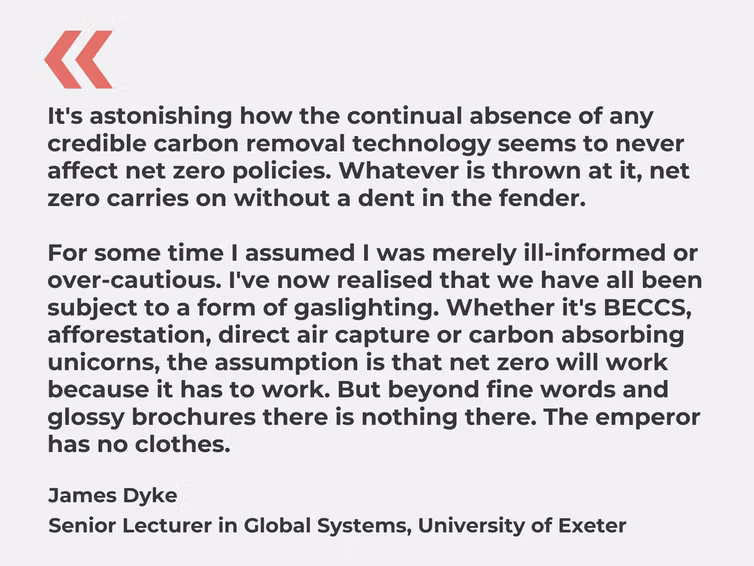
Collectively we three authors of this article must have spent more than 80 years thinking about climate change. Why has it taken us so long to speak out about the obvious dangers of the concept of net zero? In our defence, the premise of net zero is deceptively simple – and we admit that it deceived us.

The threats of climate change are the direct result of there being too much carbon dioxide in the atmosphere. So it follows that we must stop emitting more and even remove some of it. This idea is central to the world’s current plan to avoid catastrophe. In fact, there are many suggestions as to how to actually do this, from mass tree planting, to high tech direct air capture devices that suck out carbon dioxide from the air.

The current consensus is that if we deploy these and other so-called “carbon dioxide removal” techniques at the same time as reducing our burning of fossil fuels, we can more rapidly halt global warming. Hopefully around the middle of this century we will achieve “net zero”. This is the point at which any residual emissions of greenhouse gases are balanced by technologies removing them from the atmosphere.

This is a great idea, in principle. Unfortunately, in practice it helps perpetuate a belief in technological salvation and diminishes the sense of urgency surrounding the need to curb emissions now.

We have arrived at the painful realisation that the idea of net zero has licensed a recklessly cavalier “burn now, pay later” approach which has seen carbon emissions continue to soar. It has also hastened the destruction of the natural world by increasing deforestation today, and greatly increases the risk of further devastation in the future.


To understand how this has happened, how humanity has gambled its civilisation on no more than promises of future solutions, we must return to the late 1980s, when climate change broke out onto the international stage.

On June 22 1988, James Hansen was the administrator of Nasa’s Goddard Institute for Space Studies, a prestigious appointment but someone largely unknown outside of academia.

By the afternoon of the 23rd he was well on the way to becoming the world’s most famous climate scientist. This was as a direct result of his testimony to the US congress, when he forensically presented the evidence that the Earth’s climate was warming and that humans were the primary cause: “The greenhouse effect has been detected, and it is changing our climate now.”

If we had acted on Hansen’s testimony at the time, we would have been able to decarbonise our societies at a rate of around 2% a year in order to give us about a two-in-three chance of limiting warming to no more than 1.5°C. It would have been a huge challenge, but the main task at that time would have been to simply stop the accelerating use of fossil fuels while fairly sharing out future emissions.

Four years later, there were glimmers of hope that this would be possible. During the 1992 Earth Summit in Rio, all nations agreed to stabilise concentrations of greenhouse gases to ensure that they did not produce dangerous interference with the climate. The 1997 Kyoto Summit attempted to start to put that goal into practice. But as the years passed, the initial task of keeping us safe became increasingly harder given the continual increase in fossil fuel use.

It was around that time that the first computer models linking greenhouse gas emissions to impacts on different sectors of the economy were developed. These hybrid climate-economic models are known as Integrated Assessment Models. They allowed modellers to link economic activity to the climate by, for example, exploring how changes in investments and technology could lead to changes in greenhouse gas emissions.

They seemed like a miracle: you could try out policies on a computer screen before implementing them, saving humanity costly experimentation. They rapidly emerged to become key guidance for climate policy. A primacy they maintain to this day.

Unfortunately, they also removed the need for deep critical thinking. Such models represent society as a web of idealised, emotionless buyers and sellers and thus ignore complex social and political realities, or even the impacts of climate change itself. Their implicit promise is that market-based approaches will always work. This meant that discussions about policies were limited to those most convenient to politicians: incremental changes to legislation and taxes.

Around the time they were first developed, efforts were being made to secure US action on the climate by allowing it to count carbon sinks of the country’s forests. The US argued that if it managed its forests well, it would be able to store a large amount of carbon in trees and soil which should be subtracted from its obligations to limit the burning of coal, oil and gas. In the end, the US largely got its way. Ironically, the concessions were all in vain, since the US senate never ratified the agreement.


Postulating a future with more trees could in effect offset the burning of coal, oil and gas now. As models could easily churn out numbers that saw atmospheric carbon dioxide go as low as one wanted, ever more sophisticated scenarios could be explored which reduced the perceived urgency to reduce fossil fuel use. By including carbon sinks in climate-economic models, a Pandora’s box had been opened.

It’s here we find the genesis of today’s net zero policies.

That said, most attention in the mid-1990s was focused on increasing energy efficiency and energy switching (such as the UK’s move from coal to gas) and the potential of nuclear energy to deliver large amounts of carbon-free electricity. The hope was that such innovations would quickly reverse increases in fossil fuel emissions.

But by around the turn of the new millennium it was clear that such hopes were unfounded. Given their core assumption of incremental change, it was becoming more and more difficult for economic-climate models to find viable pathways to avoid dangerous climate change. In response, the models began to include more and more examples of carbon capture and storage, a technology that could remove the carbon dioxide from coal-fired power stations and then store the captured carbon deep underground indefinitely.

This had been shown to be possible in principle: compressed carbon dioxide had been separated from fossil gas and then injected underground in a number of projects since the 1970s. These Enhanced Oil Recovery schemes were designed to force gases into oil wells in order to push oil towards drilling rigs and so allow more to be recovered – oil that would later be burnt, releasing even more carbon dioxide into the atmosphere.

Carbon capture and storage offered the twist that instead of using the carbon dioxide to extract more oil, the gas would instead be left underground and removed from the atmosphere. This promised breakthrough technology would allow climate friendly coal and so the continued use of this fossil fuel. But long before the world would witness any such schemes, the hypothetical process had been included in climate-economic models. In the end, the mere prospect of carbon capture and storage gave policy makers a way out of making the much needed cuts to greenhouse gas emissions.

When the international climate change community convened in Copenhagen in 2009 it was clear that carbon capture and storage was not going to be sufficient for two reasons.

First, it still did not exist. There were no carbon capture and storage facilities in operation on any coal fired power station and no prospect the technology was going to have any impact on rising emissions from increased coal use in the foreseeable future.

The biggest barrier to implementation was essentially cost. The motivation to burn vast amounts of coal is to generate relatively cheap electricity. Retrofitting carbon scrubbers on existing power stations, building the infrastructure to pipe captured carbon, and developing suitable geological storage sites required huge sums of money. Consequently the only application of carbon capture in actual operation then – and now – is to use the trapped gas in enhanced oil recovery schemes. Beyond a single demonstrator, there has never been any capture of carbon dioxide from a coal fired power station chimney with that captured carbon then being stored underground.

Just as important, by 2009 it was becoming increasingly clear that it would not be possible to make even the gradual reductions that policy makers demanded. That was the case even if carbon capture and storage was up and running. The amount of carbon dioxide that was being pumped into the air each year meant humanity was rapidly running out of time.


With hopes for a solution to the climate crisis fading again, another magic bullet was required. A technology was needed not only to slow down the increasing concentrations of carbon dioxide in the atmosphere, but actually reverse it. In response, the climate-economic modelling community – already able to include plant-based carbon sinks and geological carbon storage in their models – increasingly adopted the “solution” of combining the two.

So it was that Bioenergy Carbon Capture and Storage, or BECCS, rapidly emerged as the new saviour technology. By burning “replaceable” biomass such as wood, crops, and agricultural waste instead of coal in power stations, and then capturing the carbon dioxide from the power station chimney and storing it underground, BECCS could produce electricity at the same time as removing carbon dioxide from the atmosphere. That’s because as biomass such as trees grow, they suck in carbon dioxide from the atmosphere. By planting trees and other bioenergy crops and storing carbon dioxide released when they are burnt, more carbon could be removed from the atmosphere.

With this new solution in hand the international community regrouped from repeated failures to mount another attempt at reining in our dangerous interference with the climate. The scene was set for the crucial 2015 climate conference in Paris.

As its general secretary brought the 21st United Nations conference on climate change to an end, a great roar issued from the crowd. People leaped to their feet, strangers embraced, tears welled up in eyes bloodshot from lack of sleep.

The emotions on display on December 13, 2015 were not just for the cameras. After weeks of gruelling high-level negotiations in Paris a breakthrough had finally been achieved. Against all expectations, after decades of false starts and failures, the international community had finally agreed to do what it took to limit global warming to well below 2°C, preferably to 1.5°C, compared to pre-industrial levels.

The Paris Agreement was a stunning victory for those most at risk from climate change. Rich industrialised nations will be increasingly impacted as global temperatures rise. But it’s the low lying island states such as the Maldives and the Marshall Islands that are at imminent existential risk. As a later UN special report made clear, if the Paris Agreement was unable to limit global warming to 1.5°C, the number of lives lost to more intense storms, fires, heatwaves, famines and floods would significantly increase.

But dig a little deeper and you could find another emotion lurking within delegates on December 13. Doubt. We struggle to name any climate scientist who at that time thought the Paris Agreement was feasible. We have since been told by some scientists that the Paris Agreement was “of course important for climate justice but unworkable” and “a complete shock, no one thought limiting to 1.5°C was possible”. Rather than being able to limit warming to 1.5°C, a senior academic involved in the IPCC concluded we were heading beyond 3°C by the end of this century.

Instead of confront our doubts, we scientists decided to construct ever more elaborate fantasy worlds in which we would be safe. The price to pay for our cowardice: having to keep our mouths shut about the ever growing absurdity of the required planetary-scale carbon dioxide removal.

Taking centre stage was BECCS because at the time this was the only way climate-economic models could find scenarios that would be consistent with the Paris Agreement. Rather than stabilise, global emissions of carbon dioxide had increased some 60% since 1992.

Alas, BECCS, just like all the previous solutions, was too good to be true.

Across the scenarios produced by the Intergovernmental Panel on Climate Change (IPCC) with a 66% or better chance of limiting temperature increase to 1.5°C, BECCS would need to remove 12 billion tonnes of carbon dioxide each year. BECCS at this scale would require massive planting schemes for trees and bioenergy crops.

The Earth certainly needs more trees. Humanity has cut down some three trillion since we first started farming some 13,000 years ago. But rather than allow ecosystems to recover from human impacts and forests to regrow, BECCS generally refers to dedicated industrial-scale plantations regularly harvested for bioenergy rather than carbon stored away in forest trunks, roots and soils.

Currently, the two most efficient biofuels are sugarcane for bioethanol and palm oil for biodiesel – both grown in the tropics. Endless rows of such fast growing monoculture trees or other bioenergy crops harvested at frequent intervals devastate biodiversity.

It has been estimated that BECCS would demand between 0.4 and 1.2 billion hectares of land. That’s 25% to 80% of all the land currently under cultivation. How will that be achieved at the same time as feeding 8-10 billion people around the middle of the century or without destroying native vegetation and biodiversity?


Growing billions of trees would consume vast amounts of water – in some places where people are already thirsty. Increasing forest cover in higher latitudes can have an overall warming effect because replacing grassland or fields with forests means the land surface becomes darker. This darker land absorbs more energy from the Sun and so temperatures rise. Focusing on developing vast plantations in poorer tropical nations comes with real risks of people being driven off their lands.

And it is often forgotten that trees and the land in general already soak up and store away vast amounts of carbon through what is called the natural terrestrial carbon sink. Interfering with it could both disrupt the sink and lead to double accounting.

As these impacts are becoming better understood, the sense of optimism around BECCS has diminished.

Given the dawning realisation of how difficult Paris would be in the light of ever rising emissions and limited potential of BECCS, a new buzzword emerged in policy circles: the “overshoot scenario”. Temperatures would be allowed to go beyond 1.5°C in the near term, but then be brought down with a range of carbon dioxide removal by the end of the century. This means that net zero actually means carbon negative. Within a few decades, we will need to transform our civilisation from one that currently pumps out 40 billion tons of carbon dioxide into the atmosphere each year, to one that produces a net removal of tens of billions.


[The article continues, here]

There is only one plausible way to cut CO2 and methane emissions.  And that's to actually cut them.  Offsets won't work.  Negative emissions won't work.  BECCS won't work.  It's no wonder emissions continue to rise.  We are heading towards a 3° C rise, not 1.5°.  And that will be catastrophic for our civilisation, the world's people and the environment.


Sunday, August 7, 2022

Soon the world will be unrecognisable


From The Guardian

The publication of Bill McGuire’s latest book, Hothouse Earth, could not be more timely. Appearing in the shops this week, it will be perused by sweltering customers who have just endured record high temperatures across the UK and now face the prospect of weeks of drought to add to their discomfort.

And this is just the beginning, insists McGuire, who is emeritus professor of geophysical and climate hazards at University College London. As he makes clear in his uncompromising depiction of the coming climatic catastrophe, we have – for far too long – ignored explicit warnings that rising carbon emissions are dangerously heating the Earth. Now we are going to pay the price for our complacency in the form of storms, floods, droughts and heatwaves that will easily surpass current extremes.

The crucial point, he argues, is that there is now no chance of us avoiding a perilous, all-pervasive climate breakdown. We have passed the point of no return and can expect a future in which lethal heatwaves and temperatures in excess of 50C (120F) are common in the tropics; where summers at temperate latitudes will invariably be baking hot, and where our oceans are destined to become warm and acidic. “A child born in 2020 will face a far more hostile world that its grandparents did,” McGuire insists.

In this respect, the volcanologist, who was also a member of the UK government’s Natural Hazard Working Group, takes an extreme position. Most other climate experts still maintain we have time left, although not very much, to bring about meaningful reductions in greenhouse gas emissions. A rapid drive to net zero and the halting of global warming is still within our grasp, they say.

Such claims are dismissed by McGuire. “I know a lot of people working in climate science who say one thing in public but a very different thing in private. In confidence, they are all much more scared about the future we face, but they won’t admit that in public. I call this climate appeasement and I believe it only makes things worse. The world needs to know how bad things are going to get before we can hope to start to tackle the crisis.”

McGuire finished writing Hothouse Earth at the end of 2021. He includes many of the record high temperatures that had just afflicted the planet, including extremes that had struck the UK. A few months after he completed his manuscript, and as publication loomed, he found that many of those records had already been broken. “That is the trouble with writing a book about climate breakdown,” says McGuire. “By the time it is published it is already out of date. That is how fast things are moving.”

Among the records broken during the book’s editing was the announcement that a temperature of 40.3C was reached in east England on 19 July, the highest ever recorded in the UK. (The country’s previous hottest temperature, 38.7C, was in Cambridge in 2019.)

In addition, London’s fire service had to tackle blazes across the capital, with one conflagration destroying 16 homes in Wennington, east London. Crews there had to fight to save the local fire station itself. “Who would have thought that a village on the edge of London would be almost wiped out by wildfires in 2022,” says McGuire. “If this country needs a wake-up call then surely that is it.”

Wildfires of unprecedented intensity and ferocity have also swept across Europe, North America and Australia this year, while record rainfall in the midwest led to the devastating flooding in the US’s Yellowstone national park. “And as we head further into 2022, it is already a different world out there,” he adds. “Soon it will be unrecognisable to every one of us.”

These changes underline one of the most startling aspects of climate breakdown: the speed with which global average temperature rises translate into extreme weather.

“Just look at what is happening already to a world which has only heated up by just over one degree,” says McGuire. “It turns out the climate is changing for the worse far quicker than predicted by early climate models. That’s something that was never expected.”

Since the dawn of the Industrial Revolution, when humanity began pumping carbon dioxide into the atmosphere, global temperatures have risen by just over 1C. At the Cop26 climate meeting in Glasgow last year, it was agreed that every effort should be made to try to limit that rise to 1.5C, although to achieve such a goal, it was calculated that global carbon emissions will have to be reduced by 45% by 2030.

“In the real world, that is not going to happen,” says McGuire. “Instead, we are on course for close to a 14% rise in emissions by that date – which will almost certainly see us shatter the 1.5C guardrail in less than a decade.”

And we should be in no doubt about the consequences. Anything above 1.5C will see a world plagued by intense summer heat, extreme drought, devastating floods, reduced crop yields, rapidly melting ice sheets and surging sea levels. A rise of 2C and above will seriously threaten the stability of global society, McGuire argues. It should also be noted that according to the most hopeful estimates of emission cut pledges made at Cop26, the world is on course to heat up by between 2.4C and 3C.


A number of climatologists, including Michael E Mann, have been very critical of this book.  And yet, the thesis is simple:

  1.  To avoid temperatures rising more than 1.5 degrees C, we need to cut emissions by 50% from now over the next 10 years.
  2. Yet emissions are still rising.  In fact, on the current trajectory, they'll be 12% higher per annum by 2030 than they are today.
  3. This will mean that temperatures will zoom past the 1.5 degree guardrail by 2030. 
  4. This will change the world dramatically and irreversibly for the worst.
There's lots of greenwashing going on.   Pious pronouncements of net-zero by 2050.  "We really care; bank with us because we care about the environment", while they continue to finance new fossil fuels.  An Australian petrol retailer has announced "carbon-neutral" petrol.  Big marketing coup!  But it's not carbon-neutral.  They're "offsetting" the carbon produced when you use their petrol by buying dodgy offsets.  One farmer admitted that he was being paid for not clearing the trees in one of his fields, (generating "offsets") while using the money he raises to clear an adjacent field.   

None of this will work.  We need to slash emissions by 50% by 2030 to avoid a 2 degree or worse rise.  And we are not.

Record high temperatures and extreme weather events are being recorded around the world. Photograph: Ian Logan/Getty Images