Showing posts with label The Conversation. Show all posts

Thursday, May 18, 2023

Climate change first 'went viral' 70 years ago

From The Conversation


We have grown so used to many things. To the pictures of wildfires and cremated animals, to the ice sheets calving into the ocean, to the promises of world leaders that they will heed the “last chance” warning of the scientists.

It’s hard for anyone under the age of 40 to remember a time when carbon dioxide build-up, whether it was “the greenhouse effect”, or “global warming” or “climate change” or now “climate crisis”, wasn’t in the news.

The long hot summer of 1988 – 35 years ago – is held as the moment that world leaders began to mouth the right pieties.

Presidential candidate (and soon to be president) George H.W. Bush said he would use the “White House effect” to fix the Greenhouse Effect (he didn’t). UK prime minister Margaret Thatcher warned of a giant experiment being conducted “with the system of this planet itself”.

Thirty-five years. But it was actually 35 years before that – fully 70 years ago this month – that the danger of carbon dioxide build-up in the atmosphere first travelled around the world.

That carbon dioxide trapped heat was uncontroversial. Irish scientist John Tyndall (possibly drawing on the work of an American, Eunice Foote) had shown that it did back in the mid-1800s.

In 1895, Swedish Nobel prize winner Svante Arrhenius had suggested that – over hundreds of years – the build-up of carbon dioxide released when humans burn oil, coal and gas might trap so much heat as to melt the tundra and make freezing winters a thing of the past.

His work was challenged, but the idea occasionally popped up in popular journals. In 1938 English steam engineer Guy Callendar suggested to the Royal Meteorological Society in London that warming was underway.

But it was in early May, 1953, at a meeting of the American Geophysical Union, that Canadian physicist Gilbert Plass – who had been corresponding with Callendar – told the gathered scientists that trouble was afoot.

Plass said that:

The large increase in industrial activity during the present century is discharging so much carbon dioxide into the atmosphere that the average temperature is rising at the rate of 1.5 degrees per century.

This got picked up by the Associated Press and other wire services and appeared in newspapers all around the world (even as far afield as the Sydney Morning Herald). Plass’s warning also popped up in Newsweek on May 18 and in Time on May 25.

The fact that the world was warming was already uncontroversial among scientists. But the emphatic connection with carbon dioxide made by Plass, as opposed to competing theories such as orbital wobbles or sunspot activity, was newsworthy.

Plass had become interested in the question of carbon dioxide buildup while working for the Ford Motor Company. He looked at how carbon dioxide actually functions in the real world, not just at sea level (without getting too technical. Many scientists had dismissed Arrhenius’s earlier work on the basis of false confidence that carbon dioxide worked the same there as in the stratosphere).

Plass kept working on the issue, with technical and popular publications through the rest of the 1950s. In 1956, he had an academic article on “the carbon dioxide theory of climate change” published in the Swedish scientific journal Tellus, and also a popular article in the American Scientist. And he was present at the first major meetings to discuss carbon dioxide build up.

Meanwhile, the carbon dioxide theory started getting more coverage among science journalists. One, George Wendt, wrote up the findings in the then well-regarded UNESCO Courier, and this got excerpted in the Irish Times in 1954, the same year that British journalists started mentioning it.

In 1957 the then-new magazine New Scientist mentioned it. By the end of the 1950s, anyone who read a newspaper could have been aware of the basic idea.

Throughout the 50s and 60s US, Swedish, German and Soviet scientists were examining the issue. In 1965 President Lyndon Johnson even namechecked carbon dioxide build-up in an address to Congress.

By the end of the 1960s international collaboration was beginning, though there was caution still. For instance, in April 1969 the American scientist Charles Keeling, who had been measuring atmospheric carbon dioxide concentrations at a Hawaiian observatory, revealed that he had been asked to change the title of a lecture from, “If carbon dioxide from fossil fuels is changing man’s environment, what will we do about it?” to “Is carbon dioxide from fossil fuel changing man’s environment?”

For climate historians like me, the 1970s are a fascinating period of intense measurement, modelling, observation and thinking which, by the end of the decade, produced a working consensus that there was serious trouble ahead. In effect, Plass had nailed it.

When Plass spoke out, the atmospheric concentration of carbon dioxide was at about 310 parts per million. Today, they’re 423 or so. Every year, as we burn more oil, coal and gas, the concentration climbs and more heat is trapped.

By the time Plass’s warning is 100 years old, the concentrations will be much higher. There’s a very good chance we will have gone over the 2°C warming level that used to be regarded as “safe”.


The Irish Times discusses climate change, way back in 1954.
 Irish Times / allouryesterdays.info


Tuesday, December 6, 2022

What legacy will Putin leave Russia?


From The Conversation


“Nobody listened to Russia,” Vladimir Putin intoned in 2018, as he unveiled the poisonous fruit of Russia’s military modernisation project: a nuclear-powered cruise missile; a hypersonic glider; and a nuclear warhead atop a drone submarine, designed to flood coastal cities with tsunamis. “Well, listen up now.”

Whether it’s new weapons, threatening nuclear war, or illegally invading sovereign states, Putin has a habit of seeking attention. In fact, it’s been his most predictable strategic reflex. Combining a thirst for great power status with a primitive nativism that has crossed over into xenophobia, Putin has consistently sought to compel others to respect Russia, though having them fear it will also apparently do.

But what sort of Russia will Putin leave behind for the millions of citizens at whose expense he has enriched himself, both personally and politically?

As his disastrous war in Ukraine demonstrates, Putin’s achievements embody anything but greatness. He will leave Russia geopolitically weakened, economically little more than a Chinese vassal, its people viewed with suspicion and hostility. Russia will have little more than a hefty nuclear arsenal and a disregard for the laws of war to coerce its neighbours.

For those reasons, future Russian historians are likely to view Putin with revulsion, not respect.

It’s worth recalling that Putin first came to power in 2000 on a wave of popular relief, not euphoria. For years, Russians had faced unappealing leadership choices: an increasingly ill and gaffe-prone Boris Yeltsin; the Communist Party’s dour Gennady Zyuganov; and Vladimir Zhirinovsky, the neofascist “clown prince” of Russian politics.

Unsurprisingly, Russians stoically but unenthusiasticaly voted for Yeltsin as president, but repeatedly elected rogues’ galleries of communists and nationalists (often called reds and browns) to Russia’s emasculated parliament as symbols of their discontent.

Enter Putin, who was plucked from obscurity by Yeltsin to become prime minister in August 1999. He soon became acting president when Yeltsin unexpectedly resigned on December 31.

In Putin, a population disillusioned with democracy and capitalism – which it blamed for economic shocks, rampant inflation and corruption, war in Chechnya, a decline in life expectancy and a shrinking population – saw the promise of relative youth. With that also came a sense of optimism that there was an alternative future for Russia than slow sclerosis, a return to the bad old days of the USSR, or muscular fascism.

At first Putin made few commitments: a vague notion of restoring Russia’s great power status, and a promise to clean up corruption.

Early in his tenure, pundits at home and abroad speculated about Putin the man. Did his shadowy KGB past hint at a preference for control, and ultimately dictatorship? Or did his role as chief of staff to the reformist mayor of St Petersburg, Anatoly Sobchak, suggest a democrat in disguise?

Of course, any doubts about Putin’s character have long since been expunged, save for a small number of his ardent Western supporters.

Yet it is worth recalling that the West has not just given Putin the benefit of the doubt on numerous occasions, but actively promoted him as a potential ally. Meeting Putin in June 2001, George W. Bush apparently “looked into his soul” and saw a trustworthy man. Tony Blair pushed hard (with Putin’s firm backing) for a new Russia-North Atlantic Council in 2002 to strengthen ties between Moscow and NATO members.

After those relationships soured over war in Iraq, Putin progressively repressed domestic freedoms with formal legislation and black PR, moulded the media into a propaganda arm, imprisoned oligarchs, embarked on gas wars against Ukraine, renationalised the energy industry, foreshadowed his current ultranationalism at the 2007 Munich Security Conference, launched the five-day war against Georgia, and threatened the West with nuclear annihilation.

Even then, Barak Obama still attempted to “reset” relations with the Kremlin in 2009 and 2010, prompting Russians to joke that when you reset a computer you didn’t erase its memory.

Western attempts to socialise Putin should therefore have ended well before Russia’s seizure of Crimea in 2014. Yet the West responded with sanctions packages, reflecting an unwillingness to accept significant risks or costs. It then actively rewarded Putin with the opportunity to further extend Russian energy dominance in Europe – and the strategic leverage that came with it – via the Nordstream gas project.

The shooting down of flight MH17 by proxy Russian forces raised opprobrium, but no retributive justice. Nor did the poisonings of dissidents in Western capitals with fourth-generation chemical weapons, the horrendous conduct of Russian forces in Syria, or the Kremlin’s earnest attempts to polarise Western societies and interfere in their elections.

The dwindling ranks of those who support a softer line on Russia often justify Western behaviour with an odd sense of victor’s guilt, in which they see the West as partly culpable for Russia’s problems.

They are right, although not in the way they might expect. It is not enlarging NATO but placating Putin that has emboldened him to invade a sovereign state in the service of his imperial ambitions and throw Europe’s security order into turmoil.

Ironically, Putin’s singular capacity to divide has assisted his success in uniting Russia. He recognises that human frailties – fear, mistrust, anger – can be weaponised to generate support and even legitimacy, albeit not one recognisable in pluralist societies.

He set Kremlin clans against one another, elevating and demoting them in games of superpresidential sport. He encouraged victimhood by blaming Russia’s woes on moral decay in the West, American imperialism, liberals, “fascists”, Islamic terrorists, the Baltic states and Ukrainians.

He presented Russia’s oligarchs with a deal: they could continue to obscenely enrich themselves on the condition they stay out of politics. All the while he gradually shaped the apparatus of the state and society into a form in which he became the essence of all decisions, and the personification of Russian nationhood.

But, even in an autocracy, that only works provided there’s some good news to report.

For many of Putin’s presidencies, he was able to point to rising standards of living. Yet Russia’s structural inequalities have remained. In 2021, for instance, Russia’s 500 richest people controlled more wealth than the poorest 99.8% of the population.

That wealth is clustered in major cities. Russia’s ethnic minorities, save for local elites, are largely excluded.

Sanctions are also hurting. According to Andrei Illarionov, Putin’s former chief economic adviser, the number of Russians living in poverty will likely triple – to around one-third of the population. And an inability to diversify its economy will make Moscow beholden to Beijing as the main viable provider of capital to fund Russia’s extraction of energy and resources.

There is also no good news from the front lines. A combination of losses and defeats has made it harder to deny the scale of Russia’s military ineptitude. Having decried Ukrainians first as Nazis and then Satanists, Russia’s propagandists are now reduced to calling them ugly.

It is therefore increasingly evident that Putin has succeeded only in creating not a great power but a pre-modern petty state, characterised by fluid fiefdoms. He presides over a decaying and stratified society where wealth can be more precarious than poverty, where failure to intone whatever nonsense pours out of a cynical state media is grounds for suspicion and mistrust, and whose much-vaunted military might has been crippled by his own hubris.

Ultimately, Putin’s bequest to his people is grimness, not greatness. The next generation of Russians will be untrusted and unwanted in many of the world’s most prosperous and welcoming nations. Those who remain will be isolated, increasingly poor, and unable to shape their own destinies.

For all the suffering Putin and his people have inflicted on others, we should not be triumphant about that. On the contrary, we should lament it.

Friday, October 7, 2022

Scrapping Covid iso rules will make things worse


From The Conversation


COVID is an exceptional disease and was at its deadliest this year, causing more deaths in Australia between June and August 2022 than at any other time. There have been 288 deaths from influenza so far this year compared to more than 12,000 deaths from COVID.

The number of deaths from COVID in Australia in the first nine months of 2022 is more than ten times the annual national road toll of just over 1,000 – but we are not rushing to remove seat belts or drink-driving laws so people can have more freedom.

Isolation flattens the COVID curve by stopping infectious people from infecting others, and is a key pillar of COVID control.

Removing isolation will not help the workforce


Workforce shortages have been felt in every sector during the pandemic. Shortages of health workers have resulted in the need to import workers from overseas, and deadly outcomes for patients in some cases.

During epidemic peaks this year, the workforce was so badly affected that supermarket shelves could not be stocked. Removing the isolation period is hoped to ease workforce shortages – but any relief will be short-lived.

At times when COVID numbers are increasing, allowing infectious people to mingle freely at work and socially will create epidemic growth and make the crisis even worse. At the current time, when cases are relatively low, removing isolation mandates will not materially benefit the workforce, but will make the workplace and schools less safe.

Eliminating isolation rules provides the opportunity for governments to save costs. Without mandatory isolation support, payments for workers needing to isolate will end.

While politicians spin this as trusting Australians to take “personal responsibility”, sadly many Australians will simply not have the means to take time off work. With elimination of mandatory isolation periods, essential workers in low paying jobs will find themselves at even more risk of contracting COVID in the workplace.

The pandemic is not over


Newer variants of SARS-CoV-2, the virus that causes COVID, are more immune-evasive than ever. Immunity from vaccines wanes within two to three months, and so too does immunity from infection. Hybrid immunity is cited as a reason for abandoning isolation, but is unlikely to eventuate.

Indeed, we saw this with the recent BA5 wave leading to more hospitalisations and deaths than the January/February BA1 wave, despite the presence of much higher vaccine and infection-based immunity in the community. While no doubt this immunity prevented an even worse outcome, it clearly did not keep pace with virus evolution.

While it was hoped hybrid immunity from vaccines and prior infection would reduce subsequent infections, this has not been the reality. Reinfection is becoming more common with variants that are increasingly distant from the original virus. And evidence is accruing that reinfection can cause severe disease.

The most vulnerable may be forced to withdraw from society and from unsafe workplaces to protect themselves. But it is a misconception that COVID is trivial for everyone else. People who are happy and healthy today could become disabled or chronically ill from COVID.

The long-term complications of COVID are substantial, and can include effects on the lungs, heart, brain and immune system. At 12 months after infection, the risk of heart attacks, strokes, blood clots and other complications including sudden death are about double compared to people who were never infected. Chronic complications can occur even after mild infection – including heart failure, strokes and dementia.

Dropping isolation will increase COVID transmission and result in an increase in serious chronic illness. It could be a mass disabling event and so drive major economic and societal losses.

The availability of treatments has been cited as a reason to cease isolation – but these are restricted to limited subgroups, and not available to everyone.

COVID is an epidemic disease and has behaved in a predictable way since 2020, causing recurrent epidemic waves.

Ceasing isolation will hasten the onset of the next wave. Allowing mass infection also creates favourable conditions for emergence of new variants which have been more contagious or more vaccine or treatment resistant.

What we need to do instead


To maximise productivity, health and social success, instead of ignoring COVID, we should tackle it with a layered approach to mitigation of transmission. This includes raising rates of boosters, widening access to antivirals and other treatments, masks, safe indoor air, and widely accessible testing.

Making isolation a rule, and supporting people financially to do so, has been a key pillar of our defences. This is still needed as viral evolution continues to outpace immunity.

We just had our worst wave and there is nothing to suggest the next won’t be similarly bad. Workplace absenteeism is a function of transmission, so better control of SARS-CoV-2 will result in greater productivity, less disruption to families and businesses, and a more successful way forward to living with COVID.

Thursday, August 11, 2022

De-carbonisation via carbon capture is a mirage


From The Conversation.


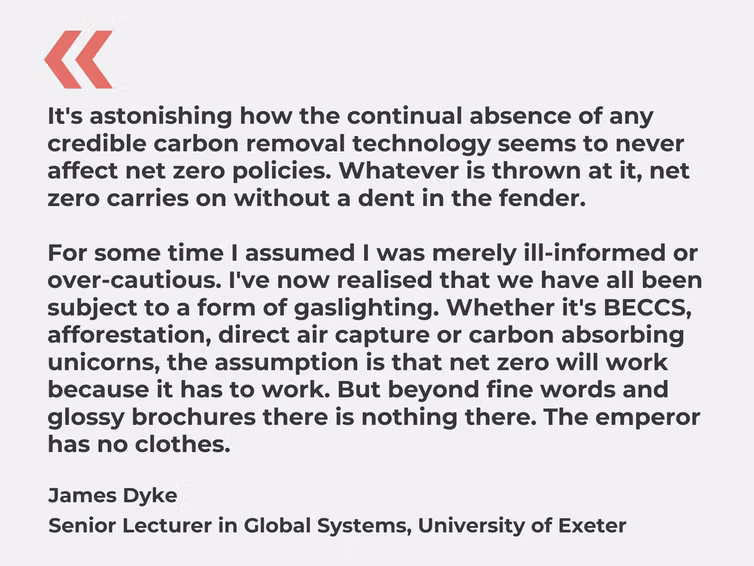
Collectively we three authors of this article must have spent more than 80 years thinking about climate change. Why has it taken us so long to speak out about the obvious dangers of the concept of net zero? In our defence, the premise of net zero is deceptively simple – and we admit that it deceived us.

The threats of climate change are the direct result of there being too much carbon dioxide in the atmosphere. So it follows that we must stop emitting more and even remove some of it. This idea is central to the world’s current plan to avoid catastrophe. In fact, there are many suggestions as to how to actually do this, from mass tree planting, to high tech direct air capture devices that suck out carbon dioxide from the air.

The current consensus is that if we deploy these and other so-called “carbon dioxide removal” techniques at the same time as reducing our burning of fossil fuels, we can more rapidly halt global warming. Hopefully around the middle of this century we will achieve “net zero”. This is the point at which any residual emissions of greenhouse gases are balanced by technologies removing them from the atmosphere.

This is a great idea, in principle. Unfortunately, in practice it helps perpetuate a belief in technological salvation and diminishes the sense of urgency surrounding the need to curb emissions now.

We have arrived at the painful realisation that the idea of net zero has licensed a recklessly cavalier “burn now, pay later” approach which has seen carbon emissions continue to soar. It has also hastened the destruction of the natural world by increasing deforestation today, and greatly increases the risk of further devastation in the future.


To understand how this has happened, how humanity has gambled its civilisation on no more than promises of future solutions, we must return to the late 1980s, when climate change broke out onto the international stage.

On June 22 1988, James Hansen was the administrator of Nasa’s Goddard Institute for Space Studies, a prestigious appointment but someone largely unknown outside of academia.

By the afternoon of the 23rd he was well on the way to becoming the world’s most famous climate scientist. This was as a direct result of his testimony to the US congress, when he forensically presented the evidence that the Earth’s climate was warming and that humans were the primary cause: “The greenhouse effect has been detected, and it is changing our climate now.”

If we had acted on Hansen’s testimony at the time, we would have been able to decarbonise our societies at a rate of around 2% a year in order to give us about a two-in-three chance of limiting warming to no more than 1.5°C. It would have been a huge challenge, but the main task at that time would have been to simply stop the accelerating use of fossil fuels while fairly sharing out future emissions.

Four years later, there were glimmers of hope that this would be possible. During the 1992 Earth Summit in Rio, all nations agreed to stabilise concentrations of greenhouse gases to ensure that they did not produce dangerous interference with the climate. The 1997 Kyoto Summit attempted to start to put that goal into practice. But as the years passed, the initial task of keeping us safe became increasingly harder given the continual increase in fossil fuel use.

It was around that time that the first computer models linking greenhouse gas emissions to impacts on different sectors of the economy were developed. These hybrid climate-economic models are known as Integrated Assessment Models. They allowed modellers to link economic activity to the climate by, for example, exploring how changes in investments and technology could lead to changes in greenhouse gas emissions.

They seemed like a miracle: you could try out policies on a computer screen before implementing them, saving humanity costly experimentation. They rapidly emerged to become key guidance for climate policy. A primacy they maintain to this day.

Unfortunately, they also removed the need for deep critical thinking. Such models represent society as a web of idealised, emotionless buyers and sellers and thus ignore complex social and political realities, or even the impacts of climate change itself. Their implicit promise is that market-based approaches will always work. This meant that discussions about policies were limited to those most convenient to politicians: incremental changes to legislation and taxes.

Around the time they were first developed, efforts were being made to secure US action on the climate by allowing it to count carbon sinks of the country’s forests. The US argued that if it managed its forests well, it would be able to store a large amount of carbon in trees and soil which should be subtracted from its obligations to limit the burning of coal, oil and gas. In the end, the US largely got its way. Ironically, the concessions were all in vain, since the US senate never ratified the agreement.


Postulating a future with more trees could in effect offset the burning of coal, oil and gas now. As models could easily churn out numbers that saw atmospheric carbon dioxide go as low as one wanted, ever more sophisticated scenarios could be explored which reduced the perceived urgency to reduce fossil fuel use. By including carbon sinks in climate-economic models, a Pandora’s box had been opened.

It’s here we find the genesis of today’s net zero policies.

That said, most attention in the mid-1990s was focused on increasing energy efficiency and energy switching (such as the UK’s move from coal to gas) and the potential of nuclear energy to deliver large amounts of carbon-free electricity. The hope was that such innovations would quickly reverse increases in fossil fuel emissions.

But by around the turn of the new millennium it was clear that such hopes were unfounded. Given their core assumption of incremental change, it was becoming more and more difficult for economic-climate models to find viable pathways to avoid dangerous climate change. In response, the models began to include more and more examples of carbon capture and storage, a technology that could remove the carbon dioxide from coal-fired power stations and then store the captured carbon deep underground indefinitely.

This had been shown to be possible in principle: compressed carbon dioxide had been separated from fossil gas and then injected underground in a number of projects since the 1970s. These Enhanced Oil Recovery schemes were designed to force gases into oil wells in order to push oil towards drilling rigs and so allow more to be recovered – oil that would later be burnt, releasing even more carbon dioxide into the atmosphere.

Carbon capture and storage offered the twist that instead of using the carbon dioxide to extract more oil, the gas would instead be left underground and removed from the atmosphere. This promised breakthrough technology would allow climate friendly coal and so the continued use of this fossil fuel. But long before the world would witness any such schemes, the hypothetical process had been included in climate-economic models. In the end, the mere prospect of carbon capture and storage gave policy makers a way out of making the much needed cuts to greenhouse gas emissions.

When the international climate change community convened in Copenhagen in 2009 it was clear that carbon capture and storage was not going to be sufficient for two reasons.

First, it still did not exist. There were no carbon capture and storage facilities in operation on any coal fired power station and no prospect the technology was going to have any impact on rising emissions from increased coal use in the foreseeable future.

The biggest barrier to implementation was essentially cost. The motivation to burn vast amounts of coal is to generate relatively cheap electricity. Retrofitting carbon scrubbers on existing power stations, building the infrastructure to pipe captured carbon, and developing suitable geological storage sites required huge sums of money. Consequently the only application of carbon capture in actual operation then – and now – is to use the trapped gas in enhanced oil recovery schemes. Beyond a single demonstrator, there has never been any capture of carbon dioxide from a coal fired power station chimney with that captured carbon then being stored underground.

Just as important, by 2009 it was becoming increasingly clear that it would not be possible to make even the gradual reductions that policy makers demanded. That was the case even if carbon capture and storage was up and running. The amount of carbon dioxide that was being pumped into the air each year meant humanity was rapidly running out of time.


With hopes for a solution to the climate crisis fading again, another magic bullet was required. A technology was needed not only to slow down the increasing concentrations of carbon dioxide in the atmosphere, but actually reverse it. In response, the climate-economic modelling community – already able to include plant-based carbon sinks and geological carbon storage in their models – increasingly adopted the “solution” of combining the two.

So it was that Bioenergy Carbon Capture and Storage, or BECCS, rapidly emerged as the new saviour technology. By burning “replaceable” biomass such as wood, crops, and agricultural waste instead of coal in power stations, and then capturing the carbon dioxide from the power station chimney and storing it underground, BECCS could produce electricity at the same time as removing carbon dioxide from the atmosphere. That’s because as biomass such as trees grow, they suck in carbon dioxide from the atmosphere. By planting trees and other bioenergy crops and storing carbon dioxide released when they are burnt, more carbon could be removed from the atmosphere.

With this new solution in hand the international community regrouped from repeated failures to mount another attempt at reining in our dangerous interference with the climate. The scene was set for the crucial 2015 climate conference in Paris.

As its general secretary brought the 21st United Nations conference on climate change to an end, a great roar issued from the crowd. People leaped to their feet, strangers embraced, tears welled up in eyes bloodshot from lack of sleep.

The emotions on display on December 13, 2015 were not just for the cameras. After weeks of gruelling high-level negotiations in Paris a breakthrough had finally been achieved. Against all expectations, after decades of false starts and failures, the international community had finally agreed to do what it took to limit global warming to well below 2°C, preferably to 1.5°C, compared to pre-industrial levels.

The Paris Agreement was a stunning victory for those most at risk from climate change. Rich industrialised nations will be increasingly impacted as global temperatures rise. But it’s the low lying island states such as the Maldives and the Marshall Islands that are at imminent existential risk. As a later UN special report made clear, if the Paris Agreement was unable to limit global warming to 1.5°C, the number of lives lost to more intense storms, fires, heatwaves, famines and floods would significantly increase.

But dig a little deeper and you could find another emotion lurking within delegates on December 13. Doubt. We struggle to name any climate scientist who at that time thought the Paris Agreement was feasible. We have since been told by some scientists that the Paris Agreement was “of course important for climate justice but unworkable” and “a complete shock, no one thought limiting to 1.5°C was possible”. Rather than being able to limit warming to 1.5°C, a senior academic involved in the IPCC concluded we were heading beyond 3°C by the end of this century.

Instead of confront our doubts, we scientists decided to construct ever more elaborate fantasy worlds in which we would be safe. The price to pay for our cowardice: having to keep our mouths shut about the ever growing absurdity of the required planetary-scale carbon dioxide removal.

Taking centre stage was BECCS because at the time this was the only way climate-economic models could find scenarios that would be consistent with the Paris Agreement. Rather than stabilise, global emissions of carbon dioxide had increased some 60% since 1992.

Alas, BECCS, just like all the previous solutions, was too good to be true.

Across the scenarios produced by the Intergovernmental Panel on Climate Change (IPCC) with a 66% or better chance of limiting temperature increase to 1.5°C, BECCS would need to remove 12 billion tonnes of carbon dioxide each year. BECCS at this scale would require massive planting schemes for trees and bioenergy crops.

The Earth certainly needs more trees. Humanity has cut down some three trillion since we first started farming some 13,000 years ago. But rather than allow ecosystems to recover from human impacts and forests to regrow, BECCS generally refers to dedicated industrial-scale plantations regularly harvested for bioenergy rather than carbon stored away in forest trunks, roots and soils.

Currently, the two most efficient biofuels are sugarcane for bioethanol and palm oil for biodiesel – both grown in the tropics. Endless rows of such fast growing monoculture trees or other bioenergy crops harvested at frequent intervals devastate biodiversity.

It has been estimated that BECCS would demand between 0.4 and 1.2 billion hectares of land. That’s 25% to 80% of all the land currently under cultivation. How will that be achieved at the same time as feeding 8-10 billion people around the middle of the century or without destroying native vegetation and biodiversity?


Growing billions of trees would consume vast amounts of water – in some places where people are already thirsty. Increasing forest cover in higher latitudes can have an overall warming effect because replacing grassland or fields with forests means the land surface becomes darker. This darker land absorbs more energy from the Sun and so temperatures rise. Focusing on developing vast plantations in poorer tropical nations comes with real risks of people being driven off their lands.

And it is often forgotten that trees and the land in general already soak up and store away vast amounts of carbon through what is called the natural terrestrial carbon sink. Interfering with it could both disrupt the sink and lead to double accounting.

As these impacts are becoming better understood, the sense of optimism around BECCS has diminished.

Given the dawning realisation of how difficult Paris would be in the light of ever rising emissions and limited potential of BECCS, a new buzzword emerged in policy circles: the “overshoot scenario”. Temperatures would be allowed to go beyond 1.5°C in the near term, but then be brought down with a range of carbon dioxide removal by the end of the century. This means that net zero actually means carbon negative. Within a few decades, we will need to transform our civilisation from one that currently pumps out 40 billion tons of carbon dioxide into the atmosphere each year, to one that produces a net removal of tens of billions.


[The article continues, here]

There is only one plausible way to cut CO2 and methane emissions.  And that's to actually cut them.  Offsets won't work.  Negative emissions won't work.  BECCS won't work.  It's no wonder emissions continue to rise.  We are heading towards a 3° C rise, not 1.5°.  And that will be catastrophic for our civilisation, the world's people and the environment.


Saturday, June 25, 2022

Russia: turning silence into free speech

 From The Conversation.


“It is impossible to stop a speeding train by throwing oneself onto the tracks,” wrote Russian poet Dmitry Kuzmin back in March. He was commenting on Olga Gordienko, a young teacher who, before she was arrested, stood for several minutes on a Moscow street with a sign that read:

At least don’t lie to yourself. War is death. Enough of this bloody fight for peace!

While acknowledging the teacher’s bravery, Kuzmin warned protestors to take care. Change would not come through such isolated acts, however admirable.

What would you do if your country launched a war of aggression, causing tens of thousands of deaths and displacing millions? What if the price of protest or even posting objections on social media was arrest and imprisonment?

What if you knew that over the past decades many of your country’s most outspoken journalists had been killed for refusing to the toe the government line? What if even mentioning the word “war” online, in print, or on the street was illegal?

Would you speak out, or keep quiet and bide your time?

These are the difficult questions facing those Russians who oppose Vladimir Putin and his invasion of Ukraine. They are, of course, nothing compared to what Ukrainians face as their country is brutalised, their towns destroyed, their people raped and murdered. But they are still important questions for the future of both countries and the world at large.

They are questions of ethical, familial, and national obligations. They are questions of personal risk, strategy and tactics. They are questions about how best to speak through silence.

One powerful if all too brief example of how silencing can be turned into speech is Novaya Gazeta, the independent Russian news outlet that held out longest against the new censorship regime. It did so, strangely enough, by seemingly agreeing to be silenced.

On 4 March, just eight days after Russia began its invasion of Ukraine, Putin signed into law legislation criminalising the “public dissemination of deliberately false information about the military forces of the Russian Federation”.

Images and news of Russia’s brutality in Ukraine were condemned as “feki” (fakes), a term borrowed from English that suggests not just deceptiveness but also the influence of what the Russian government likes to call “foreign agents”.

Already under extreme pressure from the authorities,, and now faced with the threat of 15 years imprisonment under the new law, most independent Russian media outlets either shut down operations or moved them abroad. Those that continued to operate had their websites blocked.

For around a month, however, Novaya Gazeta adopted a different strategy. It continued to report on the war using the official euphemism “special operation”, accompanied by parenthetical comments to the effect that “you know what we mean, but we are not allowed to say it”.

Throughout March, Novaya Gazeta held up official lies for ridicule. The Russian government had insisted that there were no conscripts amongst the invasion force. A headline reported that Russian conscripts were being withdrawn from Ukraine “where they never were”.

Novaya Gazeta deployed a similarly absurdist use of blanks to mark the silencing of any mention of the war:

Asked whether he is ready to stop the ___ , Putin answered “no”.

When journalist Marina Ovsyannikova interrupted a live Russian Channel One news broadcast to display a sign protesting the war and the official lies, Novaya Gazeta reported this brief puncturing of the official reality by showing an image of Ovsyannikova’s sign with all the words blanked out except the line “Don’t believe the propaganda.” 

Like the blank placards used by some Russian anti-war protestors, the erasure spoke loudly of Russian censorship and propaganda.

In its March 16 print issue, Novaya Gazeta went further in uncovering the sign:

NO ___

STOP THE ___

DON’T BELIEVE THE PROPAGANDA

THEY ARE LYING TO YOU HERE

RUSSIANS AGAINST ___

 Beneath the cover image with this text ran the headline “The Zombification Was Shaken Live on Channel One”.

Here again, the triple deletion of the word “war” arguably spoke even more loudly than Ovsyannikova’s original sign. Like the minds of the zombified, brainwashed viewers, it had been erased.

The loudness of this silence was confirmed by the reaction to the cover image. After its release, Novaya Gazeta reported that newsagents were refusing to sell the issue and that copies had been returned to their offices.

As the month wore on, possessing a copy of Novaya Gazeta became more dangerous. On 27 March, a St Petersburg news site reported that a protester had been arrested, and that the police had also taken an interest in an elderly woman in the vicinity who had been holding a copy of Novaya Gazeta.

Appearing on a news site that generally follows the government line, the article was itself another dim disturbance in the blackout of reality. It showed images and a video of the artist Yevgeniya Isayeva, dressed all in white, standing on the steps of a building on St Petersburg’s Nevsky Prospect and pouring red paint over herself while repeating the words “my heart is bleeding”.

Also visible on the video was Novaya Gazeta’s frontpage headline:

THERE IS GOOD NEWS. THE WORD PEACE IS NOT YET BANNED.

The article reported that the police removed Isayeva within the space of seven minutes. The police asked the elderly woman to put away her copy of Novaya Gazeta, but she was not detained.

On 27 March, holding a copy of Novaya Gazeta was not yet illegal. But the following day Novaya Gazeta received its second official warning and was forced to close. Despite its meticulous efforts, the dance with censorship – the newspaper’s attempt to speak through silence – had come to an end.


Sunday June 12 marked the 30th annual Russia Day celebration. That day, a protest sign was unveiled on the banks of the Moskva River in front of the Ministry of Defence building in Moscow. “Today is not my day,” it read.

The statement holds true for Russians who oppose the war both outside and inside the country. Many outside the country recognise that now is not the time for their voices to dominate. Those inside lack the strength and numbers to stop the runaway train of Putin’s bloody war.

Novaya Gazeta’s editor Dmitry Muratov, who was awarded the Nobel Peace Prize in 2021 for his journalism, has found another way of underscoring that today is not the day of Russian journalists, artists and writers.

As he first announced back in March, he is marking World Refugee Day, on June 20, by auctioning his Nobel medal and donating the proceeds to aid Ukrainian refugees. Muratov’s act once again transforms self-abnegating silence into protest speech.

In August 1991, hundreds of thousands of Russians protested the attempted coup by Soviet hardliners. By comparison, the lone protesters now unveiling signs on Russian streets only to be arrested and taken away might seem utterly inconsequential. Like the small group who unveiled banners in Red Square in August 1968 to protest the Russian invasion of Czechoslovakia, today’s protesters will probably have little to no effect this year or next, perhaps even this decade or next.

But let us hope that, like the Red Square protest over five decades ago, today’s efforts to speak through silence are heard, if not now, then in the years to come.

Source: Index on Censorship


Tuesday, June 7, 2022

Climate change: could La Niña become the norm?

 From The Conversation


Climate change is slowing down the conveyor belt of ocean currents that brings warm water from the tropics up to the North Atlantic. Our research, published today in Nature Climate Change, looks at the profound consequences to global climate if this Atlantic conveyor collapses entirely.

We found the collapse of this system – called the Atlantic meridional overturning circulation – would shift the Earth’s climate to a more La Niña-like state. This would mean more flooding rains over eastern Australia and worse droughts and bushfire seasons over southwest United States.

East-coast Australians know what unrelenting La Niña feels like. Climate change has loaded our atmosphere with moister air, while two summers of La Niña warmed the ocean north of Australia. Both contributed to some of the wettest conditions ever experienced, with record-breaking floods in New South Wales and Queensland.

Meanwhile, over the southwest of North America, a record drought and severe bushfires have put a huge strain on emergency services and agriculture, with the 2021 fires alone estimated to have cost at least US$70 billion.

Earth’s climate is dynamic, variable, and ever-changing. But our current trajectory of unabated greenhouse gas emissions is giving the whole system a giant kick that’ll have uncertain consequences – consequences that’ll rewrite our textbook description of the planet’s ocean circulation and its impact.


What is the Atlantic overturning meridional circulation?

The Atlantic overturning circulation comprises a massive flow of warm tropical water to the North Atlantic that helps keep European climate mild, while allowing the tropics a chance to lose excess heat. An equivalent overturning of Antarctic waters can be found in the Southern Hemisphere.

Climate records reaching back 120,000 years reveal the Atlantic overturning circulation has switched off, or dramatically slowed, during ice ages. It switches on and placates European climate during so-called “interglacial periods”, when the Earth’s climate is warmer.

Since human civilisation began around 5,000 years ago, the Atlantic overturning has been relatively stable. But over the past few decades a slowdown has been detected, and this has scientists worried.

Why the slowdown? One unambiguous consequence of global warming is the melting of polar ice caps in Greenland and Antarctica. When these icecaps melt they dump massive amounts of freshwater into the oceans, making water more buoyant and reducing the sinking of dense water at high latitudes.

Around Greenland alone, a massive 5 trillion tonnes of ice has melted in the past 20 years. That’s equivalent to 10,000 Sydney Harbours worth of freshwater. This melt rate is set to increase over the coming decades if global warming continues unabated.

A collapse of the North Atlantic and Antarctic overturning circulations would profoundly alter the anatomy of the world’s oceans. It would make them fresher at depth, deplete them of oxygen, and starve the upper ocean of the upwelling of nutrients provided when deep waters resurface from the ocean abyss. The implications for marine ecosystems would be profound.

With Greenland ice melt already well underway, scientists estimate the Atlantic overturning is at its weakest for at least the last millennium, with predictions of a future collapse on the cards in coming centuries if greenhouse gas emissions go unchecked.


The ramifications of a slowdown

In our study, we used a comprehensive global model to examine what Earth’s climate would look like under such a collapse. We switched the Atlantic overturning off by applying a massive meltwater anomaly to the North Atlantic, and then compared this to an equivalent run with no meltwater applied.

Our focus was to look beyond the well-known regional impacts around Europe and North America, and to check how Earth’s climate would change in remote locations, as far south as Antarctica.

The first thing the model simulations revealed was that without the Atlantic overturning, a massive pile up of heat builds up just south of the Equator.

This excess of tropical Atlantic heat pushes more warm moist air into the upper troposphere (around 10 kilometres into the atmosphere), causing dry air to descend over the east Pacific.

The descending air then strengthens trade winds, which pushes warm water towards the Indonesian seas. And this helps put the tropical Pacific into a La Niña-like state.

Australians may think of La Niña summers as cool and wet. But under the long-term warming trend of climate change, their worst impacts will be flooding rain, especially over the east.

We also show an Atlantic overturning shutdown would be felt as far south as Antarctica. Rising warm air over the West Pacific would trigger wind changes that propagate south to Antarctica. This would deepen the atmospheric low pressure system over the Amundsen Sea, which sits off west Antarctica.

This low pressure system is known to influence ice sheet and ice shelf melt, as well as ocean circulation and sea-ice extent as far west as the Ross Sea.

At no time in Earth’s history, giant meteorites and super-volcanos aside, has our climate system been jolted by changes in atmospheric gas composition like what we are imposing today by our unabated burning of fossil fuels.

The oceans are the flywheel of Earth’s climate, slowing the pace of change by absorbing heat and carbon in vast quantities. But there is payback, with sea level rise, ice melt, and a significant slowdown of the Atlantic overturning circulation projected for this century.

Now we know this slowdown will not just affect the North Atlantic region, but as far away as Australia and Antarctica.

We can prevent these changes from happening by growing a new low-carbon economy. Doing so will change, for the second time in less than a century, the course of Earth’s climate history – this time for the better.
NSW floods


Thursday, May 26, 2022

Does raising the minimum wage kill jobs?

 From The Conversation

For decades it was conventional wisdom in the field of economics that a higher minimum wage results in fewer jobs.

In part, that’s because it’s based on the law of supply and demand, one of the most well-known ideas in economics. Despite it being called a “law,” it’s actually two theories that suggest if the price of something goes up – wages, for example – demand will fall – in this case, for workers. Meanwhile, their supply will rise. Thus an introduction of a high minimum wage would cause the supply of labor to exceed demand, resulting in unemployment.

But this is just a theory with many built-in assumptions.

Then, in 1994, David Card, an economist at the University of California, Berkeley, and one of this year’s Nobel winners, and the late Alan Krueger used a natural experiment to show that, in the real world, this doesn’t actually happen. In 1992, New Jersey increased its minimum wage while neighboring Pennsylvania did not. Yet there was little change in employment.

Economics studies the production, distribution and consumption of goods and services. And so, like other social sciences, economics is fundamentally interested in human behavior.

But humans behave in a wide variety of often hard-to-predict ways, with countless complications. As a result, economists rely on abstraction and theory to create models in hopes of representing and explaining the complex world that they are studying. This emphasis on complicated mathematical models, theory and abstraction has made economics a lot less accessible to the general public than other social sciences, such as psychology or sociology.

Economists also use these models to answer important questions, such as “Does a minimum wage cause unemployment?” In fact, this is one of the most studied questions in all of economics since at least 1912, when Massachusetts became the first state to create a minimum wage. The federal wage floor came in 1938 with the passage of the Fair Labor Standards Act.

And it’s been controversial ever since. Proponents argue that a higher minimum wage helps create jobs, grow the economy, fight poverty and reduce wage inequality.

Critics stress that minimum wages cause unemployment, hurt the economy and actually harm the low-income people that were supposed to be helped.

Most students in my introductory microeconomics class can easily show, using the standard supply and demand model, that an increase in the minimum wage above the level that the market sets on its own should drive up unemployment. In fact, this is one of the most commonly used examples in introductory economics textbooks.

However, this result assumes a perfectly competitive labor market in which workers and employers are abundant and employees can change jobs with ease. This is rarely the case in the real world, where a few companies frequently dominate in what are known as monopsonies.

And so others theorized that because monopsonistic companies had the power to set wages artificially low, a higher minimum wage could, perhaps counterintuitively, prompt companies to hire more workers in order to recover some of their lost profitability as a result of the increased labor costs.

How can economists tell which of these two theories may be right? They need data.

Studying the real world is difficult, and it’s constantly changing, so it is not easy to obtain all the relevant evidence.

Unlike in medicine or other sciences, economists cannot conduct rigidly controlled clinical trials, a method vacinologists used to test the efficacy of COVID-19 vaccines. Due to financial, ethical or practical constraints, we cannot easily split people into treatment or control groups – as is common in psychology. And we cannot randomly assign a higher minimum wage to some and not others and observe what will happen, which is how a biomedical scientist might study the impact of various treatments on human health.

And in studying the minimum wage, we cannot simply look at past times when it was increased and check what happened to unemployment a few weeks or months later. There are many other factors that affect the labor market, such as outsourcing and immigration, and it’s virtually impossible to isolate and pin down one factor such as a minimum wage hike as the cause.

This is where the pioneering work of natural experiments like the ones Card and Krueger have used over the years to study the effects of raising the minimum wage and other policy changes comes in. It began with their 1994 paper, but they’ve replicated the findings with other studies that have deepened the amount of data that shows the original theory about the minimum wage causing job losses is likely wrong.

Their approach isn’t without flaws – mostly technical ones –- and in fact economists still don’t have a clear answer to the question about the minimum wage that I posed earlier in this article. But because of Card, Krueger and their research, the debate over the minimum wage has gotten a lot less theoretical and much more empirical.

Only by studying how humans actually behave can economics hope to make meaningful predictions about how a policy change like increasing the minimum wage is likely to affect the behavior of the economy and the people living in it.


In Australia, the Reserve Bank of Australia (RBA) has done a study which concludes that a rise in the minimum wage (Australia has an extensive system of minimum wages) has no effect on employment or hours worked.  This is a particularly interesting study because it looks at each level of minimum wages (there are several) which have in the past had different percentage increases.  Those with higher percentage increases should have had higher rates of employment/hours worked losses.  And they did not.  Fascinating.