
From This is not Cool
RenewEconomy (Australia)[Article by Ray Wills]:
Solar is not just getting cheaper; it is sprinting down a learning curve that has held for half a century, with module prices falling about ten-thousand-fold as cumulative capacity has exploded.
That is my first message: a technology whose cost keeps dropping predictably as deployment grows, and where every new gigawatt makes the next gigawatt cheaper again.
And beating the trend line. [Prof Wills' comment refers to the way the slope of the capacity price trend line has steepened since 2020; i.e., the learning curve has accelerated]

The second message is about speed.
When we line up all major power sources from the year each first exceeded a bigly amount of energy – 100 TWh – solar and wind are now racing ahead faster than coal, gas, hydro or nuclear ever did – nuclear did move fast for a while there, but then it stopped. Wind hasn’t.
And batteries are climbing even more steeply from their own 100 TWh “year zero”.
This is already the fastest shift in electricity generation in history, and it is still accelerating.

The third story is where it takes us.
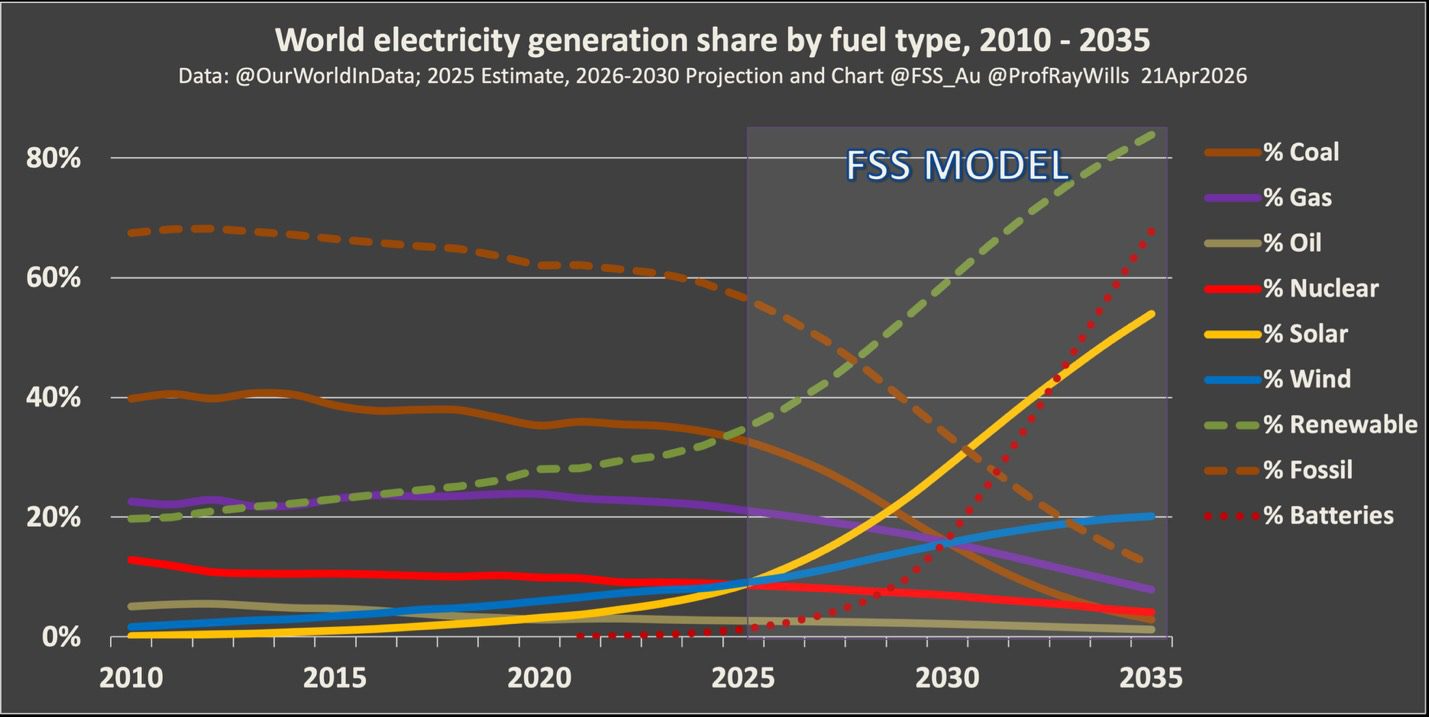
On current trajectories, the Future Smart Strategies [Prof Ray Wills' consulting company] model has solar, wind and batteries driving renewables towards around 80 per cent of global electricity by 2035, with coal, oil and gas pushed to the margins of the system.

Yet mainstream outlooks such as BNEF’s 2026 New Energy Outlook still assume a convenient slowing of this trend beyond the visible horizon, even though every call for a slowdown since 2015 has been wrong, and every retrospective look has had to revise growth up, not down.
Solar is moving fast. Really fast. Batteries are moving faster.
There is no evidence in either prices or deployment that the system is about to tap the brakes.
For our Future Smart global growth model, the logical response is not to ask why the transition is so quick, but to ask: why on earth it would be slow?
Ray Willis and Peter Newman in The Conversation:
Solar produces cheap, abundant power. Batteries allow it to be used later. These technologies are useful first to clean up electricity generation and boost energy security.
But these two technologies can unlock much more. They can make it possible to electrify polluting sectors long considered “hard to abate”.
Electric options for heavy industry are multiplying. Electric arc furnaces are now replacing coal‑fired blast furnaces in steelmaking. High‑temperature electric heat pumps and electric boilers are replacing gas in some chemical and food‑processing plants, while heavy duty battery‑electric haul trucks are being trialled in mining and construction.
These technologies are still at an early stage. They’re often more expensive up-front. But the selling point is the fact they are cheaper to run – as long as electricity is fairly cheap.
This is exactly the outcome solar and battery combinations deliver.
I have found in the past several years that Prof Ray Wills has been a much better forecaster than 95% of the rest of the renewables futurists, with the only exception being Tony Seba. What characterises both these blokes is their reliance on exponential growth curves. I have learnt from both of them.
What my own analysis suggests (still working on the data—I'll try and get my article out later this week) is that wind and solar will reach roughly two-thirds of global generation (output) by 2035, which is slower that Wills's forecasts. There are many caveats to my forecasts, which I'll get into in the article. But what this means is that fossil fuels in electricity generation will be mostly phased out by 2035.
If you add the S-curve transition taking place in EVs, emissions are likely to fall very fast from 2030 onwards. Unless the world becomes an AI hellhole.

No comments:
Post a Comment