Showing posts with label Miami. Show all posts

Friday, June 25, 2021

Florida Keys face stark reality

 From The Guardian

Long famed for its spectacular fishing, sprawling coral reefs and literary residents such as Ernest Hemingway, the Florida Keys is now acknowledging a previously unthinkable reality: it faces being overwhelmed by the rising seas and not every home can be saved.

Following a grueling seven-hour public meeting on Monday, held in the appropriately named city of Marathon, officials agreed to push ahead with a plan to elevate streets throughout the Keys to keep them from perpetual flooding, while admitting they do not have the money to do so.

The string of coral cay islands that unspool from the southern tip of Florida finds itself on the frontline of the climate crisis, forcing unenviable choices upon a place that styles itself as sunshine-drenched idyll. The lives of Keys residents – a mixture of wealthy, older white people, the one in four who are Hispanic or Latino, and those struggling in poverty – face being upended.

“The water is coming and we can’t stop it,” said Michelle Coldiron, mayor of Monroe county, which encompasses the Keys. “Some homes will have to be elevated, some will have to be bought out. It’s very difficult to have these conversations with homeowners, because this is where they live. It can get very emotional.”

Once people are unable to secure mortgages and insurance for soaked homes, the Keys will cease to be a livable place long before it’s fully underwater, according to Harold Wanless, a geographer at the University of Miami. “People don’t have a concept of what sea level rise will do to them. They just can’t conceive it,” he said.

On Monday, the county gave details of its plan to spend $1.8bn over the next 25 years to raise 150 miles of roads in the Keys, deploying a mixture of new drains, pump stations and vegetation to prevent the streets becoming inundated with seawater. The heightened roadways are eagerly anticipated by residents who told the meeting of cars being ruined by the salt water and of donning boots to wade to front doors.

“The roads are shot, they’re full of cracks, the water is permeating up,” said Kimberly Sikora, who lives in a vulnerable neighborhood of Key Largo called Stillwright Point that is still awaiting a full road elevation proposal. “I’m just looking for some kind of relief.”

Another resident, Robert Schaller of Twin Lakes, an area further along in the planning process, muttered that he “should’ve done my due diligence” when buying his house last year. “I literally stand on my balcony and watch the water come up through my street,” he said. “It’s coming up right through the pavement.”

The pancake-flat Keys are in jeopardy from rising seas that are, as a National Oceanic and Atmospheric Administration (Noaa) scientist told the county commissioners in the Monday meeting, accelerating upwards as the vast ice sheets of Greenland and Antarctica melt away. Human-caused global heating means an extra 17in of sea level rise by 2040, according to an intermediate Noaa projection used by the county.

Compounding this problem, the islands’ porous limestone allows the rising seawater to bubble up from below, meaning it just takes high tides on sunny days to turn roads into ponds, while global heating is also spurring fiercer hurricanes that can occasionally crunch into the archipelago.


Yet, despite this, the Keys electorate remains staunchly Republican

The threats faced by the Keys are shrugged off by some of its wealthy retirees who view the situation with a certain fatalism, while others in this Republican-voting bastion openly question the science. Eddie Martinez, one of the county’s five elected commissioners, challenged the Noaa scientist, William Sweet, on his sea level rise projections on Monday.

The sea level rise to date is “really a nothing number”, said Martinez, who told Sweet: “You’re a little bit more on this CO2 side, I’m more on the actual measurement side.” Another commissioner, David Rice, said that “predicting the future is probably best done with a crystal ball” and speculated that global temperatures could change following several volcanic eruptions.

“There are people who don’t want to sell because they love it here, others who want to get out while they can and those in complete denial who call you a troublemaker who is driving down property values by talking about it,” said George Smyth, a retiree who moved to Key Largo a decade ago for the quiet, slow-paced lifestyle. In 2019, his neighborhood spent 90 days partially submerged in water.

Other new realities are more laborious – Smyth has to wash his car continually to rid it of salt water and has to pay for trucks to unload piles of crushed-up rocks around his property as a buffer against the encroaching tides. While Smyth doesn’t class himself as particularly wealthy, these protections are beyond the means of low-income Keys residents, many of whom live in exposed mobile homes dotted along the islands.

Smyth fears that the county will require poorer residents to stump up the money for the roads, rather than put a levy on the tourists that flock to the Keys. “We feel we are being held hostage,” he said. “I feel sorrow for what is coming and the loss of what is a wonderful community.”

But the mayor defiantly insists the Keys can be saved, even if it is currently unclear how. “We know we live in paradise and we want to keep it that way,” said Coldiron.


What's happening in the Florida Keys is also happening in Miami.  


Friday, February 14, 2020

3 metres of sea level rise

A researcher holds ancient air trapped as gas bubbles within ice.
Photograph: AntarcticScience.com


From The Guardian:

Mass melting of the West Antarctic ice sheet, driven by warmer ocean temperatures, was a major cause of extreme sea level rise more than 100,000 years ago, according to new research.

A research team, led by scientists at the University of New South Wales, examined the cause of high sea levels during a period known as the last interglacial, which occurred 129,000-116,000 years ago.

Their study finds that melting of the West Antarctic ice sheet caused a sea-level rise of more than three metres and it took less than 2C of ocean warming for that to occur.

The study’s lead author Chris Turney is a climate change and earth scientist at UNSW [University of New South Wales].

He said the West Antarctic was particularly vulnerable to ocean warming because it sits mostly on the sea bed, rather than on land.

“This has been a big concern and is what the concern is in the present day,” Turney said.

“So the question is how much could fall into the ocean and this is where the last interglacial [period] is so important.”

To trace Antarctica’s potential contribution to this sea-level rise, the scientists travelled to West Antarctica to the Patriot Hills Blue Ice Area, which is on the periphery of the West Antarctic ice sheet.

Blue ice areas are created by katabatic winds. When these winds blow over mountains, they remove snow and ice, allowing ancient ice to come to the surface.

A lot of Antarctic research involves deep ice core drilling to study years of climate history.  In this study, the researchers used what they called “horizontal ice core” analysis, which involved simply walking across the valley towards the mountain.

“As you walk towards the mountain, you walk over increasingly older ice,” Turney said.

They used some shallow drilling to take ice samples from the surface. Through isotope measurements, they found a gap in the ice sheet record immediately prior to the last interglacial.  Turney said this gap coincided with an extreme rise in sea level and suggested a period in which there was no ice accumulating in that valley.

“It means that a large part of the west Antarctic almost certainly disappeared in the last interglacial. It melted. It flowed rapidly into the ocean,” he said.

He said the research also suggested this mass melting happened quite early during the ocean warming “somewhere between zero and 2C”. 

Turney said the current summer in Australia alone had shown the dangers of a warming world just at 1C.   “What these results suggest, or show, is that when people talk about a 2C warmer world as a good thing, actually what it shows is we don’t want to get close to 2C,” he said.

The paper says ocean temperatures during the last interglacial were likely up to 2C warmer than they are today and global sea levels were 6-9 metres higher.

3 metres is 10 feet in the old measurement.  And that's just the first stage.  The sea level will rise another 3 to 6 metres after that, and if temperatures go on rising, more and still more.  We can kiss the Netherlands and Denmark and Finland and London and Bangladesh and Alexandria and Miami goodbye.  And hundreds of other towns and villages.  Or we can build prodigiously expensive dikes, which will have to be 9 metres high (to allow for storm surges).  And we can't even do that for Miami, because it's built on an ancient coral reef, which is porous.  In Miami, they still vote for the denialist Republican Party.  Against stupidity, the Gods themselves are helpless.

All because the human race is too stupid, too greedy, too focussed on the short-term, too ignorant to bother finding out the truth, too lazy to act on it.  And because of the contemptible lies and disinformation spread by fossil fuel companies and parroted by right-wing commentators, news media and politicians.


Sunday, October 27, 2019

Global heating is accelerating sea level rise

You can read the long, in-depth and fascinating article from CarbonBrief here.  I'll give you a couple of excerpts and comment on what I think is the most interesting chart, but it's worth reading the original yourself.


Sea level rise (SLR) is one of the most severe impacts of climate change, with rising waters threatening to inundate small-island nations and coastal regions by the end of the century.

At the same time, SLR is one of the impacts with the largest uncertainties, with different studies projecting widely different ranges over the 21st century.

The Earth’s oceans have already risen by around 0.2m since the late 1800s, with the rate of SLR accelerating in recent decades. In its 2013 fifth assessment report (AR5), the Intergovernmental Panel on Climate Change (IPCC) estimated that SLR was “unlikely” to exceed 1m this century, even if emissions were very high.

However, a number of studies published in the years since then suggest that the worst-case projections for SLR could be much higher – up to 2m or more this century.

Since AR5 in 2013, a large number of new studies on future SLR have been published. Many of these have shown substantially higher worst-case SLR estimates by the end of the 21st century than those published in the AR5 – largely due to a reassessment of the potential losses from Antarctic and Greenland ice sheets.

The figure below shows estimates of SLR by 2100, if emissions are very high, published between 1983 and 2018. The figure is based on research from Dr Andra Garner of Rowan University and colleagues.

Individual studies are shown in blue, with the dots representing the best-estimate and the bars representing the high- and low-end estimates (when available) from each study. The SLR projections found in the five IPCC assessment reports are shown in black, with the grey shaded region showing the IPCC range from each report until a new one is published.

Some early estimates in the 1980s and 1990s were quite high, but that was also a period when the science surrounding ice sheet melting was less well-understood.

While a number of studies over the last decade have best-estimates of future SLR in-line with IPCC projections, their worst-case estimates are nearly all higher than the upper end of the IPCC range. As Garner tells Carbon Brief:

“Since the publication of the IPCC report in 2013, we’ve seen the range of future SLR projections expand significantly, with some studies suggesting the possibility of up to 2.5m of global mean SLR by 2100.

“There are a number of factors driving the uncertainty in future SLR amounts and rates, but the behaviour of the Antarctic and Greenland ice sheets in a warming climate is, perhaps, one of the largest contributors to this uncertainty. In particular, as new studies have come out suggesting the possibility of larger contributions to sea level rise from the Antarctic ice sheet than previously thought, we’ve seen the upper bound of future SLR projections climb upwards.”

Antarctic ice sheets, in particular, have proven to be a large source of uncertainty in future SLR projections. One study, published in Nature in 2016, suggested that a previously unconsidered process known as “marine ice-cliff instability” (MICI) meant the glaciers in the Antarctic were more unstable than scientists had thought. The paper concluded that “Antarctica has the potential to contribute more than a metre of SLR by 2100 and more than 15m by 2500” if future emissions are very high.

However, an article published in the Atlantic reported that the authors of the study “have lowered some of their worst-case projections for the 21st century” after making improvements to their model. The results are likely to put Antarctica’s contribution to SLR in 2100 at “about a foot” (30cm), the article says, which is “much closer to projections made by other glaciologists”.

A recent paper – also in Nature – argued that while MICI was not necessary to reproduce the SLR seen in ice ages, even without MICI Antarctica will likely contribute around 0.15m to sea level by 2100 under RCP8.5, with a “likely” range of 13-31cm. These estimates are notably higher than the 0.05m best-estimate contribution from Antarctica published in the IPCC AR5.


[Read more here]

Source: CarbonBrief

Now, note, this is for the scenario where emissions are very high, the so-called "business as usual" (BAU) case, where emissions keep on growing indefinitely.    Maybe BAU is unlikely, because the pressure to do something is increasing steadily.  But so far, emissions are still rising.

So this has to be the case used for planning ahead for mitigation of the consequences of global heating.   For example, if you are planning the sea defences of the Netherlands out over the next 30 or 40 or 50 years, it's no good hoping that emissions will stop growing.  And equally, you can't assume that if it is BAU, that sea level rise will be at the low end of the ranges on the right hand of the chart above.  Most likely, they will be in the middle.  But they might not.  They might be worse.   The economic consequences of SLR being at the high end of ranges are orders of magnitude worse than if they are at the low end.  So even though they might be equally probable, the outcome planners must worry about is the top end of the ranges.  That means 2 metres by 2100.

What's more, the plausible range of SLR has risen over the last decade as the science about the melting of Greenland and Antarctica has improved.  Whereas thirty years ago a one metre rise was at the top end of the forecasts, now it's in the middle.   All the risks are that sea level rise will be worse than you thought.  And if the SLR is at the top end of the forecasts (remember, these are probable ranges, so the top end is possible even if it is unlikely) then the sea level could rise 2 metres (6.5 feet) by 2100.  If you were a politician planning for the future in the Netherlands, would you start raising the dikes now, and taking other measures to protect your country?  Or would you believe the soothing lies told by denialists and do nothing?  Yet, in Miami, where flooding is already a problem, one which will lead to the end of Miami well before 2100 if the worst case projections are realised, people still vote for the Republicans.  In Australia, beach-side townships are being eroded by sea level rise, yet those same communities continue to vote for the denialist LNP coalition.  You can't cure stupid.

The probability is that emissions will go on rising.  Not enough is being done to stop that.  Even if they stop rising, the new carbon dioxide emitted just adds to what's already in the air, since it takes thousands of years for carbon dioxide to be removed from the atmosphere.  So for the level of CO₂ in the atmosphere to peak and also start falling, emissions each year have to actually fall to near zero.  Levelling off is nowhere near enough.  Even on the most optimistic scenarios, that won't happen until 2060 or later. 

So, we can rely on luck and wishful thinking.  Or we can responsibly and intelligently assess the risks and do something, both to cut emissions and to prepare for the worst.  The largest polluters are still doing nothing—in China (35% of global emissions) they are still building coal power stations and funding the construction of coal power stations in developing countries, and in the USA (15% of global emissions), we have a full-on denialist administration which is doing its damnedest to stop the closure of coal power stations and slow the roll-out of EVs.   Without these two countries doing much, much, more to slash emissions than they are doing, emissions will just keep on rising.   When the market realises just how serious the risks of SLR are, expect property prices in low-lying places to plunge.

Monday, June 24, 2019

A 6.5 feet sea level rise

"Sunny day flooding" in Miami


Over the last decade, it has become obvious that the ice caps are melting much faster than was previously believed.  This in turn implies that the sea level is going to rise faster than was thought.  The IPCC's estimate of a 1 metre rise by 2100 is prolly too low.  We may avoid the worst of this by cutting greenhouse gas emissions, but on the other hand, even if we do, global temperatures will continue rising until we stop all CO₂ and methane emissions, and in any case, the estimates of the extent of ice cap melting are being so rapidly revised upwards that it would be imprudent for coastal communities not to plan for more than 1 metre by 2100. 

As coastal communities prepare for the impacts of climate change, a new report warns that ice loss from Antarctica and Greenland could cause far more sea level rise than previously thought, and it says planners should not ignore that peril.

If planners are working with a mid-range projection of sea level rise, their efforts might protect coastal regions from the most likely scenarios depicted in climate models, but that still leaves a lot of risk, say the authors of the study published Monday in the journal Proceedings of the National Academy of Sciences.  


"Coastal decisions by and large require long lead times, and it would be nice if we could wait for the science to clear up, but we can't," said Michael Oppenheimer, an atmospheric scientist at Princeton University and one of the authors of the study.
"If you knew there was a one-third or even 10 percent chance a plane would crash, you wouldn't get on it. It's the same with sea level rise," he said.

The authors write that, for planning purposes, it would be prudent to use scenarios that anticipate 6.5 feet of sea level rise by the end of the 21st Century—more than double the likely upper limit put forward by the Intergovernmental Panel on Climate Change.

That projection of 6.5 feet of sea level rise is based on a worst-case emissions scenario in which little is done to rein in greenhouse gases and the planet warms as much as 5 degrees Celsius (9°F) above pre-industrial times.

That amount of sea level rise could inundate nearly 700,000 square miles—almost equal to the entire land mass of Indonesia—"including critical regions of food production and displacement of up to 187 million people," the authors write. "A [sea level rise] of this magnitude would clearly have profound consequences for humanity."

Meeting the Paris climate agreement's ambitions—which would require governments to take steps that keep warming under 1.5°C—would result in as much as 2 feet of sea level rise. Another half degree, up to 2°C warming, would add 4 inches on top of that.

[Read more here]

Wednesday, March 13, 2019

Winter rains in Greenland accelerate ice melt

Meltwater runs through Greenland’s Russell glacier
Source: Climate News Network


From Climate News Network.

The largest body of ice in the northern hemisphere faces a problem scientists had not identified before: Greenland’s winter rain is accelerating the loss of its vast store of ice.

Two new studies have identified mechanisms for ever-faster melting of the ice. One is that the snowline keeps shifting, to alter the levels of radiation absorbed by the ice sheet that masks the Greenland bedrock.

The other is that ever more snow and ice is simply washed away by the rainfall – even in the Arctic winter. That is because global warming has raised Greenland’s summer temperatures as much as 1.8°C, and by up to 3°C in the winter months.

Reports of winter rain over an icecap large enough – if it were all washed into the ocean – to raise global sea levels by more than seven metres are a surprise: glaciologists expect some melting of the polar ice caps each summer, to be replaced each winter by snowfall that insulates the ice below and then endures for much of the following summer.

Such icecaps are thought to shed most of their mass as glaciers deliver ice downstream to the coast, and icebergs calve and float south.

But research in the journal The Cryosphere tells a different and unexpected story: direct meltwater now running off Greenland into the sea accounts for seven-tenths of the 270 billion tonnes of ice that Greenland loses each year. And increasingly, rainy weather is the trigger that sets off the rivulets of meltwater streaming to the coast.

German and US researchers took data from 20 Greenland weather stations between 1979 and 2012, and matched this with satellite imagery that could distinguish snow from liquid water. In the data they identified more than 300 episodes of melting in which the initial trigger was the arrival of rain.

And during the 33 years of data, they found that melting associated with rainfall doubled during the summer months, and tripled in winter. Nearly a third of all the flow of water from Greenland was initiated by rainfall.

But research in the journal Science Advances in the same week pinpoints another related factor in setting the rate of melting in Greenland: the snowline.

This varies significantly from year to year. Once again, snow tends to reflect radiation, and with darker ice to absorb it the new study suggests that even Greenland’s icy mountains conform to simple physics.

Researchers flew drones inland across the bare ice to identify the snowline. A pause during a few days of high winds brought a big surprise.

“Suddenly the snowline was just gone. In a couple of days it had moved 30 kilometres or so up the ice sheet and was now out of the range of our drones.

[Read more here]

Kiss goodbye to southern Florida and coastal Bangladesh.

Friday, January 18, 2019

Antarctica's ice loss up six fold


From The Independent:

Antarctica's annual ice loss six times greater than 40 years ago, Nasa research shows.  Warming since 1979 'tip of the iceberg' as accelerating pace of melting predicted to add metres to global sea levels.

The Antarctic ice sheet is losing six times as much ice each year as it was in the 1980s and the pace is accelerating, one of the most comprehensive studies of climate change effects on the continent has shown.

More than half an inch has been added to global sea levels since 1979, but if current trends continue it will be responsible for metres more in future, the Nasa-funded study found.

The international effort used aerial photos, satellite data and climate models dating back to the 1970s across18 Antarctic regions to get the most complete picture to date on the impacts of the changing climate.
It found that between 1979 and 1990 Antarctica lost an average of 40 gigatonnes (40 billion tonnes) of its mass each year.

Between 2009 and 2017 it lost an average 252 gigatonnes a year. This has added 3.6mm per decade to sea levels, or around 14mm since 1979, the study shows.  

“That’s just the tip of the iceberg, so to speak,” Professor Eric Rignot from University of California, Irvine and lead author of the study published in Nature Geoscience. “As the Antarctic ice sheet continues to melt away, we expect multi-metre sea level rise from Antarctica in the coming centuries.”

The new analysis provides a breakdown of how ice losses in different sectors of Antarctica have changed and helps address confusion that has led to some climate change sceptics claiming the Antarctic ice mass is growing.

While western Antarctica has had some of the most visible ice loss, particularly to the extent of its sea ice, some studies have suggested that ice coverage is increasing in eastern Antarctica fast enough to cancel this out.

The latest study shows that east Antarctica ice loss has been a significant contributor to sea level rises, and called for more research on the factors that affect this.

[Read more here]

Goodbye Miami.  Goodbye Venice.   Goodbye St Petersburg.  Goodbye Holland.  Goodbye Copenhagen. Goodbye downtown Melbourne.  Goodbye.

Sunday, November 25, 2018

Sea level rise projections increasing

(Hat tip to Zeke Hausfather)


The new National Climate Assessment from the Trump administration shows more severe high-end sea level rise scenarios than were featured in the last IPCC report: up to 8 feet (2.4 meters) by 2100:

Since 1900, global average sea level has risen by about 7–8 inches (about 16–21 cm). The rate of sea level rise over the 20th century was higher than in any other century in at least the last 2,800 years, according to proxy data such as salt marsh sediments and fossil corals. Since the early 1990s, the rate of global average sea level rise has increased due to increased melting of land-based ice.  As a result, almost half (about 0.12 inches [3 mm] per year) of the observed rise of 7–8 inches (16–21 cm) has occurred since 1993.

Over the first half of this century, the future scenario the world follows has little effect on projected sea level rise due to the inertia in the climate system. However, the magnitude of human-caused emissions this century significantly affects projections for the second half of the century and beyond. Relative to the year 2000, global average sea level is very likely to rise by 0.3–0.6 feet (9–18 cm) by 2030, 0.5–1.2 feet (15–38 cm) by 2050, and 1–4 feet (30–130 cm) by 2100. These estimates are generally consistent with the assumption—possibly flawed—that the relationship between global temperature and global average sea level in the coming century will be similar to that observed over the last two millennia. These ranges do not, however, capture the full range of physically plausible global average sea level rise over the 21st century. Several avenues of research, including emerging science on physical feedbacks in the Antarctic ice sheet (e.g., DeConto and Pollard 2016, Kopp et al. 2017) suggest that global average sea level rise exceeding 8 feet (2.5 m) by 2100 is physically plausible, although its probability cannot currently be assessed (see Sweet et al. 2017, Kopp et al. 2017).

[Read more here]

(Source)

Note how each successive estimate of the likely rise in sea level has been higher than the previous one, and how the range has increased.  It's tempting to hope that the actual rise is at the low end of the projections.  But why should it be that way?  It could just as easily be at the high end of projections.  Consider what will happen to Miami if sea level rise by 2100 is actually 2.4 metres, more than the height of even the tallest man. 

Saturday, June 16, 2018

Annual Antarctic ice loss triples in just 5 years

The Thwaites Glacier in Antarctica is increasingly being viewed as posing a potential planetary emergency.
(Source: The Age)


Antarctica's ice sheet is melting at a rapidly increasing rate, now pouring more than 200 billion tonnes of ice into the ocean annually and raising sea levels half a millimetre every year, a team of 80 scientists has reported.

The rate of melting has tripled in the past decade, the study concluded. If the acceleration continues, some of scientists' worst fears about rising oceans could be realised, leaving low-lying cities and communities with less time to prepare than they had hoped.

The result also reinforces that nations have a short window - perhaps no more than a decade - to cut greenhouse gas emissions if they hope to avert some of the worst consequences of climate change.

Antarctica, the planet's largest ice sheet, lost 219 billion tonnes of ice annually from 2012 to 2017 - approximately triple the 73 billion tonne melt rate of a decade ago, the scientists concluded. From 1992 to 1997, Antarctica lost 49 billion tonnes of ice annually.

The study is the product of a large group of Antarctic experts who collectively reviewed 24 recent measurements of Antarctic ice loss, reconciling their differences to produce the most definitive figures yet on changes in Antarctica.

Their results - known formally as the "Ice Sheet Mass Balance Inter-comparison Exercise" (IMBIE) - were published in the journal Nature on Wednesday.

"The detailed record shows an acceleration, starting around 2002," Beata Csatho, one of the study authors and a glaciologist at the State University of New York at Buffalo, said in an email.

Csatho noted that comparing the first and last five-year periods in the record reveals an even steeper acceleration.

"Actually, if you compare 1997-2002 to 2012-2017, the increase is even larger, a factor of more than 5!!"

Looking closer, the rapid, recent changes are almost entirely driven by the West Antarctic ice sheet, which scientists have long viewed as an Achilles' heel. It is known to be losing ice rapidly because it is being melted from below by warm ocean waters, a process that is rendering its largest glaciers unstable.

West Antarctica lost 159 billion tonnes of ice a year from 2012 to 2017, compared with just 65 billion tonnes from 2002 to 2007.

The growth is largely attributable to just two huge glaciers - Pine Island and Thwaites. The latter is increasingly being viewed as posing a potential planetary emergency, because of its enormous size and its role as a gateway that could allow the ocean to someday access the entirety of West Antarctica, turning the marine-based ice sheet into a new sea.

Finally, the largest part of the continent, East Antarctica, has remained more stable and didn't contribute much ice to the ocean during the period of study, the assessment said. However, in the past  five years, it too has begun to lose ice, perhaps as much as 28 billion tonnes a year, although the uncertainty surrounding this number remains high.

What's happening in East Antarctica is extremely important because it has by far the most ice to give, being capable of raising sea levels by well over 30 metres. A single East Antarctic glacier, Totten, has the potential to unleash as much total sea level rise as the entire West Antarctic ice sheet, or more.

[Read more here and here]

Yet Florida, as just one example, still votes for the denialist Republican Party.

Friday, September 8, 2017

In harm's way

It looks as if hurricane Irma will hit Miami over the weekend.  It's the most intense Atlantic hurricane ever.  Here's a good explanation of why global warming has made hurricanes more intense.  Miami is barely above sea level, and already floods regularly from heavy rainfalls or high tides.  The pictures below, from the New York Times show how much development has taken place on what are essentially sand bars, and how vulnerable Miami is to catastrophe.

Yet the Florida Governor has forbidden State bureaucrats from mentioning global warming, and Senator Marco Rubio is an out and out denialist.   In fact it is hard to find any Republicans who are not denialists.

Miami in 1925 and 2017 (Source)

Sunday, January 29, 2017

Miami: adaptation.

The sea level in Miami is rising inexorably as a result of rising global temperatures (and no, the land isn't sinking)  So what are they doing to keep up?


Essentially, they're raising streets and sidewalks.  How much higher and how often will they have to do this?  Streets and sidewalks have been raised 3 feet.  What happens when the sea rises another 3 feet, and floods over the edge of the raised area into the shops and offices and homes which are now 3 feet below street level?

And Florida still votes Republican!

Read more here.

Sunday, February 21, 2016

5 metres sea level rise locked in

According to this article in New Scientist (paywalled), it’s too late to stop the seas rising at least 5 metres and only fast, drastic action will avert a 20-metre rise.

WHATEVER we do now, the seas will rise at least 5 metres. Most of Florida and many other low-lying areas and cities around the world are doomed to go under. If that weren’t bad enough, without drastic cuts in global greenhouse gas emissions – more drastic than any being discussed ahead of the critical climate meeting in Paris later this year – a rise of over 20 metres will soon be unavoidable.
After speaking to the researchers behind a series of recent studies, New Scientist has made the first calculations of what their findings mean for how much sea level rise is already unavoidable, or soon will be.
Much uncertainty still surrounds the pace of future rises, with estimates for a 5-metre rise ranging from a couple of centuries – possibly even less – to a couple of millennia. But there is hardly any doubt that this rise is inevitable.
We already know that we are heading for a rise of at least 1 metre by 2100. The sea will then continue to climb for many centuries as the planet warms. The question is, just how high will it get?


Monday, April 6, 2015

Rising sea levels

If you look across the evidence that global warming is real, everything is consistent: air temperatures are rising; sea temperatures are rising; glaciers are retreating; Arctic ice extent is at record lows; the Greenland and Antarctic icecaps are melting; and sea levels are rising.

On this page, NOAA shows the rise in sea levels.  Note that the average rise is now 3.2 mm per year.  Doesn't sound like much, does it?   But, for those who still think in inches, that an incredible one inch every 8 years.   Fine if you are 100 ft above sea level, right?  But not if you live in Miami, which in 1960 was 18 inches above sea level, and is now just 9 inches above sea level.  And it is likely that the rise is going to accelerate, as the melting of the west Antarctic ice shelves accelerates.  In fact, if I were into cherry-picking start and end points as the climate change denialists are, I could point out that over the last 3 years, the rate has been 8 mm per year.  An inch every 3 years.

Everything consistently points towards a warming earth.  Time to act.


Source


Source

Tuesday, March 10, 2015

Tea Party loons

In Florida, likely to be subject to even worse floods in future, the Tea Party Republican administration forbade their staff from using the phrases 'climate change', 'global warming' and 'sea level rise' in all official emails, letters and publications.  'Sea level rise' is to be referred to as 'nuisance flooding'!

Demented.

Read more here.


Wednesday, October 8, 2014

Miami sea level rise goes exponential

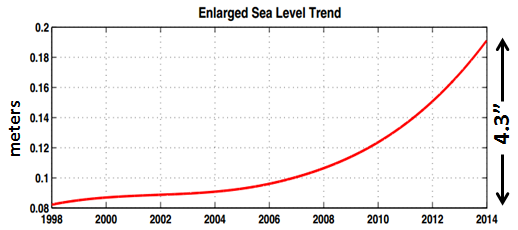
In Miami, the sea level has risen 9 inches in 100 years.  Half of this happened within the past 16 years and a third in the past 5 years.

From 1914 through 1998, sea levels rose by an average of 0.06 inches per year — a rate that was barely noticeable to residents and city planners alike. But from 1998 to 2009 the pace increased to a more troubling 0.14 inches per year. And from 2009 to the present year the pace again jumped to a terrifying 0.67 inches per year. 

An exponential rate of sea level rise that, in the past year alone, raised Miami’s surrounding ocean waters by 0.86 inches. Should the observed sea level rise over recent years continue, Miami will be facing 6-9 feet of additional water by the end of this century and not the 3-4 feet currently predicted.

(Read more  here)

And of course, the rise won't continue at the current pace: it is likely to  accelerate.

Source 

Yet Floridians (especially, of course, Republicans) remain climate change skeptics.  What hope is there for the world?

Saturday, July 12, 2014

Miami's Drowning

Another piece on how Miami is vulnerable to the rising seas.  And how everybody is intent on ignoring it.  And economists maintain that the free market is rational!


Miami and its surroundings are facing a calamity worthy of the Old Testament. It is an astonishing story. Despite its vast wealth, the city might soon be consumed by the waves, for even if all emissions of carbon dioxide were halted tomorrow – a very unlikely event given their consistent rise over the decades – there is probably enough of the gas in the atmosphere to continue to warm our planet, heat and expand our seas, and melt polar ice. In short, there seems there is nothing that can stop the waters washing over Miami completely.
It a devastating scenario. But what really surprises visitors and observers is the city's response, or to be more accurate, its almost total lack of reaction. The local population is steadily increasing; land prices continue to surge; and building is progressing at a generous pace. During my visit last month, signs of construction – new shopping malls, cranes towering over new condominiums and scaffolding enclosing freshly built apartment blocks – could be seen across the city, its backers apparently oblivious of scientists' warnings that the foundations of their buildings may be awash very soon.
Not that they are alone. Most of Florida's senior politicians – in particular,Senator Marco Rubio, former governor Jeb Bush and current governor Rick Scott, all Republican climate-change deniers – have refused to act or respond to warnings of people like Wanless or Harlem or to give media interviews to explain their stance, though Rubio, a Republican party star and a possible 2016 presidential contender, has made his views clear in speeches. "I do not believe that human activity is causing these dramatic changes to our climate the way these scientists are portraying it. I do not believe that the laws that they propose we pass will do anything about it, except it will destroy our economy," he said recently. Miami is in denial in every sense, it would seem. Or as Wanless puts it: "People are simply sticking their heads in the sand. It is mind-boggling."
Not surprisingly, Rubio's insistence that his state is no danger from climate change has brought him into conflict with local people. Philip Stoddard, the mayor of South Miami, has a particularly succinct view of the man and his stance. "Rubio is an idiot," says Stoddard. "He says he is not a scientist so he doesn't have a view about climate change and sea-level rise and so won't do anything about it. Yet Florida's other senator, Democrat Bill Nelson, is holding field hearings where scientists can tell people what the data means. Unfortunately, not enough people follow his example. And all the time, the waters are rising."
"The thing about Miami is that when it goes, it will all be gone," says Stoddard. "I used to work at Cornell University and every morning, when I went to work, I climbed more elevation than exists in the entire state of Florida. Our living-room floor here in south Miami is at an elevation of 10 feet above sea level at present. There are significant parts of south Florida that are less than six feet above sea level and which are now under serious threat of inundation."
Nor will south Florida have to wait that long for the devastation to come. Long before the seas have risen a further three or four feet, there will be irreversible breakdowns in society, he says. "Another foot of sea-level rise will be enough to bring salt water into our fresh water supplies and our sewage system. Those services will be lost when that happens," says Stoddard.
"You won't be able to flush away your sewage and taps will no longer provide homes with fresh water. Then you will find you will no longer be able to get flood insurance for your home. Land and property values will plummet and people will start to leave. Places like South Miami will no longer be able to raise enough taxes to run our neighbourhoods. Where will we find the money to fund police to protect us or fire services to tackle house fires? Will there even be enough water pressure for their fire hoses? It takes us into all sorts of post-apocalyptic scenarios. And that is only with a one-foot sea-level rise. It makes one thing clear though: mayhem is coming."

[Read the rest of the article here]

Friday, June 20, 2014

Goodbye, Miami


It's common for those who don't really understand climate change to say "oh well, I'm sure they'll think of something to sort things out."  Well, maybe they won't.  Read this fascinating piece on the difficulties Miami is already facing from rising sea levels.  Read past the first couple of paras, which are speculative though entertaining, and move on to the detailed discussion of the problems on page two and onwards.  The really depressing thing is that Florida's governor and elite are climate change deniers.  Despite the evidence all round them.  The 'she'll be right mentality'.  But she won't.

Cretinism.