Showing posts with label ICEVs. Show all posts

Tuesday, September 15, 2026

Stunning BYD EV price cut

BYD ATTO 1


 From The Driven

BYD has cut the price of its cheapest electric car to just $19,990 driveaway [US$14,190, but the Australian price includes a 10% GST (sales tax), taking the price down to an effective US$12,775], pushing the cost of a new EV in Australia below the $20,000 mark for the first time.

The special offer applies to the entry-level BYD Atto 1 Essential and is available nationwide, according to BYD Australia.

The Atto 1 was already comfortably Australia’s cheapest new electric car, launching at $23,990 before on-road costs late last year. The new offer cuts $4,000 from that headline price while also including on-road costs.

It puts the compact electric hatchback into a price bracket occupied by some of Australia’s cheapest new petrol cars, and represents another significant step down in the cost of entry to a new battery-electric vehicle.

Electric cars have already taken a huge chunk out of the Australian car market this year, posting a record 24.9 per cent share in August, and outselling petrol cars, and diesel, for the first time.

The Atto 1 Essential uses a 30 kWh BYD Blade Battery and offers up to 220 km of WLTP range. Its front-mounted electric motor produces 65 kW and the car can accelerate from 0-100 km/h in 11.1 seconds.

It also comes standard with 11 kW AC charging and DC fast charging at up to 65 kW, along with a 10.1-inch infotainment screen, wireless Apple CarPlay and Android Auto, vehicle-to-load (V2L) capability and six airbags.

BYD Australia chief operating officer Stephen Collins said the price cut was aimed at making electric vehicles accessible to more Australian households as cost-of-living pressures continue.

“At a time when Australian families are carefully considering every household expense, we’re committed to making vehicle ownership more attainable,” Collins said.

“The BYD ATTO 1 at $19,990 driveaway demonstrates our commitment to delivering outstanding value without compromising on technology, safety or quality.”

The deal further intensifies competition at the affordable end of Australia’s rapidly expanding EV market. When the Atto 1 arrived, its $23,990 starting price opened a sizeable gap to other new EVs and made it cheaper than many popular entry-level petrol cars.

Competition has since increased, including the arrival of the Geely EX2, which starts from $26,490 before on-road costs and offers 252 km of WLTP range in entry-level Complete form.

The Atto 1 is also offered in a more powerful Premium variant, which uses a larger 43 kWh battery for up to 310 km of WLTP range and a 115 kW motor.

BYD has been rapidly expanding both its model range and physical presence in Australia. The company says it has introduced eight new models or major variants since October last year, with that number expected to reach 10 by this October.

Upcoming additions include a plug-in hybrid version of the Atto 2 small SUV and the M9, BYD’s first premium people mover for the Australian market.

BYD says it has also been opening an average of one new sales and service centre a week over the past 12 months, and expects to have more than 150 dealerships across Australia by the end of 2026.

BYD has not indicated in its announcement how long the $19,990 driveaway Atto 1 Essential offer will remain available.


This is extraordinary.  To date, the cheapest new car in Australia has been the petrol-driven MG MG3, at $19,990.  And that isn't the drive-away price — you still have to add $1000 to $2000 to that.   The electricity to fill the battery would cost you $9 (30 cents/kWh) on a typical daytime home charge rate, or, at midday, thanks to a new government program, or if you have solar panels, it would be free.  Fast chargers typically cost 65 cents/kWh, so to recharge from empty to full using a fast charger, would cost you $19.50.  However, most people charge at home, and many use off-peak charging at 20 cents/kWh, if they're not using their own solar panels or the low or zero rate over midday.

The equivalent range in the MG3 would cost roughly $30 of petrol. (That is with current prices; without the Iran war it would be cheaper.)

Problem:  the range is short.  If you wanted to drive from, say, Melbourne to Sydney, you would have to stop 3 times to recharge.  With the petrol MG, you might not have to refuel at all, since the MG3's range is 750 km.  In practice, though, one only makes long journeys occasionally.  The average daily commute is 16 km, and 73% commute 20 km or less.  

To sum up: you can now buy an EV which is cheaper up front than the cheapest equivalent petrol car, and will cost you much less to run.  

Outside the US and Europe, Chinese-made EVs are going to grab market share from ICEVs, not because people care about climate change, or because of pollution, but because EVs are cheaper.  And the switch to EVs, here in Australia, and globally, has accelerated because of Trump's Iran war.  What a glorious irony.


Saturday, February 21, 2026

Trump's "energy dominance"? How we laughed.

Chart from Assaad Razzouk


 From This is not Cool


America’s “Energy Dominance” being pwned by China in the fastest growing and most important markets, the developing world.

The Deputy Prime Minister of Ethiopia, in the video below [here], remarked, “..those that love their children, plant trees.”
The jaded cynical, fossil fueled wise guys currently running Washington are not capable of comprehending the aspirations of the great majority of humanity, who don’t care to live under the thumb of Exxon and the Epstein Class.

Bloomberg:

n 2024, the Ethiopian government banned the import of fossil fuel-powered vehicles and slashed tariffs on their electric equivalents. It was a policy driven less by the country’s climate ambitions and more by fiscal pressures. For years, subsidizing gasoline for consumers has been a major drag on Ethiopia’s budget, costing the state billions of dollars over the past decade. The country defaulted on its sovereign bonds in 2023 after rising interest rates drove up the costs of servicing its debts, and it received a $3.4 billion bailoutfrom the International Monetary Fund the following year. 

In the two years since the ban on internal combustion engine vehicles, EV adoption has grown from less than 1% to nearly 6% of all of the vehicles on the road in the country — according to the government’s own figures — some way above the global average of 4%.

“The Ethiopia story is fascinating,” said Colin McKerracher, head of clean transport at BloombergNEF. “What you’re seeing in places that don’t make a lot of vehicles of any type, they’re saying: ‘Well, look, if I’m going to import the cars anyway, then I’d rather import less oil. We may as well import the one that cleans up local air quality and is cheaper to buy.’”

For decades, Ethiopia’s high import tariffs on vehicles put new car ownership out of the reach of most of the country’s population. Per capita gross domestic product is only about $1,000, and even by the standards of low-income countries, it has among the lowest car ownership rates. At 13 vehicles per 1,000 people, it’s a fraction of the African average of 73. With few cars manufactured in the country, the vast majority are imported, and most are bought used. 

The government’s import policy has upended the market. In parallel, tariffs for EVs were dropped to 15% for completed cars, 5% for parts and semi-assembled vehicles, and zero for “fully knocked down” — vehicles shipped in parts and assembled locally. That has made new EVs cost-competitive with old gasoline cars.

At one of Hallel Cars’ showrooms in central Addis Ababa, a Seagull hatchback made by the Chinese carmaker BYD sells for 3.6 million Ethiopian birr ($23,000), while a BYD subcompact SUV Yuan Up costs 4.9 million Ethiopian birr. Before the import ban, a secondhand compact Suzuki Dzire gasoline sedan cost more than 4.2 million birr.

“The majority of our customers are those making the switch from fuel cars to EVs,” said Moges Negash, Hallel Cars’ sales and marketing manager.

Hallel sells Toyota, Honda and Citroën EVs too, but models from BYD — which last year surpassed Tesla as the world’s biggest seller of EVs — dominate its showroom. Other dealerships around the city sell Chang’an vehicles, as well as those from Volkswagen and the Vietnamese manufacturer VinFast.

Although the price tag is still relatively high for a country where incomes are low, middle class consumers find it easier to get credit to buy new EVs than they did for secondhand gas-powered ones, which banks often wouldn’t lend against.

“Banks are reluctant to provide consumer credit for purchase of vehicles that have an uncertain fate,” said Abdulmenan Mohammed, a financial analyst based in London who covers Ethiopian banks. “EVs are a new technology and increasingly being used in the country, so it’s a better opportunity for banks to provide credit.”

For the government, the growth in EV sales is a vindication of its import policy, which in turn has been made possible by its investments in electricity infrastructure. The Grand Ethiopian Renaissance dam, completed in 2025 at a cost of $5 billion, produces 5,150 megawatts of power. Combined with other generating assets, including wind farms and solar, the country has excess generation capacity, which it sells to neighboring Kenya, Tanzania and Djibouti. 

The price of delivering power to Ethiopian customers is about $0.10 per kWh, which is about half that of neighboring countries, and considerably less than the US average of $0.18 per kWh. Many Ethiopian consumers pay significantly less than that, due to consumption-based subsidies on electricity.

This is now a path open to most countries without a car industry.  Solar panels are cheap as.  Batteries are plunging in costs.  You could run your vehicle fleet on the power of the sun.  Ban the import of petrol and diesel vehicles, encourage the roll-out of household and utility-scale batteries and storage, and end the import of expensive ICEVs and oil.  Clean your air, cut your balance of payments crisis, get cheap transport, and stop global heating.  What's not to like? 

If you do have a car industry, banning ICEV imports would still help you.  And maybe, as EV sales explode, you'll encourage your own car industry to switch to producing EVs.  Globally, land transport is responsible for ~20% of emissions.

Meanwhile, the US has embraced last-century technology.

Tuesday, November 4, 2025

China's ICEV sales peaked in 2017

 (ICEV = internal combustion engined vehicle)

From Our World in Data


Electric cars have become incredibly popular in China. In 2020, one in eighteen new cars sold was electric. By 2024, this had increased to one in two.

This growth has pushed down sales of internal combustion engine (ICE) cars, which run mostly on petrol. As you can see in the chart, sales of ICE cars peaked in 2017 and have declined since.

The world reached peak ICE car sales just one year later.

The displacement of petrol cars with electric ones is vital in decarbonizing transport. The rise of electric vehicles in China means the IEA expects oil demand to peak earlier than previously projected.

Here, “electric cars” include fully battery-electric ones and plug-in hybrids. In China, 56% of them were fully battery-electric.

Track data on the evolution of electric cars across the world


 My forecast:  EVs and PHEVs will reach 90% market share in China by end 2029.

Wednesday, November 20, 2024

Mass production of first solid-state EV battery

 From The Electric Viking

Solid-state batteries have no liquid electrolyte.   They have a much greater energy density than conventional lithium-ion batteries, and even greater than sodium-ion.  This particular battery has a lower energy density than other solid-state batteries which are still in developmental mode.  But the company developing these batteries (Chery) expects to double their energy density by 2027.  They can also be charged 6 times faster than conventional batteries (fully charged in 5 minutes), and will likely end up being much cheaper too.

The energy density of these batteries will be high enough to power heavy duty "diesel" trucks.

The commercialisation of solid-state batteries appeared to be half a decade away, or more.  And here they are.  

Step by step, we move closer to the point where ICE vehicles will just be unsellable, and all cars will be EVs.


Sunday, April 7, 2024

EVs really are cleaner than petrol cars

 From BNEF, by Corey Cantor


As electric vehicles become a bigger part of the global car fleet, a contrarian take seems to surface every few months: are electric vehicles really that clean?

When it comes to lifecycle emissions, the answer is a resounding yes. According to a new report by BloombergNEF, in all analyzed cases, EVs have lower lifecycle emissions than gas cars. Just how much lower depends on how far they are driven, and the cleanliness of the grid where they charge.


At the beginning of their lives, battery-electric vehicles, or BEVs, are emissions-intensive, thanks in large part to their battery-manufacturing needs. But once on the road, internal combustion engine vehicles (ICEs) quickly speed past BEVS – in terms of CO2 emissions, at least – because of the heavy emissions that gas-guzzling cars spew.

To determine the breakeven point, BloombergNEF looked at five different regions: the US, China, Germany, the UK and Japan. In any of these markets, the lifecycle CO2 emissions of a medium-sized BEV manufactured today and driven for 250,000 kilometers (155,000 miles) would be
27-71% lower than those of equivalent ICE vehicles.

A driver in the US would reach the breakeven point at 41,000 km – or in around two years of driving, assuming an average annual distance traveled of around 19,000 km. In China, meanwhile, the breakeven distance would fall at 118,000 km, or after roughly 10 years, due to the region’s fossil-fuel-heavy grid.


With zero-emission generation on the rise worldwide, that breakeven point could come a lot sooner by the end of the decade.

Across the five markets surveyed, the lifecycle breakeven falls to between one and four years for a BEV manufactured in 2030. A driver in the US will only need to travel about 21,000 kilometers, or around a year’s worth of driving, for a BEV to be cleaner than an ICE. A driver in China would still need longer than drivers in other areas surveyed, but it would take them only 53,000 km – or slightly over four years – to reach the breakeven point.

BNEF’s analysis assumes an average emissions intensity for each region per year. But in reality, EV charging emissions intensity will vary depending on the regional energy mix – and even the time of day charging takes place.

For instance, an EV driver in California who charges during daytime hours will be produce half as many grams of CO2 per kilowatt-hour charged as a driver who charges at night. The gap between daytime and nighttime charging grows even wider by the end of the decade.


Utilities currently offer tariffs to encourage overnight charging, but in the future they may get a better “green bang for their buck” by incentivizing charging at peak renewable hours.

Improvements to the EV manufacturing process could make electric vehicles even greener. Recycling batteries could help reduce the lifecycle emissions of new EVs, while on-shoring or near-shoring the full battery manufacturing process – which laws like the US’s Inflation Reduction Act have encouraged – could reduce emissions associated with global transport.

BNEF clients can access the full report here.


Monday, January 22, 2024

BMW says ICEVs have peaked


From Bloomberg

BMW AG says demand for its luxury cars powered by gasoline reached its highest point last year and expects all-electric models to lead future growth.

The German premium-car maker has well-filled order books for battery cars with a target of half a million vehicle sales this year, roughly a fifth of total deliveries, Chief Financial Officer Walter Mertl said. BMW group EV sales jumped 75% last year, driven by models like the i4 sedan and as overall sales growth has slowed in the US and some European countries.

“The tipping point for combustion engines was last year,” Mertl, 49, said on a call with journalists, with regulation to cut carbon dioxide emissions capping any expansion. “Future volume growth will primarily come from battery electric vehicles.”

BMW saw strong EV orders during November and December, said Mertl, with demand in Europe set to keep growing. The manufacturer hasn’t seen any pullback, and expects the new i5 sedan and additional Mini brand EVs to boost sales, he said.

“The current sales plateau of combustion cars will continue and then fall off slightly,” he said.

By the end of the decade, BMW’s EVs will have higher returns than its combustion-engine cars, Mertl said.


Sunday, August 21, 2022

EVs massively reduce emissions -- and save money


From Yale Climate Connections


With high energy prices and increasing urgency to reduce fossil fuel burning, it makes sense to get the most out of every gallon of gasoline or kilowatt-hour of electricity.

A previous post showed that charging an EV costs around the equivalent of $1.41 per gallon in the U.S., offering consumers a major savings over gasoline. Part of why EVs are cheap to operate is that they use energy with impressive efficiency.

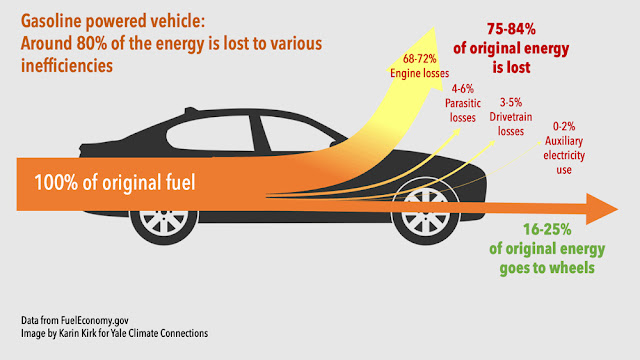
Delving deeper, there’s a stark difference between the way internal combustion and electric engines use energy. The bad news is that combustion engines are fundamentally inefficient. But the good news is that electric motors offer vast improvements and save money and energy. Even better: Replacing traditional vehicles with electric ones will require far less energy overall. Traditional cars and trucks are surprisingly inefficient. Modern gasoline-powered vehicles waste a whopping 80% of the energy in their fuel. For each gallon pumped into the tank, only a bit more than three cups go to moving the vehicle forward. In economic terms, for a $5.00 gallon of gasoline, only $1.00 of it gets you closer to your destination.

Most of this waste is an inescapable consequence of thermodynamics. Internal combustion engines ignite liquid fuel to create a pressurized gas that pushes pistons to turn a crankshaft that ultimately spins the car’s wheels. This multistep process bleeds off energy all along the way. Most of the energy in the fuel ends up as heat, and only a small fraction reaches the wheels. The concept of wasted heat becomes intuitive when one thinks about the hot air wafting off a car’s running engine. The engine itself gets hot; a cooling system is needed to manage excess heat; and heat is dispersed through the radiator and blows out the exhaust. All of that heat comes from gasoline, and none of it helps propel the vehicle.

Further energy uses come from pumps and fans, some of which, ironically, are needed to carry away waste heat. These are called parasitic losses. Mechanical friction within the transmission and drivetrain lops another 3 to 5% off the overall efficiency. The final loss of energy is from auxiliary electrical components like heated seats, lights, the audio system, and windshield wipers. Taken together, these accessories can consume up to 2% of the vehicle’s total energy intake.

The net result is that only around 20% of the energy that’s pumped into the fuel tank ends up at the wheels.


Even the most fuel-efficient gasoline-powered vehicles can’t sidestep these energy losses. Cars with high fuel economy are lighter, smaller, and more aerodynamic, thereby making the best possible use of the energy that ends up in the drivetrain. Diesel engines have somewhat better thermodynamic efficiency, averaging in the high 30s to around 40%. But major thermodynamic losses are a stubborn fact of life for all combustion-based engines.

For a more detailed explanation and sources for the figure above, see FuelEconomy.gov.

Electric vehicles are propelled by entirely different mechanisms. Energy enters the vehicle as electricity, which directly powers the drivetrain: EVs need not convert one form of energy to another, which is a big factor in their efficiency

Electric motors are simple machines with few moving parts, especially compared with the complexities of an internal combustion engine. In an EV, electricity from the car’s battery flows into a cylinder that generates a rotating magnetic field. Inside that cylinder is a rotor that spins as it gets pulled along by the magnetic attraction. The spinning rotor turns an axle that drives the wheels.

The whole process works in reverse, too: The car’s spinning wheels can turn the rotor and feed electricity back into the battery. This process of regenerative braking can recapture energy that would otherwise be lost as friction and heat.

EVs are not 100% efficient though, and they lose energy in a few ways. Some energy is lost in the process of recharging the battery, and electricity is consumed for the vehicle’s cooling and power steering. Auxiliary electric use is higher in EVs compared with combustion engines, mostly due to the electricity needed to heat the car’s interior in cold weather. In an internal combustion vehicle, waste heat is used to warm the car’s cabin.

In all, the various energy losses in an EV add up to 31% to 35%. Regenerative braking adds 22% back into the system, making the overall efficiency around 87% to 91%. The specific numbers vary based on the type of car and how it’s used, but the overall simplicity and efficiency is a contrast to traditional vehicles that have been the mainstay of the roadways for 130 years.

The numbers are from FuelEconomy.gov, and DigitalTrends has a helpful explainer for how various components of EVs work.


The energy efficiency of EVs is a clear boon for consumers, but it offers an even more significant benefit in the transition away from petroleum-burning transportation. In the U.S., about 8.9 million barrels of motor gasoline are used every day, and around 80% of that energy is wasted as heat and friction. Of the total amount of gasoline burned, only 1.8 million of those barrels (20%) propel vehicles along the road. This means that if the gasoline vehicle fleet was replaced with EVs, those EVs would need the energy equivalent of only around 1.8 million barrels of gasoline per day, plus the 11% energy loss within the EV itself. The rough math pencils out to the energy equivalent of around 2 million barrels of gasoline per day, which is a substantial savings over the 8.9 million barrels currently used.

Of course, this begs the question of the efficiency of electric power plants that charge EVs. Thermal power plants – such as coal, gas, or nuclear – face similar thermodynamic challenges as internal combustion engines, but power plants are more efficient than cars. Coal and nuclear are around 33% efficient, and combined cycle natural gas power plants are about 44% efficient. At the top end of the scale, hydropower is approximately 90% efficient. Even if the grid were entirely fueled by coal, 31% less energy would be needed to charge EVs than to fuel gasoline cars. If EVs were charged by natural gas, the total energy demand for highway transportation would fall by nearly half. Add in hydropower or other renewables, and the result gets even better, saving up to three-fourths of the energy currently used by gasoline-powered vehicles.


But what about batteries? Manufacturing an EV battery consumes the energy equivalent of about 74 gallons of gasoline. Over the 10-year lifespan (or more) of the battery, the energy investment in the battery is far too small to change the outcome – which is good news.

Decarbonizing the world’s energy supply is an enormous and daunting task. But at least in this case, the job gets easier as highway transportation shifts away from oil. The major improvement in driving efficiency offered by EVs means that vehicles can emit less carbon and less pollution, while also lowering overall energy demand. In a world of tough tradeoffs, this one is an easy win.

Tuesday, March 15, 2022

100% EVs by 2025?

From a Twitter thread by Professor Ray Wills, who along with Tony Seba, has been consistently right with his forecasts for the growth in EV sales.  He has been even more optimistic than me, and I was very optimistic.  In mid-2016, when EV/PHEV sales were just 1% of global car sales, I forecast that they would reach 16% in 2022.  They reached 10% in 2021, and at current growth rates should hit ±16% in 2022.  The problem with most forecasters is that they extend lines linearly instead of exponentially.  If something is growing by 50% per annum,  it goes up 10-fold every 5 and a half years.  EV sales are growing by 70% per annum, while total car and commercial vehicle sales are falling.  Wills's forecast of an end to ICEV sales by 2025 seems perfectly plausible.  


Sales of electric cars hit 6.6m in 2021

> 3X EVs market share from 2019

> 2X 2020

16m #EVs on the road worldwide

More #EVs now sold every week than in the whole of 2012

But overall car sales are still falling

We hit peak car in 2017 

WEForum article.


Note that these are sales of EVs only, and do not include PHEVs


Note how hybrids are falling and how (B)EVs are now dominant


China is 1/3rd of the global car/light truck market


Full self driving (level 5) by 2027!  Transport as a service (TaaS) takes off.


Saturday, November 27, 2021

EVs are 4 times as efficient as ICEVs

I often see comments that switching to EVs is pointless as long as they draw their electricity from a grid which is fuelled by coal.   But, in fact, EVs (electric vehicles) use energy far more efficiently than ICEVs (petrol/diesel vehicles).  A  little lateral thinking would make this obvious:  even a plain old-fashioned hybrid reduces energy use by 40-50%, because it has regenerative breaking and the engine doesn't idle when the car is stationary.   

Also, as grids green, the electricity EVs use will get greener every year.

 From the US Department of Energy.

Electric vehicles (EVs) are more efficient than their gasoline-powered counterparts. An EV electric drive system is only responsible for a 15% to 20% energy loss compared to 64% to 75% for a gasoline engine. EVs also use regenerative braking to recapture and reuse energy that normally would be lost in braking and waste no energy idling. See All-Electric Vehicles for details.

EVs are 60% to 73% efficient, depending upon drive cycle. However, if the energy recaptured from regenerative braking is counted (i.e., recounted when it is re-used), EVs are 77% to 100% efficient. (For more information on how vehicle efficiency is calculated, see Vehicle Fuel Efficiency.)


Sunday, August 29, 2021

Air pollution linked to mental illness

Pollution in London. Photograph: Toby Melville/Reuters


From The Guardian


Exposure to air pollution is linked to an increased severity of mental illness, according to the most comprehensive study of its kind.

The research, involving 13,000 people in London, found that a relatively small increase in exposure to nitrogen dioxide led to a 32% increase in the risk of needing community-based treatment and an 18% increase in the risk of being admitted to hospital.

The researchers said the findings were likely to apply to most cities in developed nations, and cutting air pollution could benefit millions of people.

The study used the frequency of admission to hospital or visits to community doctors and nurses as a measure of severity. The researchers calculated that a small reduction in one pollutant alone could reduce illness and save the NHS tens of millions a year.

Levels of air pollution in London have fallen in recent years but there is no safe level, said Ioannis Bakolis, of King’s College London, who was part of the research team. “Even at low levels of air pollution, you can observe this kind of very important effect.”

Recent research has shown that small increases in air pollution are linked to significant rises in depression and anxiety. It has also linked dirty air to increased suicides and indicated that growing up in polluted places increases the risk of mental disorders. Other research has found that air pollution causes a “huge” reduction in intelligence and is linked to dementia. A global review in 2019 concluded that air pollution may be damaging every organ in the human body.

The new study, published in the British Journal of Psychiatry, tracked patients in south London from their first contact with mental health services and used high-resolution estimates of air pollution at their homes.

The quarterly average NO2 levels in the study area varied by between 18 and 96 micrograms per cubic metre (µg/m³). The researchers found that people exposed to 15µg/m³ higher levels of pollution had an 18% higher risk of being admitted to hospital and a 32% higher risk of needing outpatient treatment after a year.

The link was strongest for NO2, which is largely emitted by diesel vehicles, but was also significant for small particle pollution, which is produced by burning all fossil fuels. The small particle levels varied from 9 to 25 µg/m³ and an increased exposure of 3 units increased hospital admission risk by 11% and outpatient treatment risk by 7%.

The scientists assessed the patient data again seven years after the first treatment and found the link to air pollution was still apparent. The findings were not explained by a range of possible other factors including age, sex, ethnicity, deprivation or population density, although unidentified factors might still play an important role.

“Identifying modifiable risk factors for illness severity and relapse could inform early intervention efforts and reduce the human suffering and high economic costs caused by long-term chronic mental illness,” the researchers said.

The study was not designed to prove a causal link between air pollution and the severity of mental illness – that requires difficult experimental work. But the link is “biologically plausible”, the researchers said, as air pollutants are known to have potent inflammatory properties and inflammation is believed to be a factor in psychotic and mood disorders.

The World Bank has estimated that air pollution costs the global economy $5tn a year, but this includes only the well-known damage caused to heart and lungs.

“Cost evaluations currently only factor in physical health, but we’re seeing more studies demonstrating links with mental health,” said Newbury. “We think it can be important to include these, because it could tip the scales and make it clearer that investing in reducing air pollution is cost-effective.”

The researchers estimated that reducing the exposure of the UK’s urban population to small particle pollution alone by just a few units, to the World Health Organization’s annual limit of 10µg/m³, would cut the use of mental health services by about 2% and save tens of millions of pounds each year.

Prof Kevin McConway of the Open University, who was not part of the study team, said: “This is a good study. The statistical analysis is generally appropriate [and] does increase confidence that there’s at least some element of cause and effect in the association between pollution and mental health.

“But it’s not easy for people to avoid pollution. Reducing air pollution in cities needs communal action on a broad scale.”

A separate new study has shown that heart attacks rise as the level of air pollution rises. The research examined data from southern Lombardy in Italy, an area with 1.5 million inhabitants.

Francesca Gentile, of the IRCCS Policlinico San Matteo Foundation in Pavia, said: “The results could be used to predict the incidence of this life-threatening condition [and] improve health service efficiency by being factored into ambulance forecasting models and warning systems.” The study was presented at the European Society of Cardiology 2021 congress.


We all know what the solution to air pollution is.  It's the rapid transition of land transport to EVs and of electricity generation to renewables.  It's that simple.  Why aren't governments acting?


Monday, July 26, 2021

Some battery-pack prices below $100 for first time

 From BNEF

Lithium-ion battery pack prices, which were above $1,100 per kilowatt-hour in 2010, have fallen 89% in real terms to $137/kWh in 2020. By 2023, average prices will be close to $100/kWh, according to the latest forecast from research company BloombergNEF (BNEF).

For the first time, battery pack prices of less than $100/kWh have been reported. These were for batteries in e-buses in China. While these were the lowest reported price, the volume-weighted average price for e-buses in China was slightly higher, $105/kWh.

Battery electric vehicle (BEV) pack prices are $126/kWh on a volume-weighted average basis. At the cell level, average BEV prices were just $100/kWh. This indicates that on average, the battery pack portion of the total price accounts for 21%.

BNEF’s 2020 Battery Price Survey, which considers passenger EVs, e-buses, commercial EVs and stationary storage, predicts that by 2023 average pack prices will be $101/kWh. It is at around this price point that automakers should be able to produce and sell mass market EVs at the same price (and with the same margin) as comparable internal combustion vehicles in some markets. This assumes no subsidies are available, but actual pricing strategies will vary by automaker and geography.

Price reductions in 2020 are thanks to increasing order sizes, growth in BEV sales and the introduction of new pack designs. New cathode chemistries and falling manufacturing costs will drive prices down in the near term. The prices of cathode materials have fallen since reaching a high in spring 2018, finding a more stable level during 2020.

James Frith, BNEF’s head of energy storage research and lead author of the report, said:  “It is a historic milestone to see pack prices of less than $100/kWh reported. Within just a few years we will see the average price in the industry pass this point. What’s more, our analysis shows that even if prices for raw materials were to return to the highs seen in 2018, it would only delay average prices reaching $100/kWh by two years – rather than completely derailing the industry. The industry is becoming increasingly resilient to changing raw material prices, with leading battery manufacturers moving up the value chain and investing in cathode production or even mines.”

 Leading battery manufacturers are now enjoying gross margins of up to 20% and their plants are operating at utilization rates over 85%. Maintaining high utilization rates is key to reducing cell and pack prices. If utilization rates are low, then equipment and building depreciation costs are spread over fewer kilowatt-hours of manufactured cells.

Daixin Li, a senior energy storage associate at BNEF, added: “The increasingly diversified chemistries used in the market result in a wide range of prices. Battery manufacturers are racing to mass-produce higher energy-density batteries with some new chemistries such as lithium nickel manganese cobalt oxide – NMC (9.5.5) – and lithium nickel manganese cobalt aluminum oxide – NMCA – set to be mass-produced as early as 2021. Lithium iron phosphate – LFP – however plays as a cost-competitive alternative, contributing to the lowest reported cell prices of $80/kWh.”

The path to achieving $101/kWh by 2023 looks clear, even if there will undoubtedly be hiccups, such as commodity price increases, along the way. There is much less certainty on how the industry will reduce prices even further from $100/kWh down to our expectation of $58/kWh by 2030. This is not because it is impossible but rather that there are several options and paths that could be taken.

One possible route to achieving these lower prices is the adoption of solid-state batteries. BloombergNEF expects that these cells could be manufactured at 40% of the cost of current lithium-ion batteries, when produced at scale. These reductions would come from savings in the bill of materials and in the cost of production, equipment, and the adoption of new high-energy density cathodes. In order to realize these reduced prices, the supply chain for key materials, such as solid electrolytes, not used in lithium-ion batteries today, needs to be established.

BNEF's calculation for further declines in battery-pack costs until 2023 is just 10% per annum (December 2020 to December 2023), which is a significant slowdown in the previous rate of decline.  If the historic trend were to continue, battery-pack prices would average about $84 by end 2023.  That would spell the extinction of petrol or diesel vehicles (ICEVs).  EV sales are already exploding.   It's very hard to see that many ICEVs will continue to be bought after 2023 or 24.  The most likely factor slowing battery cost declines will be strong demand.  


Thursday, June 17, 2021

The S-curve: reason to be optimistic about the energy transition

 The shape of the S-curve is caused by exponential growth.  Something starts off minuscule, but if it grows by, say, 10% a year, it will double every 8 years.  In 16 years it's up four-fold, in 24, eight-fold, in 32 sixteen-fold*.  But at some point, it starts approaching the natural limits set by its environment.  When everyone has a colour TV, the rapid growth from when it started out comes to an end.  

This dynamic produces a sideways S-curve--rapid growth at the beginning succeeded by slower growth later, as the market niche is filled.


Source: ClimateCrocks

Notice how electricity started an S-curve in 1900, but was then interrupted by the 1930s Great Depression and WW2.  Computer penetration has levelled off at 70%, though that prob'ly doesn't include smartphones, where penetration must be close to 95%.  All the same, the pattern is clear: slow gains at first, then an explosion, followed by a levelling off.


From ClimateCrocks


Many people suggest that rates of new product introduction and adoption are speeding up, but is it really, across the board? The answer seems to be yes. An automobile industry trade consultant, for instance, observes that “Today, a typical automotive design cycle is approximately 24 to 36 months, which is much faster than the 60-month life cycle from five years ago.”  The chart below, created by Nicholas Felton of the New York Times, shows how long it took various categories of product, from electricity to the Internet, to achieve different penetration levels in US households.  It took decades for the telephone to reach 50% of households, beginning before 1900.  It took five years or less for cellphones to accomplish the same penetration in 1990.  As you can see from the chart, innovations introduced more recently are being adopted more quickly.  By analogy, firms with competitive advantages in those areas will need to move faster to capture those opportunities that present themselves.


So why is ClimateCrocks optimistic?   Because the global uptake of wind, solar, batteries and EVs shows the classic pattern of the S-curve: rapid compound growth.   At first penetration was tiny, and people said, 'oh, what nonsense, wind/solar/EVs  are less than 1% of the market, how ever could they reach 100%?'   Yet look, for example, at plug-in sales in Germany.  3% in 2019, 13.5% in 2020, a likely 30% this year (2021).  The maths of sustained compound growth is inexorable.  

These technological transformations are fuelled by rapid cost declines (for example, new-build solar going from 3.2 times the cost of new-build coal to 1/3rd the cost in just 11 years) or by greater convenience, or by both.  EVs are a couple of years away from price parity with petrol/diesel vehicles (ICEVs).  New-build wind and solar are cheaper than new-build coal.  In fact, they're cheaper than the cost of digging up coal and burning it, and that's before a carbon tax.  

Whereas in the past we had to rely on  the goodwill of communities to switch to cleaner energy or transport, now we can rely on self-interest.  If we combine goodwill with self-interest, the transition will be irresistible, and fast.


* Solar is growing by 15% per annum, and has been for decades.  That means it doubles every 5 years.  EVs have been growing at 50% a year, which means sales go up 5-fold every 4 years.

Tuesday, June 15, 2021

Do EVs catch fire more often than ICEVs?

There's a common trope that cars with lithium-ion batteries are much more likely to catch fire than cars with petrol or diesel engines.

This doesn't seem to be the case


Tesla's Vehicle Fire Data provided for the period 2012-2020 reveals that there has been about one vehicle fire for every 205 million miles traveled.

That's over 10-times higher than the average distance between fires than in the case of the national average of 19 million miles in the U.S., according to the National Fire Protection Association (NFPA) and U.S. Department of Transportation. However, we must remember that because of the growing production and sales, most of the Tesla cars are new, way younger than the U.S. average.

Both numbers include "instances of vehicle fires caused by structure fires, arson, and other things unrelated to the vehicle," which means that the actual average distance between fires caused by the vehicle itself is even better.

Tesla has also revealed the results for the previous periods: 2012-2018 (170 million miles) and 2012-2019 (175 million miles), which indicate that the average is improving over time.

[From InsideEVs]

Source: InsideEVs


However, there doesn't seem to be any prima facie link between vehicle age and fire risk.

Today’s vehicles are older than in the past. In 1983, the average household vehicle was 7.6 years old, compared to 10.3 years old in 2017. Figure 3 shows that the number of vehicle fires per billion miles driven has fallen 81 percent over the same period. The decline has been fairly steady over time.

[From NFPA :Fire Statistics and reports]


Of course, there are other potential factors, such as (perhaps) safer roads or safer cars.  All the same, despite an increase in the average age of vehicles, the incidence of fires has fallen.  It is unlikely therefore that increasing age of a car materially increases its risk of catching fire.  Which means Tesla's younger fleet is prob'ly not a key factor in its 10-times better fire incidence rate.  

The trope is false at best, unproven at worst.

NZ to subsidise EVs and tax ICEVs

 From The Guardian

The New Zealand government is introducing subsidies to make electric vehicles thousands of dollars cheaper and new petrol and diesel cars [ICEVs] more expensive, as the country tries [to] transition to an emissions-free fleet.

The changes follow New Zealand’s Climate Commission recommendations which laid out sweeping changes required to get the country closer to its emissions targets.

The subsidies for electric and some hybrid vehicles would be up to NZ$8,625 [US$6150] for new vehicles and NZ$3,450 [US$2460] for used [imported] cars. They will start next month.

Transport now makes up almost 33% of long-lived greenhouse gas emissions in Aotearoa, and last week, the Climate Commission laid out new benchmarks for the country to transform the makeup of its fleet. The commission’s recommended plan included banning imports of petrol and diesel cars by 2032, and that road transport be almost completely decarbonised by 2050. To meet its goal for transport emissions, the commission concluded electric vehicles would need to make up half of all light vehicle registrations by 2029, and 100% by 2035.

“Our transport emissions are the fastest growing source of greenhouse gas emissions in New Zealand, so we need to start taking action now if we are going to meet our 2050 targets,” transport minister Michael Wood said in a written statement.

“New Zealand is actually lagging behind on the uptake of EVs, so we are playing catch up internationally,” he said. He said the policy would prevent up to an estimated 9.2m tonnes of carbon dioxide emissions.

The subsidies would be funded by introducing new charges on imports of high-emission utility vehicles and SUVs. For example, an imported Toyota Hilux – one of New Zealand’s more popular utes – could incur a fee of NZ$2,900. Those fees would kick in at the start of January 2022.

New Zealand is one of the world’s worst performers on emission increases, and hitting its climate goals will require a reversal of its current trajectory. The country’s emissions rose by 57% between 1990 and 2018 – the second greatest increase of all industrialised countries. Earlier this year, data showed that New Zealand’s emissions had increased by 2% in 2018-19. 


To be fair, NZ's CO2 emissions per capita were 7.7 tonnes in 2018, lower than China's (8 tonnes), Canada and the USA (16.1 tonnes) and Australia (16.8 tonnes), because 82% of electricity comes from renewable sources  The good news is that despite having relatively low emissions for a developed country, it's still trying to reduce them further.


Source: Wikipedia (Cameron Paisley)


Monday, May 3, 2021

The 2030 Emissions gap

To prevent global temperatures rising by more than 1.5 degrees C  above pre-industrial levels, the world needs to cut emissions by 50% by 2030.  This is because global temperatures are rising by 0.2 degrees C  every decade.  The transient (decade by decade, as opposed to the century-by-century) rise is roughly proportional to the level of emissions.  In other words, if we halve emissions, we will also halve the decadal temperature increase to 0.1 degrees.  And the sooner we do this, the sooner global temperatures will stop rising.  

Emissions may have peaked (I'm cautious because I thought they had 5 years ago, and they still rose from then, though the increase was small), but without moving away from coal and petrol-/diesel-powered cars, they're not going to fall rapidly.  Indeed, as poorer countries industrialise, global emissions will go up.  If emissions remain around current levels, then temperatures will continue to rise by 0.2 degrees C per decade, taking global temperatures to 3 degrees above pre-industrial levels by 2100.  If on the other hand, we cut emissions by half by 2030, the decadal rise will slip to 0.1 degrees.  That means that temperatures will be just 2 degrees C higher in 2100 than they were before industrialisation.  Still bad, but much less bad than 3 degrees.  If we halve emissions again by 2040, the global decadal rise in temperatures will fall to 0.05 degrees, meaning that temperatures in 2100 will be ~1.7 degrees above pre-industrial levels.  And that is in the middle of the 1.5 to 2 degrees target.

So we need to halve global emissions by 2030 and halve them again by 2040.  Climate Action tracker (see chart below) has calculated how much emissions will fall as a result of commitments made at the recent Leaders Climate Summit convened by President Biden.  As you can see, it's still not enough.  But I suspect emissions may fall much faster. First, because renewables continue to get cheaper than fossil fuels; second, because battery pack prices are plumetting; third, because EVs will soon have the same 'sticker price' as ICEVs; fourth, because the EU carbon price is rising fast, and the EU will soon start applying it to imports from countries which don't have a carbon price.  At current levels (EU48/tonne), coal-powered generation becomes extremely uneconomic.


From Climate Action Tracker